
So, how often should you actually get your dryer vents cleaned? It's the number one question we get, and the honest answer is… it depends.
The general rule of thumb for most Canadian households is to schedule a professional cleaning once every 1 to 3 years. But that's just a starting point. Think of it less like a hard-and-fast rule and more like a baseline you need to adjust based on your home and habits.
Your Essential Dryer Vent Cleaning Schedule
Picture your dryer vent as a small, dedicated highway. Its only job is to get hot, moist, lint-filled air out of your home as quickly as possible. When it’s clear, everything flows smoothly, and your dryer works like a charm.
But when lint starts to build up, that highway gets clogged. Traffic slows to a crawl, heat gets trapped, and your dryer has to work much harder to do its job. Not only does this waste energy and drive up your hydro bill, but it also creates a serious fire hazard.
This is why a one-size-fits-all schedule just doesn't work. The real key is understanding the unique factors in your home—like how many people live there, whether you have pets, and even the layout of your vent system—that can dramatically shorten that 1-to-3-year window.
From a Guideline to a Personal Plan
A single person living in a condo will have completely different cleaning needs than a busy family of five with a golden retriever. For many homeowners across Canada, that 1-to-3-year cycle holds up pretty well. It’s a solid timeframe for managing the typical lint accumulation we see in Canadian homes, especially given our humid summers which can make lint stickier and build up faster.
To make things easier, here’s a quick reference table to help you pinpoint a more accurate schedule for your situation.
Quick Guide to Dryer Vent Cleaning Frequency
Use this table as a quick reference to estimate your ideal cleaning schedule based on common Canadian household scenarios.
| Household Scenario | Recommended Cleaning Frequency | Key Risk Factor |
|---|---|---|
| Single Person or Couple | Every 2-3 years | Low laundry volume, minimal lint. |
| Family of 3-4 | Every 1-2 years | Moderate to high laundry volume. |
| Large Family (5+) | Annually (every year) | Constant dryer use, heavy lint loads. |
| Home with Pets (1+) | Annually (every year) | Pet hair clogs vents much faster. |
| Long Vent Run (>7.5m / 25ft) | Annually (every year) | Lint settles easily in long, complex vents. |
This table should give you a better sense of where you stand. If you're still not sure, this decision tree can help you visualize whether it’s time to call in a pro.
As you can see, your day-to-day habits and your dryer's performance are the biggest clues. If your clothes are taking forever to dry or the machine feels hot to the touch, those are red flags telling you it’s time for a cleaning, regardless of when it was last done.
Your dryer vent is a classic "out of sight, out of mind" system, but it has a massive impact on your home's safety and your monthly hydro bill. Being proactive isn't just about maintenance; it's about preventing a fire and stopping energy waste.
Ultimately, tailoring your cleaning schedule to your home is one of the smartest things you can do. The same logic of airflow and buildup applies to other crucial systems in your house, which is why it's also helpful to understand how often to clean air ducts for a truly healthy home. In the next section, we’ll dive deeper into the specific factors that mean you need to get those vents checked more often.
Factors That Shorten Your Cleaning Timeline
While the one-to-three-year rule is a decent starting point, it doesn't quite capture the reality of every Canadian household. Think of it like a "best case scenario" guideline. The moment you factor in your family’s unique habits and your home’s layout, that timeline can shrink dramatically.
Several common culprits can speed up lint buildup, turning that safe-sounding guideline into a risky gamble.
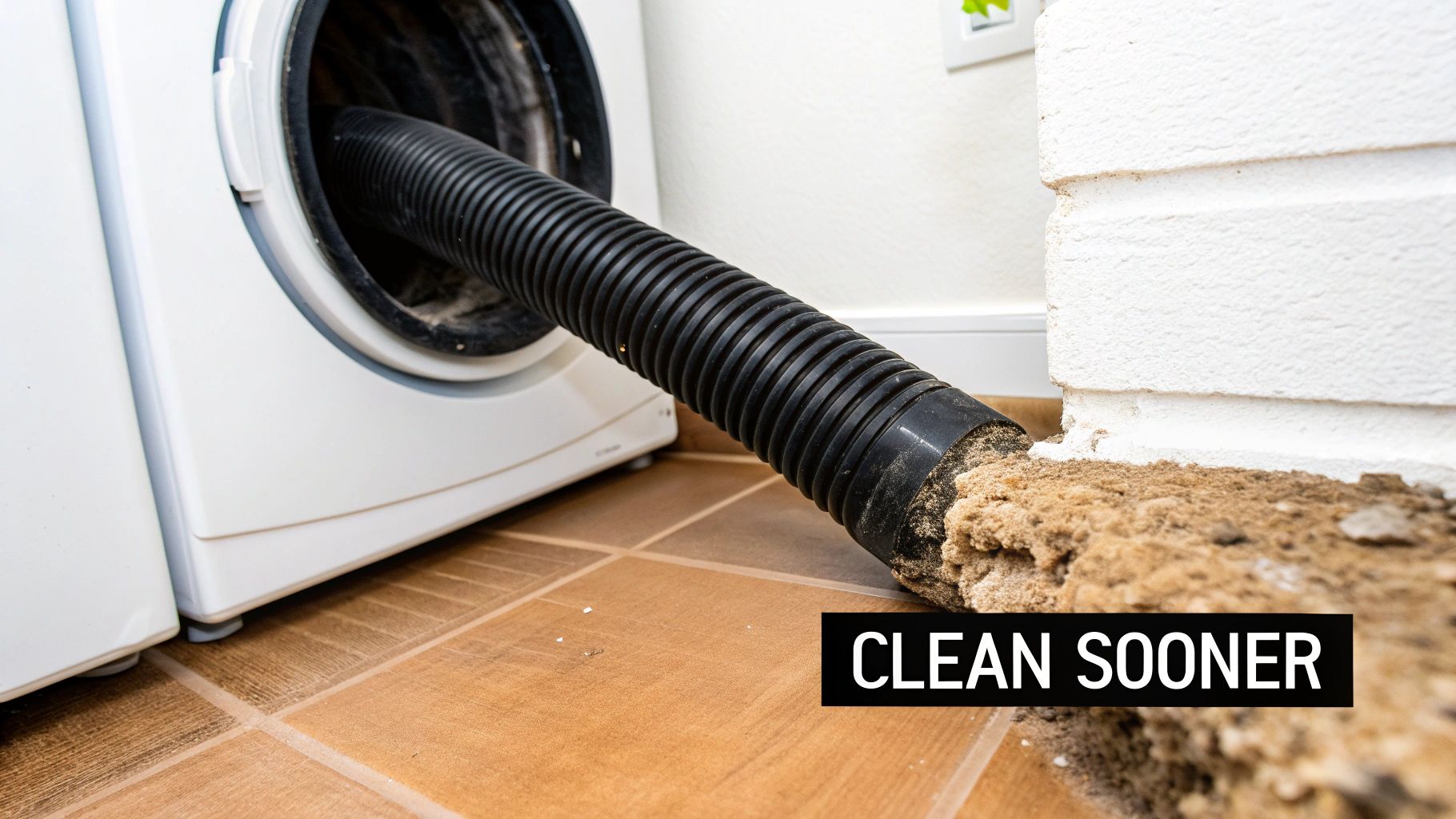
If your home has a lot going on—high laundry volume, furry family members, or a long, winding vent path—you absolutely need to adjust your cleaning schedule. Waiting too long isn't just inefficient; it’s a fire hazard waiting to happen.
Your Household and Laundry Habits
The biggest factor influencing how often to clean your dryer vent is, simply, how much you use it. A big family churning out eight or more loads a week is pushing way more lint through the system than a couple doing just a few loads.
It’s not just about quantity, either. The type of laundry you do makes a huge difference. Heavy items like towels, fleece blankets, and cozy flannel pyjamas shed a ton of fibres compared to lightweight shirts. If your laundry baskets are always piled high with these lint-heavy fabrics, your vent is on the fast track to getting clogged.
For busy Canadian households in this high-use category, a more frequent 6-12 month cleaning schedule is the smart, safe choice.
The Pet Factor
Every Canadian pet owner knows the struggle: fur gets on everything. Your dryer vent is no exception. In fact, it’s one of the worst places for it to end up. Pet hair is notorious for mixing with lint to form thick, heavy clogs that are incredibly stubborn.
These dense clumps of fur and lint act like a dam inside your ductwork, trapping dangerous levels of heat and moisture. Even a single pet can easily cut your safe cleaning interval in half, making an annual cleaning an absolute must for animal lovers.
Controlling airborne fluff is a big part of keeping a healthy home with pets. If you're fighting a losing battle with dander, check out our guide on how to reduce dust in your house—it goes hand-in-hand with a clean vent system.
Your Home's Vent Design
Finally, the physical path the vent takes from your dryer to the outside wall is a massive piece of the puzzle. The longer and more complex the route, the harder it is for lint to escape. Many Canadian homes, especially townhouses and older builds, have less-than-ideal vent runs.
Keep an eye out for these high-risk design flaws:
- Vent Length: Any run longer than 7.5 metres (25 feet) is a red flag. The airflow weakens over that distance, allowing lint to settle and accumulate easily.
- Bends and Elbows: Every sharp 90-degree turn acts like a speed bump for air and a collection point for lint. The more bends, the faster the buildup.
- Vent Material: Those flimsy, accordion-style foil vents are a lint magnet. Their ridged interior traps debris far more effectively than smooth, rigid metal ducts.
If your laundry room is tucked away in the basement or the centre of your house, chances are you have a long, complicated vent. This kind of setup inherently needs more frequent attention, making an annual professional inspection a critical safety measure.
Warning Signs Your Dryer Vent Is Already Clogged
Even if you’re a stickler for a cleaning schedule, it’s vital to know the red flags of a developing clog. Your dryer is actually pretty good at telling you something’s wrong. These aren't just minor quirks—they're urgent warnings that a serious fire hazard is building up inside your walls.
Learning to recognize what to look, listen, and even smell for can help you catch a dangerous lint buildup before it turns into a disaster.

If you spot any of the following symptoms, it's a clear signal to stop using your dryer right away and check out the vent.
Excessively Long Drying Times
Is a standard load of towels suddenly taking two or even three full cycles to get dry? This is hands-down the most common—and earliest—warning sign of a clogged vent.
When the vent is blocked, all that hot, moist air has nowhere to escape. It gets trapped right inside the drum, basically re-soaking your clothes and making the drying process painfully slow. A cycle that used to take 45 minutes might now stretch to 90 minutes or more.
Unusually Hot Surfaces
Here’s another telltale sign: an unusually hot dryer. If the top of your machine feels scorching hot to the touch while it’s running or just after, that’s a big red flag. It means heat isn't escaping properly through the vent.
This trapped heat doesn't just put a massive strain on your dryer's motor and parts, leading to early breakdowns. It also creates the perfect tinderbox for highly flammable lint to catch fire.
A dryer that's too hot to touch is a machine working overtime against a blockage. This is a critical sign that your appliance is overheating, significantly increasing the immediate risk of a fire.
For a deeper dive, our guide on the top 5 warning signs of clogged vents offers more detail on what to look for.
Strange Odours and Visible Lint
Sometimes, your own senses are the best detectors. Pay close attention to any strange smells wafting from your laundry room when the dryer is on.
- A burning smell: This is the most alarming sign of all. It could mean lint trapped in the vent, the exhaust tube, or even inside the dryer itself has started to smoulder. If you smell burning, turn off the dryer immediately.
- A musty odour: When damp air can’t get out, it creates a perfect environment for mildew to grow in the trapped lint. The result is a gross, musty smell that clings to your supposedly "clean" laundry.
You should also pop outside for a quick visual check. Look for lint and gunk building up around the exterior vent flap. During a harsh Canadian winter, you might even see that the vent is frozen shut or won’t open properly—a clear sign of a serious blockage.
Here's a quick checklist to help you spot trouble before it escalates.
Dryer Vent Clog Detection Checklist
| Symptom | What It Means | Action Required |
|---|---|---|
| Clothes Take Forever to Dry | Hot, moist air is trapped in the drum because the vent is blocked. | Stop using the dryer and schedule an inspection. |
| Dryer Is Hot to the Touch | The machine is overheating due to a lack of airflow, posing a fire risk. | Immediately discontinue use and call a professional. |
| Burning Smell | Lint is overheating and may be close to igniting. | Turn off the dryer immediately. This is an emergency. |
| Musty Odour on Clothes | Moisture is trapped in the vent, causing mould and mildew to grow. | The vent needs to be professionally cleaned and cleared. |
| Lint Around Exterior Vent | The clog is pushing lint and debris out of the vent opening. | Clean the external vent area and get the full duct inspected. |
If you notice even one of these signs, it's not something to put on the back burner. It's your home’s way of telling you that the dryer vent needs immediate attention to keep your family safe.
The Hidden Costs of a Neglected Dryer Vent
It’s easy to put off cleaning your dryer vent. Out of sight, out of mind, right? But what feels like a minor chore can have surprisingly serious consequences, hitting you where it hurts most: your family's safety and your wallet. A clogged dryer vent is a ticking time bomb, creating a perfect storm for both financial waste and a devastating fire.
At its core, the danger comes down to simple chemistry. Lint is incredibly flammable. When your vent gets blocked, all that hot, moist air from the dryer has nowhere to escape, causing temperatures to skyrocket inside the ductwork. This combination of highly combustible fuel (lint) and trapped, concentrated heat is the exact recipe for a house fire, turning a routine laundry day into an emergency.
To get a clearer picture of the critical link between dryer maintenance and safety, particularly the grave risk of fire, it’s worth reading up on how to clean a dryer and prevent fire hazards.
The Financial Drain on Your Hydro Bill
Even if you avoid the worst-case scenario, a neglected vent is silently siphoning money from your bank account every time you run a load. With energy costs on the rise across Canada, every bit of household efficiency matters. A clogged vent chokes your dryer, forcing it to work much harder and run longer to get your clothes dry—and that extra runtime shows up directly on your hydro bill.
A cycle that should take 45 minutes can easily stretch to 90 minutes or more as the appliance struggles against the blockage. That’s double the energy consumption for the exact same result. Over the course of a year, that wasted electricity adds up to a significant and completely avoidable expense.
Across Canada, factors like regional allergens and winter furnace dust only make lint problems worse. In many older neighbourhoods, long and complex vent runs are common, often requiring more frequent cleaning to stay safe and efficient. Getting a clear idea of the cost of professional dryer duct cleaning shows how a small, proactive investment prevents much larger financial headaches down the road.
Safety and Savings: An Essential Investment
The statistics are sobering. Fire Prevention Canada reports that clothes dryers are associated with more home fires than any other appliance. A leading cause? Lint buildup due to failure to clean. The good news? These incidents are almost entirely preventable with regular maintenance.
It’s crucial to reframe how you think about this task. Dryer vent cleaning isn’t just another chore to check off your to-do list; it’s an essential investment in your home’s safety and your financial well-being.
By keeping your vent clear, you're not just doing basic maintenance. You are actively protecting your home from fire, lowering your monthly hydro bills, and extending the life of your dryer. The real question isn't just how often to clean a dryer vent, but rather, can you afford not to?
Choosing Between DIY and Professional Vent Cleaning
So, you've realized your dryer vent needs a good clean-out. The big question now is, should you roll up your sleeves and do it yourself, or is it time to call in the pros? The best answer really comes down to your specific vent system, how comfortable you are with this kind of home maintenance, and what tools you have kicking around in the garage.
It's a classic homeowner's dilemma—weighing your own time and effort against a professional's skill and specialized gear. Just like with other DIY approaches to home care, knowing when to tackle a job and when to pass it off is key.

The Do-It-Yourself Approach
Going the DIY route can absolutely work for some setups. If you have a short, straight dryer vent that punches right through an exterior wall—pretty common in bungalows or main-floor laundry rooms—you can probably get the job done with a basic vent cleaning kit from a store like Canadian Tire or Home Hardware. These usually come with a flexible rod and a brush you can attach to a drill.
But here’s the catch: the DIY approach isn't without its risks. It's surprisingly easy to just push the lint further down the pipe, compacting it into an even more stubborn and dangerous clog. Worse, you could accidentally damage or disconnect the vent sections hidden in your walls or ceilings. That’s a major problem, as it would cause hot, damp, lint-filled air to vent directly into your home's structure.
When to Call a Professional
For most homes, calling a professional is the smarter, safer bet—especially if you're dealing with a complicated vent system. If your vent is long, has a few elbows and bends, or snakes its way up through the attic or between floors, a simple DIY kit just won't cut it. It lacks the power and the reach.
Professionals show up with serious equipment, like high-powered vacuums and reverse-blowing air tools that dislodge debris. They also use long, flexible rotary brushes designed to navigate tight corners and clean the entire length of the ductwork without causing any damage.
Hiring a pro just takes all the guesswork out of the equation. It's peace of mind in a service call. If you want to see what the full process looks like, our guide on how to clean your dryer vent lays it all out. At the end of the day, a professional cleaning guarantees the job is done right, protecting your home and getting your dryer back to peak performance.
Your Top Dryer Vent Cleaning Questions Answered
Still got a few things on your mind? No problem. Here are some of the most common questions we get from homeowners across Canada about keeping their dryer vents clean, safe, and working properly.
How Much Does Professional Dryer Vent Cleaning Cost in Canada?
This is a big one, and the honest answer is: it depends. The cost can shift based on where you live, how long your vent is, and how tricky it is to access. That said, most Canadian homeowners can expect to pay somewhere in the range of $125 to $250 for a professional cleaning.
Think of it less as a cost and more as an investment. You’ll often see that money come back to you in lower energy bills, not to mention the peace of mind that comes from preventing expensive repairs or a devastating fire. Any trustworthy company will give you a clear, upfront quote before they start.
Does a Gas Dryer Need Its Vent Cleaned More Often Than an Electric One?
In a word, yes. It's a smart habit to get into. While both electric and gas dryers produce a ton of lint, gas dryers have an extra safety consideration: they vent combustion byproducts, including dangerous carbon monoxide. For that reason alone, ensuring the vent has clear, unobstructed airflow is absolutely critical.
We always recommend more frequent checks for gas dryers to make sure there are no blockages that could put your family at risk.
A Quick Word of Warning: We’ve seen the "leaf blower trick" online and strongly advise against it. Trying to blast lint out with a leaf blower can just compact it into a dense plug deeper inside the duct. Worse, it can tear fragile foil ducts or even disconnect sections hidden within your walls, turning a simple clog into a major headache.
Does Having a Laundry Room in the Basement Change How Often I Need a Cleaning?
It absolutely can, and it's something many people overlook. When your dryer is located far from an outside wall—a typical setup for basements in many Canadian homes—it means the vent has to travel a longer distance, often with several twists and turns along the way.
Every bend is another spot where lint loves to build up and choke off airflow. As a rule of thumb, vents that are longer than 7.5 metres (25 feet) are at a much higher risk for clogs and should be professionally cleaned at least once a year, sometimes more if you do a lot of laundry. For these more complex vent systems, calling in a professional isn't just easier—it's safer.
When it comes down to it, keeping your dryer vent clean is one of the simplest yet most important things you can do for your home's safety. If you're looking for a trusted expert in Canada, you can rely on the team at Can Do Duct Cleaning. With over 30 years of hands-on experience, our team uses the best equipment in the business to make sure your vents are clear, efficient, and safe.
Don't wait for a warning sign. Protect your home and family—schedule your professional dryer vent cleaning today.

