
For countless Canadians, the sneezing, itchy eyes, and constant sniffles aren't just a seasonal annoyance—they're a daily battle waged inside their own homes. The best air purifiers for allergies are always the ones armed with a True HEPA filter. This isn't just a marketing gimmick; these filters are the gold standard for trapping the tiny airborne irritants like pollen, pet dander, and dust mites that make you miserable.
Think of it as your first line of defence, creating a sanctuary of clean air where you can finally take a deep, clear breath.
Your Guide to Conquering Home Allergies
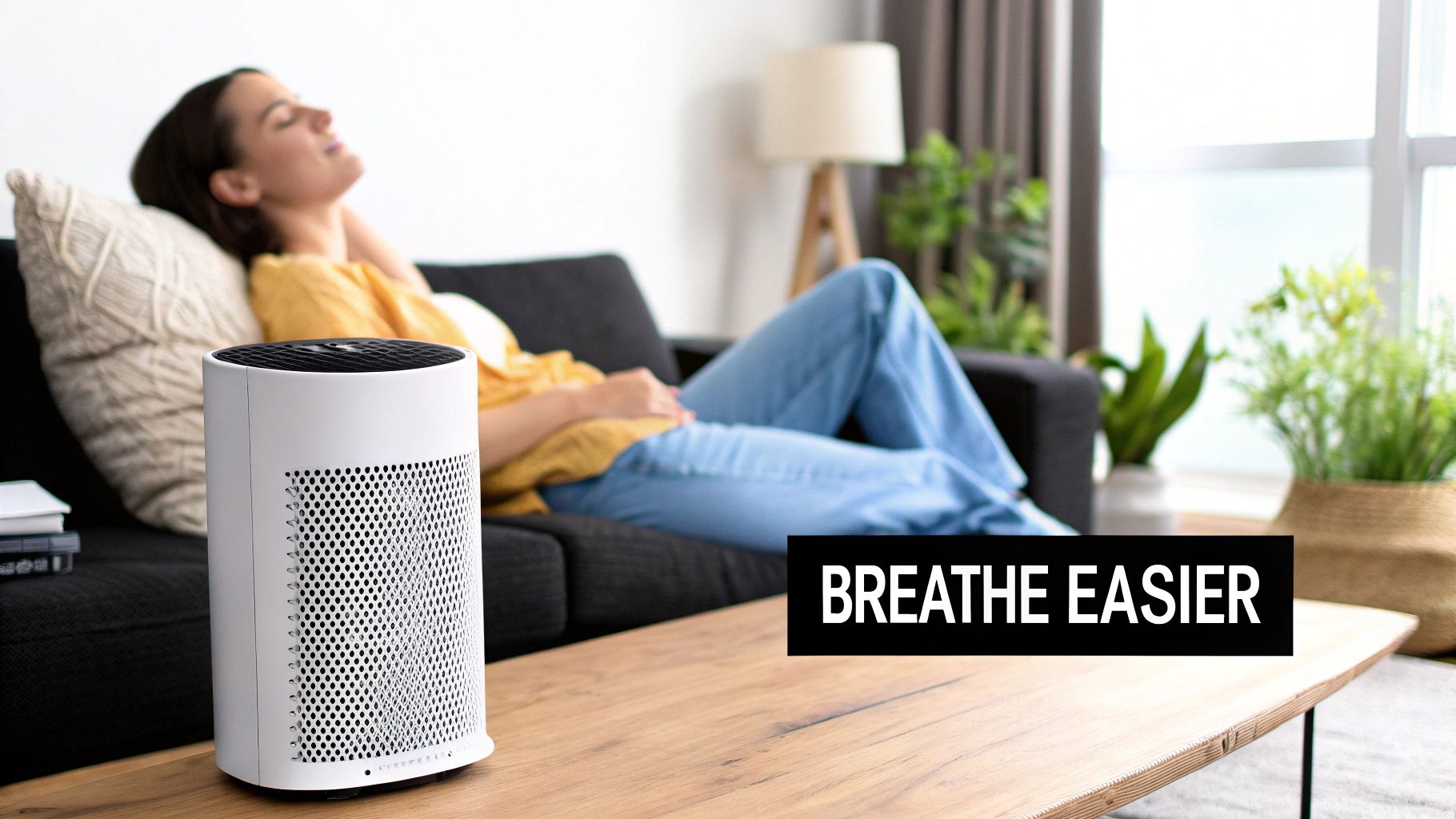
Dealing with allergy symptoms indoors is incredibly frustrating. You shut the windows tight to keep the pollen out, only to realize you've trapped a whole host of other invisible triggers inside with you. Common household allergens are microscopic particles that just float around your living space, waiting to be inhaled.
These tiny troublemakers are precisely why your symptoms can flare up even when you're just relaxing on the sofa. An air purifier essentially acts like a super-fine net, constantly pulling air from the room, snagging those irritants, and preventing them from ever reaching your nose and lungs.
The Invisible Triggers in Your Home
For most people suffering from allergies, the real enemy is completely invisible. The air inside a typical Canadian home is often a cocktail of pollutants that can make symptoms worse, day in and day out. Knowing what you're up against is the first step toward getting real relief.
Here are the usual suspects:
- Pollen: It hitches a ride indoors on your shoes, clothes, and even your pets, quickly becoming a relentless indoor problem.
- Pet Dander: These are just microscopic flakes of skin shed by cats, dogs, and other furry or feathered family members.
- Dust Mites: These tiny critters love to live in your bedding, carpets, and furniture. It’s actually their waste that is a powerful allergen.
- Mould Spores: Often lurking in damp spots like basements and bathrooms, these spores can easily get kicked up into the air you breathe.
An air purifier is built specifically to capture these airborne particles. By constantly filtering the air, it drastically cuts down your exposure to the very things that trigger your allergy symptoms. The result? Less congestion, fewer headaches, and a much better night's sleep.
Of course, a purifier can't do it all. It’s crucial to tackle allergen sources at their root. For instance, learning the right way of cleaning mold from caulk in your shower can make a huge difference. The same goes for dust that has already settled on surfaces.
For a complete strategy on tackling that pesky dust, check out our guide on how to reduce dust in your house. Paired with one of the best air purifiers for allergies, these tips will help you turn your home back into a true haven.
How Air Purifiers Trap Airborne Allergens
Think of an air purifier less like a complicated gadget and more like a high-tech net for your air. It’s constantly at work, pulling in room air that's full of invisible irritants—dust, pollen, pet dander—and trapping them before they have a chance to make you sneeze.
This isn’t just about moving air around. An effective purifier is actively scrubbing the air, removing the very things that trigger your itchy eyes and stuffy nose. The real magic, of course, is in the "net" itself—the filters inside.
The Gold Standard: True HEPA Filters
If you're serious about allergy relief, one term is non-negotiable: True HEPA. It's not just marketing fluff; it's a strict performance standard. HEPA stands for High-Efficiency Particulate Air, and to earn that "True" title, a filter must be certified to capture a whopping 99.97% of airborne particles down to 0.3 microns in size.
Just how small is that? A single human hair is about 50-70 microns thick. The common culprits behind allergy attacks—mould spores (4-20 microns), pollen (10-100 microns), and pet dander (often under 10 microns)—are easily snagged by this incredibly fine mesh.
This is the one feature you absolutely cannot compromise on. You’ll see terms like "HEPA-type" or "HEPA-like" on cheaper models, but they simply don't cut it. Those filters lack the certification and can let smaller, more potent allergens slip right back into the air you breathe. With a True HEPA filter, what gets captured stays captured.
This works through a few clever physics principles all happening at once:
- Impaction: Bigger particles like dust can't make the sharp turns with the airflow and slam straight into the filter fibres.
- Interception: Medium-sized particles try to follow the air, but as they cruise past a fibre, they get snagged.
- Diffusion: The tiniest particles, like smoke, bounce around randomly until they inevitably collide with and stick to a fibre.
This three-pronged attack makes True HEPA filters the undisputed champions of removing airborne irritants. It’s the same technology you’ll find in high-quality whole-home systems. If you're considering that route, getting familiar with the different types of furnace filters for allergies is a great place to start.
Tackling Odours and Fumes with Activated Carbon
While a HEPA filter is a particle-trapping powerhouse, it can't do anything about smells and chemical fumes. That's where its partner comes in: the activated carbon filter. This filter is designed specifically to trap gases, odours, and volatile organic compounds (VOCs) that a HEPA filter ignores. We’re talking about stubborn cooking smells, fumes from cleaning supplies, or that lingering pet odour.
Activated carbon is treated to be incredibly porous. To give you an idea, a single gram has the surface area of a football field. All that surface area acts like a giant sponge, adsorbing gas molecules and neutralizing odours that can otherwise irritate your airways. The best purifiers for allergy sufferers will almost always pair a True HEPA filter with an activated carbon filter.
This one-two punch delivers a far more comprehensive clean, tackling both the physical allergens and the chemical irritants in your air. It's a combination that experts and regulatory bodies prefer. For instance, air quality standards in places like California point consumers toward HEPA and activated carbon purifiers because they work incredibly well without creating any harmful byproducts like ozone. You can dig deeper into what’s driving the market by checking out the latest residential air purifier market trends.
Matching an Air Purifier to Your Room Size
Choosing an air purifier without checking your room size is like trying to cool your house on a hot July day by opening the fridge door—it’s just not going to work. An undersized unit will run constantly but never catch up, leaving dust and pollen to float around freely. To get real, noticeable relief from your allergies, the purifier needs enough muscle to clean all the air in your room, over and over again.
This is where you’ll run into two acronyms that matter: CADR and ACH. They might sound a bit technical, but they're the key to making a smart purchase. Honestly, getting a handle on these two ratings is the most important thing you can do to find a purifier that actually helps your allergies.
Translating CADR Into Real-World Power
Think of the Clean Air Delivery Rate (CADR) as the purifier's horsepower. It’s a straightforward rating that tells you how much clean air the machine can pump out. Measured in cubic feet per minute (CFM), a higher CADR number simply means it cleans the air in your room faster. More power, faster cleaning.
The process itself is simple: the machine pulls in the dirty, allergen-filled air, pushes it through its filters, and sends out fresh, clean air.
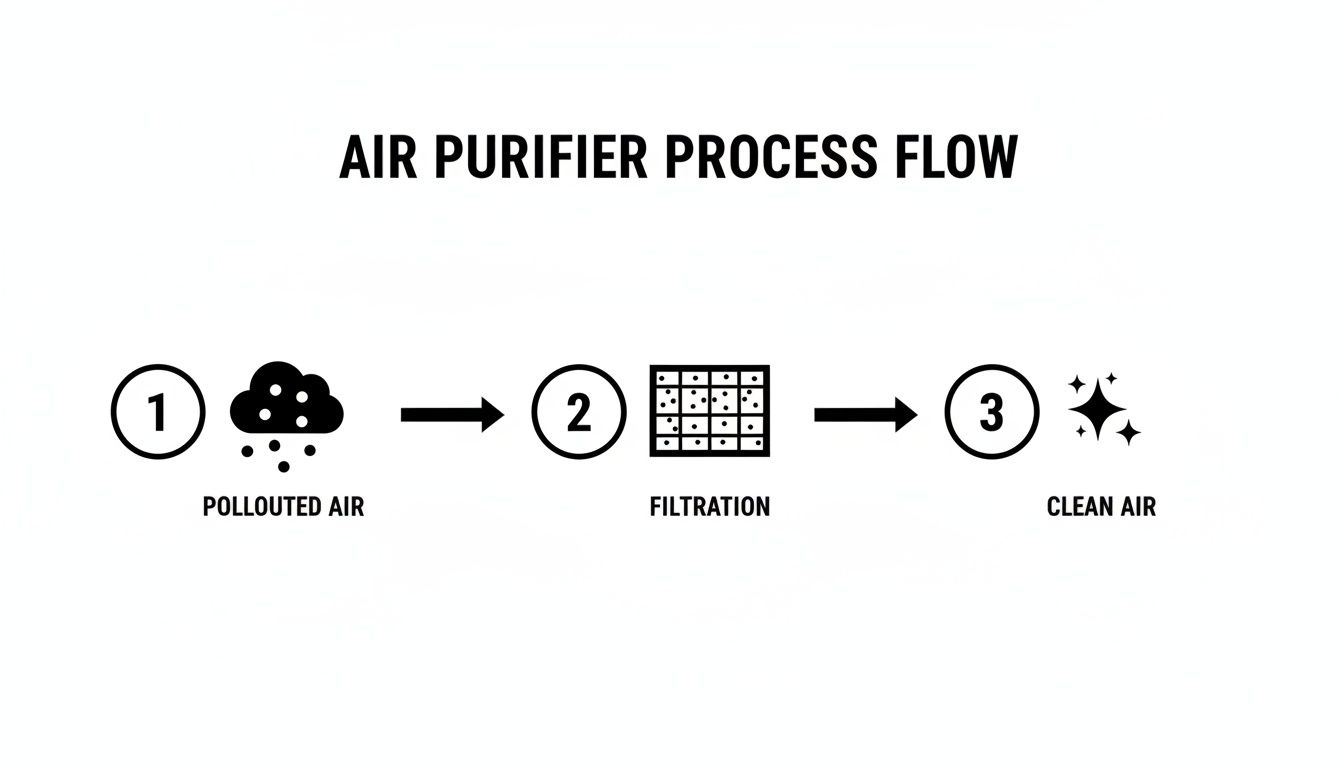
It’s this continuous cycle of grabbing contaminated air and replacing it with purified air that the CADR rating measures.
Why ACH is the Most Important Metric for Allergies
So if CADR measures speed, Air Changes per Hour (ACH) tells you how thorough the purifier is. This number shows how many times the unit can cycle through and filter the entire volume of air in a room every single hour. For just general air freshening, 2 or 3 air changes per hour is perfectly fine.
But for allergy sufferers, this is where you need to pay close attention. To keep your sneezing, itchy eyes, and stuffy nose at bay, you have to keep allergen levels consistently low.
That's why you should always look for a purifier rated to achieve at least 4 to 5 ACH for your room’s specific size.
This high turnover rate means that as soon as new pollen blows in through an open window or dust gets kicked up from the carpet, the purifier is powerful enough to snatch it out of the air almost immediately. It prevents that slow buildup of irritants that triggers an allergy attack. A unit hitting 5 ACH in your bedroom creates a protective bubble of clean air, which makes all the difference for a restful night's sleep.
Calculating Your Needs for Any Room
Okay, so how do you connect the dots between your room and the right CADR? There’s a simple rule of thumb that works great.
First, figure out your room's square footage (just multiply its length by its width). Then, take that number and multiply it by 2/3 (or 0.67). The result is the minimum CADR rating you should be looking for.
Let's look at a couple of typical Canadian room sizes:
- For a standard bedroom (150 sq. ft.): 150 x (2/3) = 100. You’ll need a purifier with a CADR of at least 100.
- For a larger, open-concept living room (350 sq. ft.): 350 x (2/3) ≈ 233. You'll need a much beefier unit with a CADR of at least 233.
To make it even easier, here's a quick reference table.
CADR and Room Size Guide for Canadian Homes
Use this table to quickly find the minimum CADR rating you'll need to effectively manage allergies in different-sized rooms.
| Room Size (Square Feet) | Typical Canadian Room Type | Recommended Minimum CADR (for Allergies) |
|---|---|---|
| Up to 150 sq. ft. | Small Bedroom, Home Office, Nursery | 100 |
| 151 – 250 sq. ft. | Master Bedroom, Den | 167 |
| 251 – 400 sq. ft. | Living Room, Open Kitchen Area | 267 |
| 401 – 650 sq. ft. | Large Rec Room, Open-Concept Main Floor | 433 |
This simple calculation helps guarantee your purifier is strong enough to hit that crucial 4-5 ACH mark, keeping your air fresh and your allergy symptoms down.
If you're not even sure what pollutants you're dealing with, grabbing an air quality testing kit is a great first step. It gives you a baseline, so you know exactly what you’re up against before you start shopping.
Smart Features and Long-Term Ownership Costs
When you’re picking out an air purifier for allergies, it’s easy to get focused on the upfront price tag. But that's only part of the story. Owning an air purifier is more like a long-term relationship than a one-time purchase, and you need to consider the ongoing costs and handy features that make life easier.
The biggest recurring cost you'll face is, hands down, filter replacement. Those HEPA and carbon filters are the workhorses of the unit, and they don't last forever. They fill up with all the gunk you want out of your air, and if you don't change them, the purifier stops being effective. It's like trying to wash dishes with a dirty sponge—at a certain point, you’re just spreading the mess around.
Budgeting for Filters and Energy
Most brands suggest swapping out the main HEPA filter every 12 months, but some high-use models might need a fresh one every six months. The carbon pre-filters, which tackle odours and bigger debris, usually need replacing every three to six months. All in, you can expect to spend anywhere from $60 to over $150 per unit each year.
Before you buy, do a quick search for the price and availability of the replacement filters. That great deal on a purifier can lose its shine fast if the filters are expensive or a pain to find.
And since you’ll likely be running the machine 24/7 for the best results, electricity use matters. Keep an eye out for models with an ENERGY STAR certification. These are designed for efficiency and often use no more power than a standard light bulb on their lower settings, so they won't send your hydro bill through the roof. This regular upkeep is a lot like taking care of your HVAC system; our guide on furnace filter replacement frequency breaks down a similar routine for your furnace.
The Rise of Smart Air Purifiers
Beyond the running costs, today's air purifiers come loaded with "smart" features that are genuinely helpful for allergy sufferers—not just flashy tech for the sake of it. They bring a level of automation and real-time feedback that makes managing your air quality a breeze.
Here are a few key features to look for:
- Real-Time Air Quality Sensors: These continuously scan the air for pollutants like PM2.5 (the really fine stuff) and sometimes even pollen. Many units display this info with a simple colour-coded light, giving you an instant read on your air quality.
- Auto Mode: This is probably the most practical feature. In Auto Mode, the purifier uses its sensors to adjust the fan speed on its own. If you burn the toast or a gust of pollen blows in, it will automatically ramp up to clear the air, then power down to save energy and keep things quiet.
- App Connectivity: Wi-Fi-enabled purifiers connect to a smartphone app, letting you change settings from anywhere. You can create schedules, check your home’s air quality history, and get alerts right on your phone.
The demand for these connected devices is soaring, with the smart air purifier market growing into a multibillion-dollar industry. Features that automatically adjust to changing conditions are especially popular, giving homeowners peace of mind that their air is being managed efficiently without them having to lift a finger.
Creating a Whole-Home Clean Air Strategy
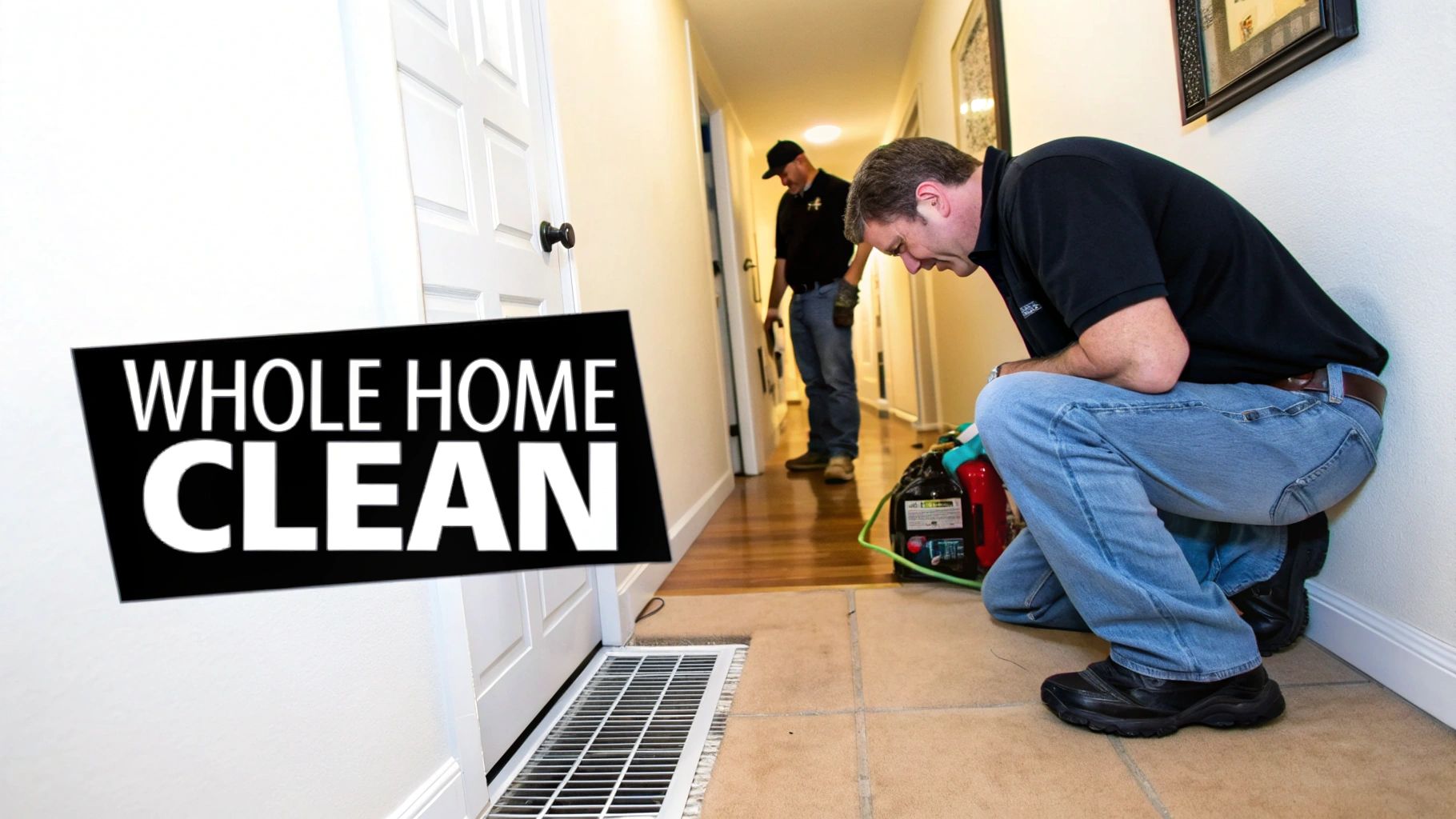
A top-notch portable air purifier can absolutely transform a single room. It can become your sanctuary from pollen, dust, and pet dander. But what happens the second you step out of that room? Allergens couldn't care less about doorways. They hitch a ride throughout your entire home on the very system meant to keep you comfortable: your HVAC.
Think of your home’s ductwork as its circulatory system. Year after year, this hidden network collects a shocking amount of dust, dander, mould spores, and other gunk. Every single time your furnace or AC kicks on, it blasts those trapped irritants right back into the air you’re breathing, completely defeating the purpose of your portable purifier.
It's a frustrating cycle. You feel great in one room, but the sneezing and stuffiness come roaring back the moment you walk into the kitchen. To get real, lasting allergy relief for your entire home, you need to think bigger than just one plug-in unit. You have to tackle the problem at its source.
Signs Your HVAC System Is Part of the Problem
So, how can you tell if your home's air ducts are working against you? The clues are often subtle, but they’re there if you know what to look for. Paying attention to these signs can tell you if a deeper clean is what you really need.
You might need to look beyond a portable unit if you notice:
- You're Still Suffering: You’re running one of the best air purifiers for allergies in your bedroom all night, but you still wake up congested or your symptoms act up in the living room.
- Dust Piles Up Near Vents: You’re constantly wiping away dust bunnies or a fine film of dust that gathers right around your air vents, even just a day or two after cleaning.
- That Stubborn Musty Smell: There’s a faint, musty odour you can't quite place. It seems to get stronger whenever the heat or AC is running, which can be a telltale sign of mould or mildew hiding in the ducts.
- Allergies Are Getting Worse: Your symptoms seem to be intensifying over time, even though nothing else in your life has really changed.
How Professional Duct Cleaning Removes Allergens
This is where professional duct cleaning becomes the critical next step in your clean air strategy. It's a process that targets the hidden reservoir of airborne irritants, clearing out years of accumulated junk from deep inside your HVAC system. No portable purifier, no matter how powerful, can ever reach that far.
A professional service uses specialized, high-powered vacuums and rotating brushes to scrub and extract contaminants from every inch of your ductwork. This process removes the source of allergens that your system has been recirculating for years, ensuring the air it pushes out is genuinely clean.
This is far more than a quick vacuum job. Technicians seal off your system to create powerful negative pressure. This ensures all the dislodged dust and debris are sucked directly into a containment unit outside, not just blown back into your house. It’s a complete reset for your home's respiratory system.
A Cohesive Approach to Cleaner Indoor Air
When you pair targeted room purification with a professionally cleaned HVAC system, you create a powerful, two-pronged defence against allergens. Duct cleaning tackles the main source of the problem, and your portable air purifiers act as the cleanup crew, catching any new particles that find their way inside. This integrated approach is the key to consistently clean air in every single room.
Beyond cleaning, you also have to think about humidity and ventilation. Dry winter air can irritate your sinuses, making you even more sensitive to allergens. You can learn more about how a whole-home humidifier works with your furnace to keep moisture levels just right. Similarly, good ventilation is crucial for exhausting pollutants. A fantastic resource from Odd Job Handyman Services explains the role of a working bathroom fan in improving home air quality, which is another vital piece of the puzzle. When you address your home's air from every angle, you can finally get comprehensive and lasting relief.
Your Air Purifier Buying Checklist
Deciding to buy one of the best air purifiers for allergies can feel like a big move, but you're now equipped with everything you need to choose with confidence. This simple checklist will help you tie it all together and pick a machine that actually brings relief.
Think of this as your final game plan for cleaner air. By running through these steps, you can go from just browsing online to actually enjoying a healthier home.
Measure Twice, Purchase Once
First things first: grab a measuring tape and get the size of the room where the purifier will do its work. Multiply the length and width in feet to get the square footage. This single number is the bedrock of your entire decision.
Getting an accurate measurement saves you from buying a unit that's too weak to handle the space or wasting money on a beast of a machine you just don't need. It’s a simple step that prevents a lot of headaches later.
Calculate Your CADR and Confirm HEPA
With your room size figured out, it's time to find your minimum required Clean Air Delivery Rate (CADR). The rule of thumb is easy: take your square footage and multiply it by 2/3. For anyone dealing with allergies, this ensures the purifier can cycle the air four to five times per hour (ACH), keeping those pesky allergen levels down.
As you shop around, look for one specific phrase on the box: "True HEPA" filtration. This is the one thing you can't compromise on. It's your guarantee that the filter is certified to snag 99.97% of common airborne troublemakers like pollen, pet dander, and mould spores.
Evaluate Long-Term Ownership Costs
The sticker price is just the beginning. Before you pull the trigger, do a quick search for the model's replacement filters.
- Filter Costs: How much do the True HEPA and activated carbon filters cost?
- Replacement Schedule: Find out how often the manufacturer says you need to swap them (it's usually every 6-12 months).
- Energy Use: Keep an eye out for an ENERGY STAR label. It means the unit can run 24/7 without sending your hydro bill through the roof.
This little bit of homework reveals the true cost of owning the machine and helps you budget for the long haul, so there are no nasty surprises down the road.
The Definitive Step for Whole-Home Relief
A portable air purifier is a fantastic tool for creating an oasis of clean air in one room. But if your HVAC system is pushing years of dust and allergens through the vents, you're constantly fighting a losing battle. If you're still sneezing and sniffling throughout the house, it's time to go to the source.
Scheduling a professional duct cleaning is the single most effective way to get true, whole-home relief. When you clear out the reservoir of irritants hiding in your ductwork, the air circulating through your home is clean from the get-go. This lets your new air purifier maintain that clean air instead of just trying to keep up with a contaminated system. For a genuinely healthy home, tackling your ducts is the final, crucial piece of the puzzle.
Your Top Questions Answered
When you're trying to find real relief from allergies, wading through the specs and features of air purifiers can feel overwhelming. Let’s clear the air and tackle some of the most common questions we hear from homeowners across Canada.
Should I Run an Air Purifier 24/7?
Absolutely. For the best results, you want your air purifier running around the clock. Think of it this way: allergens like pollen, pet dander, and dust are always finding their way into your home. Running the unit 24/7 is the only way to continuously trap them, keeping levels consistently low so they don't have a chance to build up and trigger your symptoms.
Thankfully, you don't have to worry about your hydro bill skyrocketing. Modern units with an ENERGY STAR certification are designed for this exact purpose. They're incredibly efficient, so the benefit of breathing clean air all day and night comes at a surprisingly low cost.
Where Is the Best Place to Put an Air Purifier?
Simple—put it where you spend the most time. For most of us, that's the bedroom or the main living area. The most important thing is to give it room to breathe.
Make sure to leave at least a foot of open space on all sides of the unit. Avoid tucking it into a tight corner, behind a sofa, or underneath a table. This placement ensures it can effectively pull in polluted air and circulate clean air throughout the entire room without obstruction.
How Effective Are Air Purifiers for Pet Allergies?
They are a game-changer, especially for anyone allergic to cats and dogs. It’s a common misconception that fur is the problem; the real culprit is the microscopic dander—tiny skin flakes—that our pets naturally shed.
A unit with a True HEPA filter is engineered to capture these minuscule irritants. Many of the best models for allergies also feature an activated carbon filter, which is fantastic for neutralizing those stubborn pet odours. Honestly, it’s one of the best investments you can make for peacefully coexisting with your furry family members.
Will an Air Purifier Eliminate All Dust?
It will make a massive difference in the amount of airborne dust, but it won't let you throw out your duster just yet. Air purifiers are brilliant at capturing the fine, lightweight dust particles that float around in the air—the very particles you breathe in that cause allergies.
However, heavier dust will still settle on your floors and furniture. The best strategy is a tag-team approach:
- Use a high-quality air purifier to constantly capture airborne dust.
- Stick to a regular cleaning routine with a HEPA-filter vacuum and microfibre cloths to handle the settled dust.
This one-two punch is your strongest defence against dust, helping everyone in your home breathe a little easier.
If you find you’re still sneezing and suspect that years of dust and allergens are trapped in your ductwork, a portable purifier might not be enough to solve the core problem. Can Do Duct Cleaning provides professional duct cleaning services across the Greater Toronto Area to remove these hidden contaminants at the source. To learn more about how we can help you achieve truly clean air throughout your entire home, visit us at candoductcleaning.com.

