
When you hear air conditioning pipe, you're really talking about the circulatory system of your AC unit. It’s a network of tubes that moves refrigerant to create cold air and drains away the moisture pulled from your home. Getting to know these pathways is the key to understanding how your system keeps you cool.
Understanding Your AC System's Lifelines
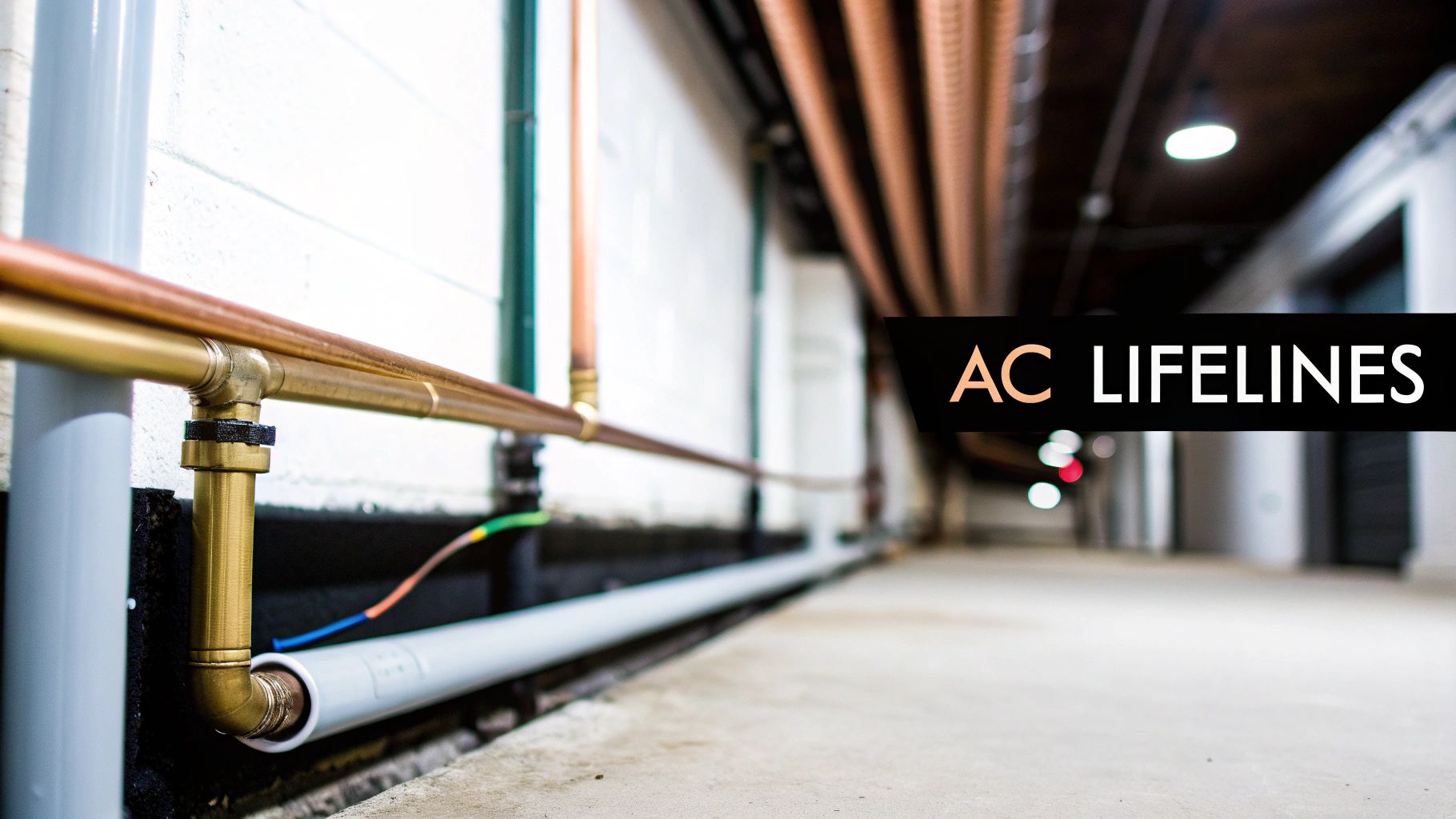
It’s helpful to think of your AC not as one big box, but as a complex system working behind the scenes. In this system, the network of pipes acts like veins and arteries, moving essential fluids exactly where they need to go. Without them, there's simply no cooling.
This network isn't made of just one type of pipe. Instead, it’s a specialized team of components, each with a crucial job. Tucked away in your walls or running along the outside of your house, they work silently to keep you comfortable. But if one of these pipes fails, your entire system can grind to a halt—usually on the hottest day of a southern Ontario summer.
The Main Players in Your AC Pipe Network
To really get what’s happening when your AC runs, you need to know about the two main types of pipes doing the work. Understanding their roles makes it much easier to spot a problem before it turns into a major repair bill.
Here’s a quick breakdown to help you visualize what's happening inside your AC system.
Quick Guide to AC Pipe Functions
| Pipe Type | Primary Function | Simple Analogy |
|---|---|---|
| Refrigerant Lines | Move refrigerant between the indoor and outdoor units to transfer heat. | The circulatory system, carrying the cooling agent (like blood) to and from the heart of the system. |
| Condensate Drain Line | Channels condensation (water) away from the indoor unit to prevent moisture buildup. | The plumbing system, safely draining away wastewater to prevent floods and damage. |
Let's dive a little deeper into what each one does.
Refrigerant Lines: These are the real workhorses of the cooling process. They always come in a pair, moving the refrigerant—the magical cooling agent—between the indoor evaporator coil and the outdoor condenser. One line carries cold refrigerant gas, and the other carries hot liquid refrigerant, creating the heat exchange that ultimately cools your home's air.
Condensate Drain Line: As your AC works its magic, it pulls a surprising amount of humidity from the air. That moisture has to go somewhere! The condensate drain is a simple but vital pipe that gives this water a safe path out of your home, preventing overflows, water damage, and mould growth.
A healthy pipe network is the unsung hero of home comfort. It ensures cool air is delivered efficiently and moisture is managed correctly, protecting both your AC system and your home itself.
Knowing the basics helps you describe problems more clearly to a technician and appreciate the engineering that keeps you comfortable. While these pipes are different from your home’s ventilation system, they are directly connected to it. To see how they fit into the bigger picture, you can learn more about the role of residential ductwork systems in your home’s overall HVAC health.
The Two Critical Types of AC Pipes
To really get what's happening inside your air conditioner, you have to look past the big metal boxes and trace the pathways that connect everything. The whole cooling process really comes down to two different sets of pipes, each with a very specific and critical job. It helps to think of them as a circulatory system and a plumbing drain; one moves the lifeblood of the AC, while the other gets rid of the messy leftovers.
First up, you have the refrigerant lines. This is a pair of copper pipes that works as a team, moving refrigerant between the indoor and outdoor parts of your AC. These lines are the heart of the cooling cycle, grabbing heat from inside your home and dumping it outside.
The second network is the condensate drain line. This pipe's job is much simpler but just as important. When your AC cools the air, it pulls a ton of moisture out. The condensate line is just a drainage pipe that channels all that water safely away from your house.
The Dynamic Duo: Refrigerant Lines
The refrigerant lines are where all the cooling magic actually happens. This pair of copper pipes keeps the heat exchange going in a continuous loop. They’re completely different in size, temperature, and what they do, but one can't work without the other.
Here’s a closer look at the two:
The Suction Line (or Vapour Line): This is the bigger of the two pipes, and it’s almost always wrapped in thick, black foam insulation. Its job is to carry cool, low-pressure refrigerant gas from your indoor unit (the evaporator coil) back out to the compressor. Think of it as the return trip for the refrigerant after it’s picked up heat. That insulation is non-negotiable—it stops the pipe from "sweating" all over the place and prevents it from soaking up more heat from the surrounding air, which would just make your AC work harder.
The Liquid Line: This is the smaller, thinner copper pipe, and it’s usually not insulated. It carries hot, high-pressure liquid refrigerant from the outdoor unit back inside to the evaporator coil. This line will feel warm if you touch it while the system is on because it's full of the heat that was just pulled out of your home.
Together, the suction and liquid lines create the temperature difference your AC needs to cool your home. A problem with either air conditioning pipe—like a tiny leak or a blockage—can shut the whole system down.
The Unsung Hero: The Condensate Drain Line
While the refrigerant lines are busy with the complex science of cooling, the condensate drain line deals with a very simple, but potentially messy, byproduct: water. When warm, humid air from your house blows over the ice-cold evaporator coil, moisture condenses right onto it—exactly like how water droplets form on a cold glass of lemonade on a hot day.
All that water drips into a collection pan and then flows into the condensate drain line, which is usually a white PVC pipe. From there, it's supposed to drain harmlessly outside or into your home's plumbing.
It's easy to forget this pipe exists, but if it gets clogged with algae, dust, and other gunk, the drain pan will overflow. That can lead to serious water damage to your furnace, drywall, and floors, turning a small, preventable problem into a very expensive headache.
Getting these pipe systems installed and maintained correctly is absolutely essential for your AC to run efficiently and safely. HVAC pros handle a staggering amount of piping. Just to give you an idea, California had 12,286 HVAC businesses in 2020, with contractors noting that a standard AC install can use anywhere from 50 to 100 feet of copper piping. These experts make sure every connection is tight and every pipe is the right size and properly insulated—tasks that are critical for your system’s performance. You can read more about the scale of HVAC installations over at Workyard.com.
How Pipe Materials And Insulation Boost Efficiency
The materials that make up your air conditioner’s pipes aren't just picked out of a bin. They're a carefully engineered part of a system designed to be as efficient and durable as possible. Each material has a specific job, and together they determine how well your AC cools your home and how long it’ll last.
For the refrigerant lines—the superhighways for your system’s cooling agent—the material of choice is almost always copper. There’s a good reason for this. Copper is fantastic at transferring heat, which is essential for the refrigerant to do its job of absorbing warmth from inside your house and dumping it outdoors. It’s also tough and resists corrosion, making it perfect for the high-pressure work it has to do.
On the other hand, the condensate drain line is usually made from PVC (polyvinyl chloride). This pipe just carries away low-pressure water, so the heat-transferring magic of copper isn't necessary. PVC gets the nod here because it’s cheap, light, and won’t rust or corrode, giving it a long, hassle-free life.
The Critical Role of Pipe Insulation
Just as important as the pipes themselves is the insulation wrapped around them. You’ve probably seen it: a thick, black foam sleeve covering the larger of the two copper refrigerant lines (the suction line). This isn’t just for looks—it’s a powerhouse of energy efficiency.
Think of it like a koozie on a cold can on a hot, humid day. Without that sleeve, condensation would bead up all over the cold pipe, causing it to "sweat." That dripping water can lead to moisture damage inside your home.
Even more importantly, the insulation stops the cold refrigerant gas from warming up as it travels back to the compressor. If it absorbs heat from the surrounding air, your AC has to work much harder to cool your home.
This diagram helps visualize how all these parts come together.

As you can see, the refrigerant cycle and the condensate drainage are two distinct but equally crucial functions of your central air conditioner.
A single tear or gap in this foam insulation forces your air conditioner to work harder to achieve the same cooling effect, leading directly to higher energy bills and increased wear on the compressor. It’s a small detail with a huge impact on performance.
The manufacturing of these specialized pipes is a pretty big deal. For some context, California's HVAC manufacturing sector alone employed 7,239 people in 2025, with production costs heavily tied to materials. Between 2020 and 2023, copper prices shot up by over 40%, forcing manufacturers to get creative. As high-efficiency heat pumps gain popularity, the demand for specialized piping has also jumped by 15%, showing how the industry is adapting. You can dig into more of this HVAC equipment manufacturing data over at IBISWorld.
At the end of the day, the right materials and proper insulation work together to protect your system and your wallet. It's a lot like how sealing your ductwork is crucial for good airflow; maintaining your pipe insulation is key to thermal efficiency. If you're thinking about your system's overall health, check out our guide on the benefits of using mastic sealant for ductwork to see how every single part plays a role.
Recognizing Common Air Conditioning Pipe Problems
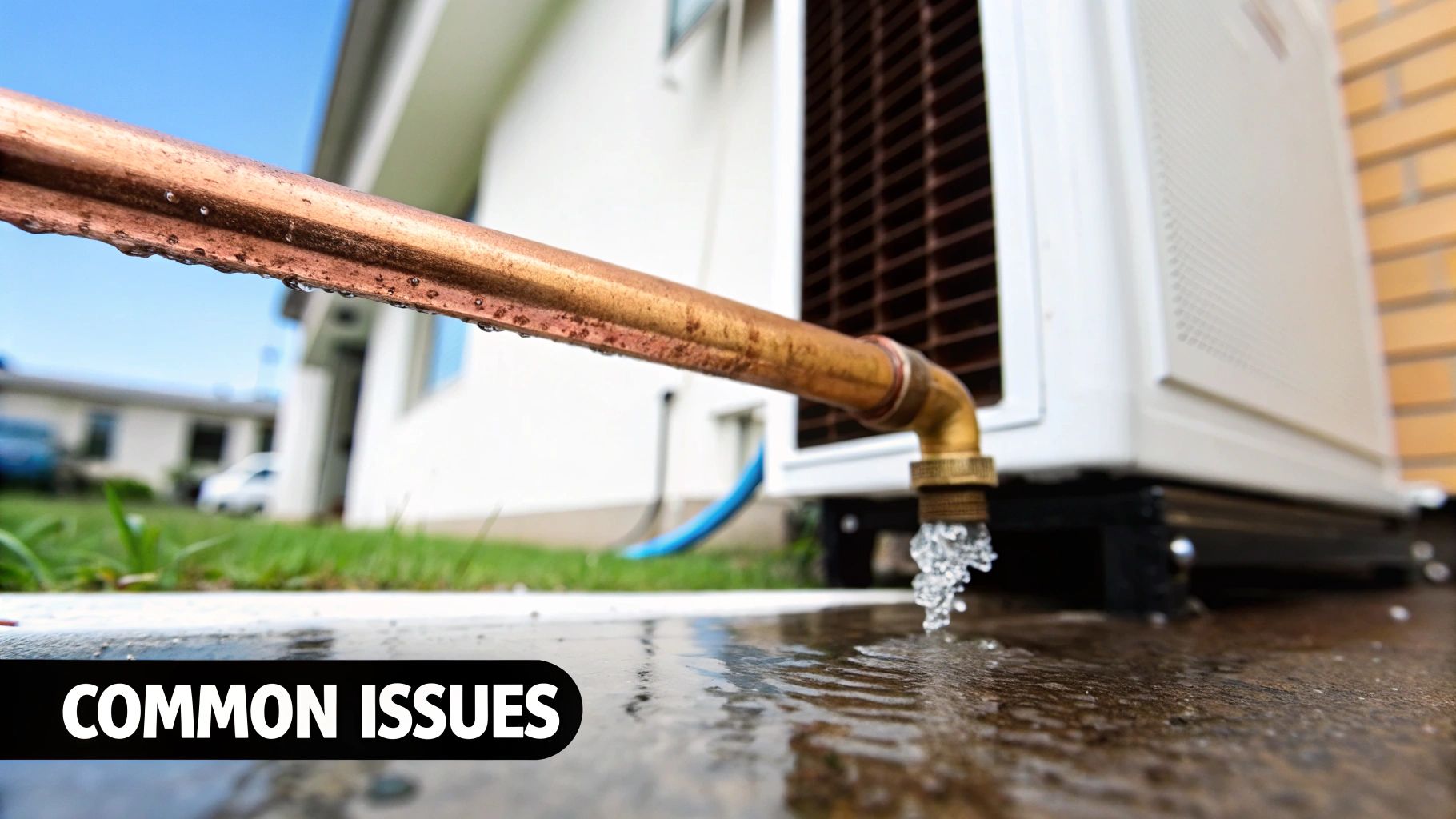
Think of your AC pipes as the circulatory system of your home's cooling. They don't often complain, but when they do, they give off clear signals. A weird noise, an unexpected puddle, or a layer of ice—these are all clues that something’s not right.
Learning to spot these early warnings is crucial. It can mean the difference between a quick, affordable fix and a complete system breakdown in the middle of a sweltering GTA heatwave. Let's break down the most common issues so you know what to look for.
Refrigerant Leaks Hissing and Inefficiency
A refrigerant leak is one of the most serious problems your AC can have. Refrigerant isn't like gas in a car; it doesn't get "used up." If your system is low, it means there's a leak somewhere in the copper lines, and your AC's cooling power is literally escaping into the air.
Keep an ear and an eye out for these classic signs:
- Hissing or Bubbling Sounds: That faint hissing you hear near your indoor or outdoor unit? It's often the sound of refrigerant gas escaping from a tiny hole in a copper pipe.
- Warm Air from Vents: If the air blowing out of your vents feels lukewarm, it's a dead giveaway. Without enough refrigerant, your system just can't pull heat out of your home effectively.
- AC Runs Nonstop: Your air conditioner will work overtime, struggling to hit the temperature you’ve set on the thermostat. It's running hard but going nowhere.
A refrigerant leak doesn't just spike your electricity bill. It puts immense strain on your AC’s compressor, which happens to be the most expensive part to replace.
Condensate Drain Clogs Water Damage and Shutdowns
Your AC doesn't just cool the air; it also removes humidity. All that moisture gets funnelled out through the condensate drain line, a simple PVC pipe. But this damp environment is a perfect breeding ground for algae, mould, and grime, which can eventually create a stubborn clog.
The signs of a blockage are usually messy and hard to miss:
- Water Pooling: The most obvious clue is a puddle of water around your indoor furnace or air handler. This happens when the drain pan overflows because the water has nowhere else to go.
- Musty Smells: That damp, mildewy odour coming from your vents means water is sitting stagnant somewhere it shouldn't be, letting mould take hold.
- Sudden System Shutdown: Many modern ACs have a safety float switch. If the water in the drain pan gets too high, this switch will automatically shut down the entire system to prevent a flood.
Sometimes these clogs are linked to bigger airflow problems. If your ducts are dirty or obstructed, it can throw off the whole system and mimic the symptoms of a blockage. Knowing the signs of blocked air ducts can help you get to the root of the issue.
To help you quickly diagnose what might be going on, here's a simple breakdown of common problems and their tell-tale signs.
Common AC Pipe Problems and Their Symptoms
| Problem | Key Symptoms | Likely Location |
|---|---|---|
| Refrigerant Leak | Hissing sounds, warm air from vents, AC running constantly | Copper refrigerant lines (indoor or outdoor unit) |
| Condensate Clog | Water pooling, musty odours, system shutting down | PVC condensate drain line near the indoor unit |
| Frozen Pipes | Visible ice/frost on outdoor copper pipes, reduced cooling | Large insulated suction line, evaporator coil |
This table is a great starting point, but remember that some symptoms can overlap. If you're ever unsure, it's always best to get a professional opinion.
Frozen Air Conditioning Pipes
It's a bizarre sight on a hot summer day: a thick layer of ice coating the copper pipes on your outdoor unit. This isn't a sign that your AC is working overtime—it's a red flag that something is seriously wrong with either its airflow or refrigerant level.
There are two main culprits behind a frozen air conditioning pipe:
- Restricted Airflow: A filthy air filter, blocked vents, or a dirty indoor coil can starve the system of warm air. Without that air to absorb heat from, the refrigerant gets far too cold, freezing any moisture on the coil. That ice then travels right down the pipe.
- Low Refrigerant: A leak causes the pressure inside the system to drop. This pressure drop makes the remaining refrigerant intensely cold, which instantly freezes condensation on the coil and the attached refrigerant line.
No matter the cause, a frozen pipe is your cue to shut the system off immediately. Running an AC with frozen lines can quickly destroy the compressor, leading to a repair bill you definitely don't want.
When to DIY and When to Call an HVAC Pro
Knowing where to draw the line between a quick weekend fix and a job for a seasoned pro is one of the most important things you can learn as a homeowner. Some issues with your AC's pipes are perfect for a little hands-on maintenance. It feels good to save a bit of money and keep your system humming along.
But some jobs are strictly hands-off. Messing with the wrong thing can be dangerous, lead to shockingly expensive repairs, or even void your warranty. Knowing the difference protects your investment, keeps your family safe, and is just plain smart.
Safe DIY Checks for Every Homeowner
You definitely don't need a technician's licence to handle the basics. These simple checks are safe, easy, and can stop some of the most common AC pipe problems dead in their tracks. Think of it as your pre-season checklist to get your air conditioner ready for another sweltering Toronto summer.
Here are a few things you can absolutely tackle yourself:
- Inspect the Pipe Insulation: Have a look at the black foam insulation wrapped around the larger copper pipe—the suction line—that runs to your outdoor unit. If you see cracks, tears, or big chunks missing, your AC is losing efficiency and working harder than it needs to. You can find replacement foam sleeves at most hardware stores; they just slide right on.
- Clear Out the Outdoor Unit: Your condenser unit outside needs to breathe. Take a few minutes to gently clear away any leaves, grass clippings, or other debris that’s piled up around it. You want to make sure there are at least two feet of clear space on all sides.
- Clean the Condensate Drain: To stop algae and other gunk from building up, you can pour a simple mix of one part distilled vinegar and one part water down the access point of your condensate drain line. Doing this once or twice a year can prevent a nasty clog that causes water to back up into your home.
If you're feeling confident and want another simple but effective DIY project, this smart thermostat DIY installation guide is a great way to upgrade your system's brain.
Red Flags That Demand a Professional HVAC Technician
While a little DIY is fantastic, some jobs are non-negotiable. You have to call a certified professional. Trying these repairs yourself isn't just risky—it's often illegal in Ontario because of the strict environmental rules around refrigerants.
Any problem that involves refrigerant is a clear signal to stop and call a pro. This chemical is under high pressure and requires specialized tools and a licence to handle safely.
Here are the scenarios where you absolutely need to pick up the phone:
- Suspected Refrigerant Leaks: If you hear a hissing sound, spot an oily film on the copper lines, or your AC is just blowing lukewarm air, you've probably got a leak. A technician has to find the source, patch it, and then recharge the system with exactly the right amount of refrigerant.
- Frozen Refrigerant Lines: A thick layer of ice on your air conditioning pipe isn't normal. It's a symptom of a much bigger problem, like low refrigerant or a severe airflow blockage. Just letting it thaw won't fix anything, and if you keep running the AC, you could destroy the compressor—the heart of the whole system.
- Replacing Damaged Copper Pipes: If a pipe is badly bent, crimped, or has a hole in it, it's not a simple patch job. It requires a pro to cut, fit, and braze (a type of high-temperature welding) a new piece in.
- Major Condensate Clogs: If that vinegar flush didn't do the trick and water is still backing up, the clog is likely deep inside the line. A technician has the right tools to snake it out without cracking the pipe.
Trying to tackle refrigerant issues on your own can cause more damage, void your warranty, and create a health hazard. HVAC technicians in the GTA are trained to handle these complex systems safely. Sometimes, what looks like a pipe problem is actually an airflow issue caused by dirty ducts. Our experts at Can Do Duct Cleaning can see if a professional air duct cleaning service is what you need to get the air moving freely again.
AC Pipe Repair Costs and Rules in Ontario
When your AC acts up, especially if it's a pipe issue, two big questions immediately pop into every homeowner's head in the Greater Toronto Area: "How much is this going to set me back?" and "Are there any specific rules I need to know about?"
Getting a handle on these answers is the key to fixing your system without getting overcharged or accidentally breaking the law. This is especially true when you're dealing with the intricate network of pipes in your air conditioner.
Here in Ontario, the government is very particular about who can work on your AC’s refrigerant lines. It’s not a free-for-all. Because of their environmental impact, refrigerants are highly regulated. Any technician touching those lines—whether to find a leak, recharge the system, or make a repair—absolutely must be certified with an Ozone Depletion Prevention (ODP) card. That's not a friendly suggestion; it's the law.
This rule exists to make sure those environmentally sensitive refrigerants are handled correctly and don't escape into the atmosphere. Hiring someone without an ODP card for a refrigerant job isn't just a gamble on your AC's health—it's illegal.
Breaking Down Repair Costs in the GTA
Let's talk money. Repair costs can swing wildly based on how complex the problem is, what parts are needed, and the going labour rates in your neighbourhood. But having a ballpark idea helps you budget and know if a quote feels right.
Here’s a rough guide to what you can expect for common AC pipe repairs:
- Clearing a Condensate Drain Clog: This is usually a straightforward job. If a technician can clear the blockage quickly with a snake or a flush, you’re likely looking at $100 to $250.
- Repairing a Minor Refrigerant Leak: This one’s more involved. The tech needs to pinpoint the leak, patch the pipe, and then top up the refrigerant. Costs here can start around $300 and go up to $1,000 or more, depending on where the leak is and how much refrigerant is needed.
- Replacing a Section of Pipe: Sometimes a piece of the copper line is too corroded or damaged to save. Slicing it out and replacing it can run you anywhere from $250 to $750, which covers both the new pipe and the labour to install it.
The price of materials like copper pipe definitely plays a role in your final bill. The demand for HVAC parts is always high. To give you an idea, the HVAC market in a large region like California hit $33.71 billion in 2024, and contractors there saw a 25% increase in copper pipe purchases over five years, partly due to new energy codes. You can learn more about the growth in the HVAC equipment market on IBISWorld. This trend shows how material costs can affect repair prices everywhere, including here in the GTA.
Of course, a single repair is just one part of your overall home comfort budget. To get a bigger picture, check out our guide on duct cleaning costs in Toronto for more context on maintaining your entire HVAC system.
Common Questions About AC Pipes
Even with the basics covered, you probably still have a few questions about the pipes connected to your air conditioner. We get it. Here are some of the most common things GTA homeowners ask us, with straightforward answers to help you understand what's happening with your system.
Why Is Only One Air Conditioning Pipe Insulated?
If you’ve ever looked at the two copper lines running to your outdoor unit, you've probably noticed that the bigger one is wrapped in black foam insulation, but the smaller one isn't. This isn't an oversight—it's by design.
The larger pipe, the suction line, carries cold refrigerant gas back to your compressor. That insulation is crucial for preventing it from soaking up heat from the surrounding air. Without it, your AC would have to work a lot harder. It also stops the super-cold pipe from "sweating" condensation everywhere.
The smaller liquid line, on the other hand, carries hot liquid refrigerant, so it doesn't need insulation. In fact, letting it release a bit of heat is actually part of the cooling cycle.
Can I Replace My Own AC Pipe Insulation?
Absolutely. This is one of the easiest and most effective DIY tasks you can do for your AC. If you see that the black foam insulation on your suction line is cracking, crumbling, or missing chunks, it's time for a replacement.
You can find tubular foam pipe insulation at any hardware store. Just measure the diameter of the copper pipe, buy the matching size, and carefully slice off the old stuff with a utility knife. The new insulation usually comes with a slit down the side, so you can just pop it over the air conditioning pipe and secure it with some zip ties or good-quality electrical tape.
This simple fix costs next to nothing but can make a real difference in your system's efficiency and lower your energy bills. You're making sure your AC isn't wasting energy just moving refrigerant around.
How Often Should I Clean My Condensate Drain Line?
Think of this as essential preventative maintenance. To stop a clog from causing a messy water backup, it's a great idea to flush your drain line once or twice a year. Doing it in the spring, right before the cooling season kicks off, is perfect timing.
All it takes is a simple mixture of one part distilled vinegar and one part water poured down the line. This helps kill off any algae, gunk, or sludge before it turns into a major blockage. If you live somewhere especially humid or run your AC constantly, flushing it every few months provides some extra insurance.
Is It Normal for My AC Pipes to Be Wet?
On a scorching, humid day, seeing a bit of condensation on the insulated suction line is usually fine. That just means the insulation is doing its job. But if you're seeing pools of water, constant dripping, or moisture on the uninsulated pipe, that’s a red flag.
Excessive sweating can point to problems like a clogged air filter that's choking off airflow or, more seriously, low refrigerant. And if you ever see a layer of frost or ice building up on either pipe, shut the system off right away and call a pro. That's a sign of a bigger issue that could wreck your compressor if you ignore it.
If you're dealing with pipe problems that are more than a simple DIY fix, or you just want a professional to give your system a thorough check-up, Can Do Duct Cleaning is ready to help. Our certified technicians have the tools and expertise to handle anything from tricky refrigerant leaks to stubborn drain clogs. Contact us today to book your service and keep your home cool all summer long.

