
Commercial air duct cleaning is a heavy-duty service that gets right inside a building’s HVAC system to pull out all the accumulated dust, debris, and allergens. It’s a much bigger job than what you’d see in a house, requiring powerful, specialized equipment to clean the air and boost system efficiency in a business setting. For any Canadian business, from Vancouver to Halifax, this isn't just a "nice-to-have"—it's an essential piece of building maintenance.
Why Duct Cleaning Is a Non-Negotiable for Canadian Businesses
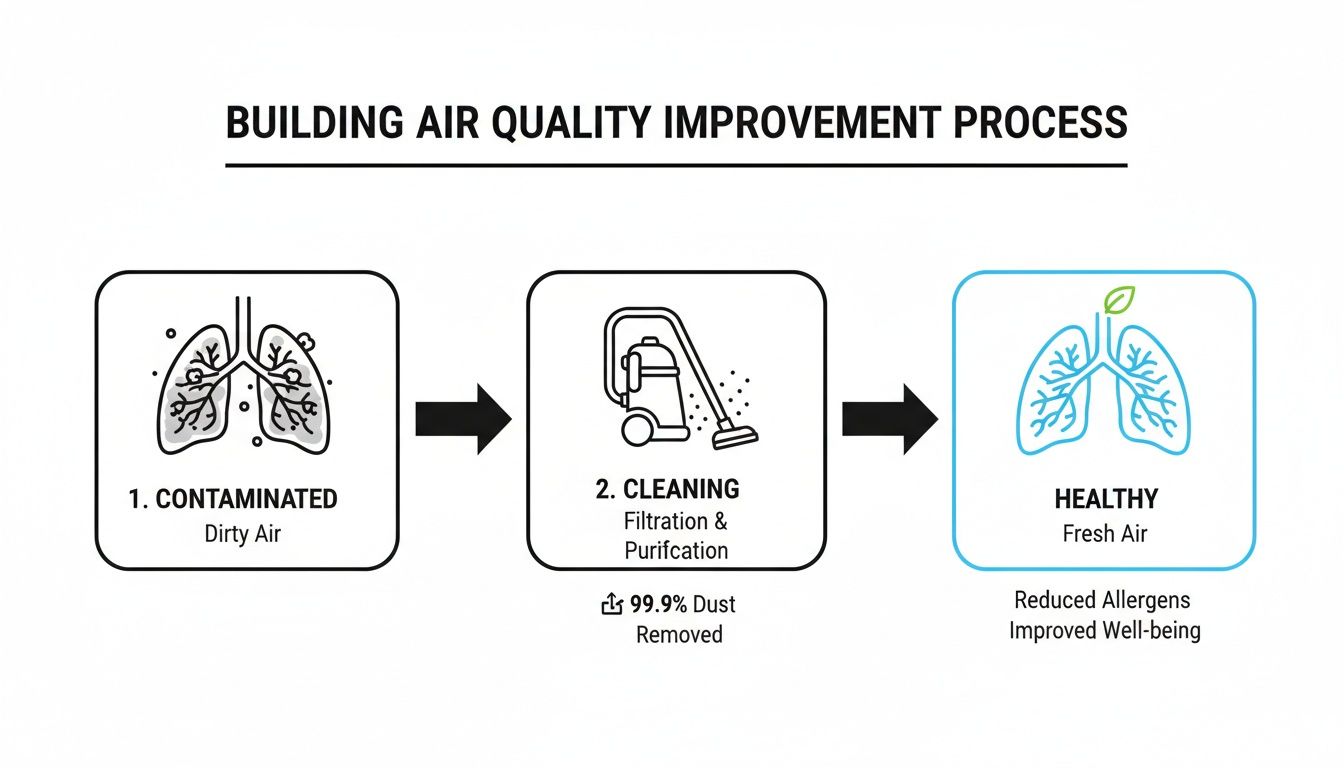
Think of your building’s HVAC system as its lungs. The maze of ducts is like the airways, pulling air in and pushing it out to every single corner of your property, from offices to storefronts. And just like our own lungs, those airways have to stay clear to work properly.
Over time, they get clogged up with a nasty mix of dust, pollen, mould spores, and even leftover construction debris. This build-up makes your HVAC system work way harder than it should, driving up your hydro bills and putting a strain on the equipment. Even worse, it’s constantly pushing all those contaminants back into the air your staff and customers breathe all day long.
The Foundation of a Healthy Indoor Environment
Whether you run a small office in the GTA or a sprawling industrial facility in Alberta, a healthy indoor environment is just plain good business. Poor air quality trickles down and affects your bottom line in more ways than you might think.
- Employee Well-being: Stuffiness and airborne irritants can trigger allergies and asthma, leading to more sick days and less productive staff. Understanding the harmful risks of dirty ducts is a crucial first step for any manager looking to create a healthier workspace.
- Customer Experience: Nobody likes a musty smell or seeing dusty vents. It creates a bad first impression and can be enough to stop customers from coming back.
- Operational Resilience: A clean HVAC system doesn't just run more efficiently; it’s also less likely to break down. That means a longer lifespan for your expensive equipment and fewer surprise repair bills.
This focus on a clean and sanitary environment is a cornerstone of any successful commercial operation, much like the standards outlined in this ultimate restaurant kitchen cleaning checklist.
Professional commercial air duct cleaning isn’t just about getting rid of dust. It's a strategic investment in the health of your building, the well-being of your people, and your energy budget. It’s how you make sure the ‘lungs’ of your business are breathing easy.
Hiring an experienced pro is key. Technicians who know the Canadian market understand our diverse climate and provincial building codes. They have the right tools and expertise to tackle complex commercial systems, ensuring the work is done right—safely and effectively. This simple act of proactive maintenance paves the way for a healthier, more productive, and cost-efficient business.
The Professional Air Duct Cleaning Process Explained
Ever wondered what actually happens during a professional commercial duct cleaning? It’s a lot more than just sticking a vacuum hose into a vent. Think of it as a deep-clean for your building's entire "respiratory system," a careful, methodical process designed to get the job done right without getting in the way of your business.
The real work starts well before a single tool is switched on. It begins with a thorough on-site assessment. A technician will walk through your space, inspecting the HVAC system, mapping out the ductwork, and figuring out the best access points. They’re also gauging the level of contamination to build a cleaning plan that’s customized for your property.
Once they have a plan, the team preps the area. This is all about containment. They'll lay down drop cloths and cover any furniture or equipment near the vents and registers. The goal is simple: make sure the dust and debris coming out of your ducts don't end up all over your office, store, or warehouse.
Creating a Powerful Negative Pressure System
With the site prepped and protected, the core cleaning begins. The crew connects a massive, high-powered vacuum collection system—often truck-mounted—to the main lines of your ductwork. This unit creates what's known as negative air pressure throughout the entire system.
Basically, they turn your entire network of ducts into a giant, sealed vacuum cleaner. This is the secret to a mess-free, effective cleaning. The constant suction ensures that every speck of dust, dirt, and debris they loosen gets pulled straight into the collection unit instead of being blown back into your workspace.
This is how you go from contaminated air to a healthy, clean environment.
With the negative pressure system running, it’s time to get everything moving. Technicians start at the vents furthest away from the vacuum and work their way back, using specialized tools to agitate and dislodge every bit of buildup from the duct surfaces.
A professional cleaning isn’t just about suction; it’s about active agitation. Without dislodging stubborn, caked-on debris, even the most powerful vacuum will leave significant contaminants behind.
Agitation and Meticulous Cleaning
The agitation tools are where the real magic happens. Depending on the duct material and size, technicians have a whole arsenal of equipment designed to scrub your ductwork from the inside out.
- Rotating Brushes: These are fed deep into the ducts on long, flexible cables to scrub the interior walls, breaking loose years of caked-on grime.
- High-Pressure Air Whips: For corners and uneven surfaces, these tools blast compressed air in all directions to knock debris free.
- Skipper Balls: These little powerhouses are sent zipping through the ducts on compressed air, bouncing erratically to dislodge stubborn particles.
Using the right tool for the job is what separates a surface-level clean from a truly deep one. You can learn more about the specialized professional duct cleaning equipment and see why it makes such a difference.
A truly thorough job doesn't stop at the ducts. The technicians also clean every critical component of your HVAC system—the air handler, evaporator coils, fans, grilles, and registers. If you skip these parts, they can quickly re-contaminate the clean ducts.
To finish, the team runs a final inspection, sometimes with a camera, to make sure everything is spotless. They then seal up the access points, pack up their equipment, and clean the workspace, leaving your property exactly as they found it—only with much, much cleaner air.
Tangible Benefits for Your Business Operations
Investing in professional commercial air duct cleaning is about much more than just ticking a box on a maintenance checklist. It's a smart business move that delivers real, measurable returns you'll see in your building, your team, and your bottom line. These aren't just minor perks; they directly impact your operational efficiency and financial health.

The advantages really stack up across three core areas: creating a healthier space for everyone inside, making your expensive HVAC equipment run better and last longer, and delivering some serious long-term cost reductions. Let's break down how each one contributes to a stronger business.
Fostering a Healthier Indoor Environment
The first thing you'll notice after a proper duct cleaning is the air itself. It just feels fresher. That's because your HVAC system is the lungs of your building, and if the airways are full of dust, mould spores, and allergens, that’s exactly what it's pumping into every single room.
Getting rid of all that junk has a direct impact on your people. Fewer airborne irritants mean fewer triggers for allergies and breathing problems, which often translates to fewer sick days. A healthy team is a productive team, and clean air helps everyone—staff and customers alike—feel more comfortable and focused.
A clean, healthy workspace isn't just a nice-to-have anymore; it's a core expectation. Showing you're invested in air quality sends a powerful message about how much you value your team's well-being.
This isn't a new concept. In major Canadian hubs, commercial duct cleaning has been a key part of building maintenance since the 1960s. Property managers know the deal: air quality tests taken after a cleaning often show a 40-50% drop in particulate matter. In a business setting, that can lead to a reduction in sick days by up to 15%.
Boosting HVAC Performance and Longevity
Think of your HVAC system as the engine in a performance car. If the air intake is clogged with dirt, that engine has to struggle, strain, and burn more fuel just to keep moving. It’s the same with your building's heating and cooling system.
When ducts are clogged, the whole system has to work overtime to push air through. This puts a massive strain on critical parts like the blower motor, fans, and coils, causing them to wear out much faster.
Cleaning out that debris is like giving the engine clean, open airways. Air flows freely, the system runs smoothly, and the daily stress disappears. The result? A longer functional lifespan, fewer surprise breakdowns, and less money spent on emergency repairs. To see just how well a clean system can run, check out our guide on comprehensive HVAC ductwork cleaning.
Achieving Significant Long-Term Cost Savings
This is where the investment really pays for itself. An HVAC system that isn't fighting against blockages uses a lot less power to heat and cool your space. That difference shows up immediately on your monthly hydro bills.
But the savings go deeper. By extending the life of your equipment, you push back the massive capital expense of a full system replacement by years. When you add up the lower utility bills and the deferred replacement costs, professional duct cleaning quickly becomes one of the smartest maintenance decisions a facility manager can make.
To put it in perspective, here's a look at the kind of numbers we see across Canada.
Quantifiable Benefits of Commercial Duct Cleaning
This table breaks down the key advantages of regular duct cleaning for commercial properties, providing estimated figures based on Canadian industry data.
| Benefit Area | Impact Metric | Typical Improvement |
|---|---|---|
| Energy Efficiency | Reduction in HVAC operational costs | 20-30% |
| Air Quality | Decrease in airborne particulate matter | 40-50% |
| Employee Health | Reduction in sick days | Up to 15% |
| Equipment Lifespan | Reduced strain and fewer breakdowns | Extended longevity |
Ultimately, these figures show that commercial duct cleaning isn't a cost—it's an investment that pays dividends in efficiency, health, and equipment preservation.
Determining Your Ideal Cleaning Schedule
So, how often should you actually get your commercial air ducts cleaned? It would be easy if there were a magic number, but the truth is, it's not that simple. The right schedule really boils down to what goes on inside your specific building, because no two businesses kick up the same amount of dust and debris.
Industry groups like the National Air Duct Cleaners Association (NADCA) suggest a general cleaning every three to five years. But think of that as a starting point—a baseline for, say, a quiet, low-traffic office space.
For a lot of Canadian businesses, especially in busy urban centres, that timeline just doesn't cut it. What happens within your walls is the biggest factor. A corporate head office has a completely different air quality profile than a bustling restaurant kitchen or a manufacturing plant floor.
Factors That Influence Your Cleaning Frequency
To build a maintenance plan that’s both smart and cost-effective, you need to look past the generic advice and size up your property’s unique situation. Certain things just make dust, debris, and other gunk build up faster, meaning you’ll need a professional crew to come in more often.
Here are the big things to watch for:
- High Occupancy and Foot Traffic: Places like retail stores, schools, and hotels have a constant flow of people tracking in dust, fibres, and outdoor pollutants that get sucked right into the ventilation system.
- Industrial Processes: If your facility is involved in manufacturing, woodworking, or similar work, you're generating a ton of airborne particles that your HVAC system is breathing in all day long.
- Presence of Sensitive Occupants: Healthcare facilities, retirement homes, and daycares have to be extra careful. They need top-notch air quality to protect vulnerable people.
- Recent Renovations or Construction: Even a small reno project creates a huge amount of fine dust from drywall and wood, and guess where it loves to settle? Your ductwork.
- Local Environmental Conditions: A building near a major highway or industrial park in a city like Toronto is going to be exposed to far more outside pollution than one tucked away in a quiet suburb.
Figuring out how often ducts should be cleaned based on these factors is the key to staying ahead of the game.
A customized cleaning schedule isn't about spending more; it's about spending smarter. By aligning your maintenance with your facility's actual needs, you maximize the benefits of clean air and HVAC efficiency without unnecessary costs.
For example, while NADCA’s general advice for a typical Canadian property is every 3-5 years, local pros often recommend a 2-3 year cycle for high-traffic spots like hotels and manufacturing plants to keep things running smoothly. This kind of proactive cleaning helps prevent major repairs, which affect an estimated 1 in 3 commercial HVAC units that go without regular maintenance.
By looking at your unique situation, you can move from a vague guideline to a strategic maintenance plan. This tailored approach ensures your investment in commercial air duct cleaning delivers the best possible return for your business.
Decoding the Cost of Duct Cleaning Services
Trying to budget for commercial air duct cleaning can feel a bit like guesswork. There’s no simple, flat-rate answer because every building is unique. Think of it like getting a quote for catering an event—the price isn’t just a number pulled from a hat. It depends on the number of guests, the complexity of the menu, and the venue itself.
The same logic applies here. A professional quote is built by looking at the specific scope and complexity of your HVAC system. Understanding what goes into that calculation is the first step to knowing you're getting a fair price for a job done right.
Key Variables That Drive the Price
When a technician puts together a quote, they’re really just measuring the amount of work involved. A bigger, more complicated system naturally requires more time and effort.
Here are the main things that will shape the final cost:
- Building Size and Square Footage: This is the most obvious factor. A massive warehouse will have a far more extensive network of ducts than a small retail shop, and that means more ground to cover.
- System Complexity: A straightforward, linear duct system is one thing. A multi-storey office building with separate climate zones, dozens of vents, and complex returns is another beast entirely. The more twists and turns, the higher the cost.
- Accessibility of Ductwork: How easy is it to get to the ducts? If they're in an open ceiling, the job is much simpler. If technicians have to navigate tight crawl spaces or work around drywall, that extra time and effort will be reflected in the quote.
- Level of Contamination: A system that hasn’t seen a cleaning in ten years will be packed with thick, caked-on grime. That requires a lot more muscle and time to break loose than a system with just a light layer of dust.
Understanding Common Pricing Models
In Canada, duct cleaning companies usually price their services in a few different ways. Some charge by the hour, others give you a flat-rate project fee, and for larger commercial properties, a per-square-foot model is also quite common.
It can be helpful to see how other maintenance services are priced to get a better feel for what to expect. This guide on understanding commercial cleaning service pricing offers a good perspective on how quotes for facility services are often structured.
The cheapest quote is rarely the best value. A price that seems too good to be true often means cut corners, skipped steps, or subpar equipment. You could end up paying for a job that leaves your ducts almost as dirty as they were before.
For instance, commercial air duct cleaning in Canada typically has a labour rate around $75 per hour. A full cleaning for a mid-sized business often falls in the $450 to $1,000 range. For bigger jobs, companies might quote between $0.05 and $0.20 per square foot.
A good quote should be transparent, breaking down exactly what you're paying for. To get a better handle on the numbers, you can explore a deeper dive into what to expect from the average cost of air duct cleaning. A reputable company will always provide a clear, itemized estimate that shows you the true value of the service, not just a lowball price.
How to Choose a Reputable Duct Cleaning Provider
The success of your commercial air duct cleaning comes down to one thing: the team you hire. A great crew delivers results that last, while a questionable one can leave you with an empty wallet and ducts that are just as dirty as before. Doing your homework on potential vendors is the single most important thing you can do to protect your property and your investment.

Think of it this way: you wouldn't hire an unlicensed electrician to rewire your building. The same logic should apply to your building's "respiratory system." The right qualifications are what separate the real pros from the amateurs.
Look for Essential Credentials
Before you even think about pricing, there are a few non-negotiable credentials to check. These are the basics that prove a company is legitimate and takes its work seriously. In Canada, these qualifications are clear signs of professionalism.
Here’s what should be on your checklist:
- NADCA Certification: The National Air Duct Cleaners Association (NADCA) is the gold standard for HVAC system cleaning worldwide. A certified company follows a strict code of ethics and has proven its expertise.
- Comprehensive Insurance: The provider absolutely must have proper liability insurance to cover any accidental damage to your property. In Canada, they also need to have Workplace Safety and Insurance Board (WSIB) or equivalent provincial coverage for their crew.
- Verifiable Commercial Experience: Don’t be afraid to ask for references or case studies from businesses like yours. A company with a solid track record in commercial projects gets the unique challenges that come with bigger, more complex systems.
These credentials are your first line of defence against scams or a job done poorly. They're your proof that you're dealing with a professional, accountable operation.
Any company worth its salt will have no problem showing you proof of certification, insurance, or past projects. If they get dodgy about these basic requests, that’s a massive red flag. Thank them for their time and move on.
Ask the Right Questions
Once you have a shortlist of qualified companies, it's time to dig a little deeper. A quick chat can tell you a lot about their methods, their gear, and whether they’re truly committed to quality.
A sharp facility manager should always ask:
- What’s your complete cleaning process? They should be able to walk you through a method that involves creating negative air pressure, using agitation tools like air whips or brushes, and cleaning every single component.
- Can you tell me about the equipment you use? You want to hear about powerful, truck-mounted vacuums and specialized tools. If they mention a simple shop-vac, they're not equipped for a commercial job.
- How do you protect our property while you work? They should have a clear plan for containment, like using drop cloths and sealing off registers to keep any dust and debris from getting into your workspace.
- Will you give me a detailed, itemized quote before you start? Vague promises or verbal-only quotes are a bad sign. Always insist on a written estimate that spells out the entire scope of work and every single cost.
Choosing the right provider is all about finding someone you can trust. By checking their credentials and asking the right questions, you can feel confident that your commercial air duct cleaning will be done right, keeping your air clean and your system running efficiently.
Your Top Questions About Commercial Duct Cleaning Answered
Even with all the facts, it’s natural for Canadian business owners to have a few more questions before booking a service. Let’s tackle some of the most common ones so you can feel confident moving forward.
Will The Cleaning Process Disrupt My Business Operations?
This is the number one question we hear, and for a good reason—downtime is expensive. Any true professional builds their entire service around getting the job done without getting in your way.
That’s why experienced crews offer flexible scheduling, often working after hours, on weekends, or even over holidays when your space is empty. They also use containment strategies, like drop cloths and sealing off vents, to keep the work area isolated. It’s a clean, quiet process that shouldn't interfere with your day-to-day business.
Is Duct Cleaning Necessary For a Brand-New Building?
It sounds strange, but the answer is a definite yes. New construction sites are incredibly messy, and your new HVAC system’s ductwork often becomes a collection bin for all that debris.
Think of it this way: post-construction duct cleaning isn't just a "nice-to-have"—it's an essential first step to protect your HVAC investment and guarantee healthy air from day one. If you skip it, you’re just blowing drywall dust, sawdust, and other construction gunk through your new facility.
A thorough cleaning right after construction clears out all that initial debris before it can circulate, protecting the delicate components of your new system and giving everyone fresh, clean air from the moment they step inside.
What Are The Telltale Signs My Ducts Need Cleaning?
Your building has its own way of telling you when its "lungs" are getting clogged up. If you know what to look for, you can catch problems early before they turn into bigger, more expensive headaches.
Keep an eye out for these common red flags:
- Visible Dust: If you see little puffs of dust shooting out of your supply vents when the system kicks on, that’s a dead giveaway the ducts are full.
- Funky Odours: A persistent musty or stale smell that only seems to appear when the heat or AC is running is a classic sign of mould or mildew hiding in the ductwork.
- Weak Airflow: Are some rooms stuffy while others are fine? Inconsistent airflow is often caused by major blockages or clogs in the ducts.
- More Sneezing and Coughing: If your employees or regular customers seem to be complaining more about allergies or respiratory issues indoors, your air quality is the likely culprit.
- Constant Dusting: Finding a new layer of dust on desks and shelves just a day or two after cleaning means your HVAC system is probably just blowing it around.
If you notice any of these signs, it's a strong hint that it's time to book a professional inspection and commercial air duct cleaning.
For over 30 years, Can Do Duct Cleaning has been the go-to partner for businesses across the GTA looking for clean air and efficient HVAC systems. Our certified technicians deliver a thorough, professional service designed to cause zero disruption to your business. Schedule your on-site inspection today!

