
A Panasonic energy recovery ventilator (ERV) is like a set of lungs for your house. It’s a smart system that breathes for your home, constantly swapping out stale, polluted indoor air for fresh outdoor air. The best part? It does this while cleverly recycling energy, which keeps your heating and cooling bills in check.
What Is a Panasonic ERV and How Does It Work?
Modern homes are built to be airtight, which is great for keeping your heating and cooling costs down. But there's a downside: that tight seal also traps indoor air, letting pollutants, allergens, and humidity build up. Without a way to ventilate, your home simply can't "breathe," and the air quality suffers.
This is exactly the problem a Panasonic energy recovery ventilator is designed to solve. Think of it as a smart, two-way gatekeeper for your home's air. It does two jobs at once:
- Exhausts Stale Air: The system pulls musty, humid air out of rooms that need it most, like kitchens, bathrooms, and laundry rooms.
- Supplies Fresh Air: At the same time, it draws in an equal amount of fresh air from outside.
But the real magic happens inside the ERV's core. This is where the two airstreams pass by each other—without ever actually mixing—to exchange energy.
The Year-Round Advantage
In the winter, the ERV grabs heat from the warm, stale air it's pushing outside and transfers it to the fresh, cold air coming in. This simple step pre-warms the incoming air, so your furnace doesn't have to work nearly as hard to get it up to room temperature.
The system does the exact opposite during our sticky GTA summers. It pulls heat and humidity out of the incoming outdoor air and transfers it to the outgoing exhaust air. This pre-cools and dehumidifies the fresh air before it even gets to your air conditioner, giving your A/C a much-needed break.
This diagram breaks down the simple but brilliant process of how an ERV gives you fresh air without the energy penalty.
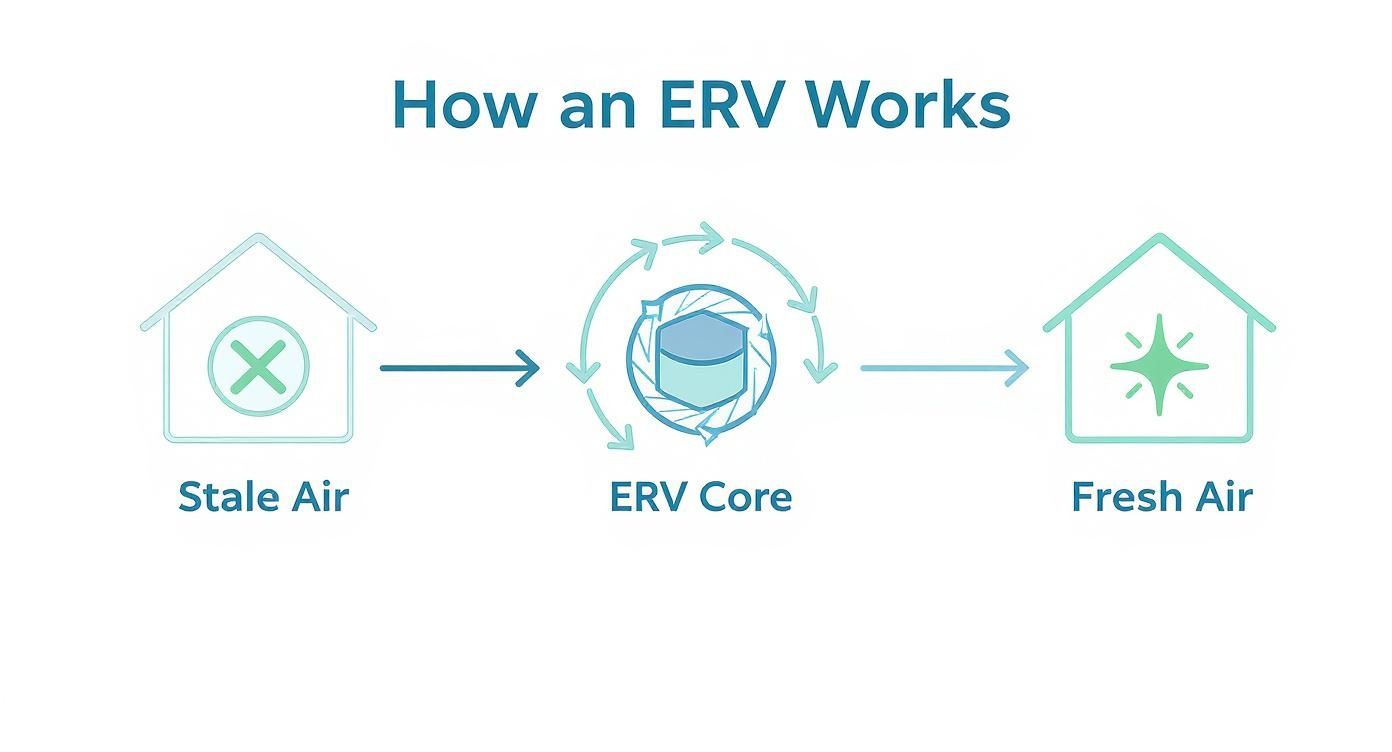
At its heart, the ERV is an energy recycler. It makes sure you get the fresh air you need without just throwing your heating or cooling dollars out the window.
By constantly bringing in filtered fresh air, an ERV dilutes all the stuff you don't want to be breathing—like VOCs, allergens, and excess CO2. This is huge for maintaining good indoor air quality and supporting your family's respiratory health. Of course, for the system to work its best, the air needs a clean path to travel, which is why keeping your home's entire ventilation network clean is key. You can learn more about how professional cleaning for ventilation systems works hand-in-hand with an ERV.
It's no surprise that these systems are becoming more and more common. The North American market for ERVs is expected to balloon from about USD 4.36 billion in 2025 to over USD 12.6 billion by 2035. This boom is being driven by new, stricter energy codes and a growing awareness of how important healthy indoor air is, putting top brands like Panasonic right at the forefront.
Comparing Top Panasonic ERV Models
Trying to pick the right Panasonic ERV model can feel like you're staring at a wall of specs. But it really just comes down to one thing: matching the machine to your home's actual needs. Panasonic has a solid lineup, but let's cut through the noise and look at two of their most popular series to see what really sets them apart.
Once you get the core differences, you can stop worrying about the technical jargon and start seeing how certain features will actually make your home more comfortable. This way, you get a system that’s just right—not too small for the job and not overloaded with features you don't need.
To make things easier, here’s a quick side-by-side look at the key players.
Panasonic ERV Model Feature Comparison
| Model Series | Ideal Application | Airflow (CFM) | Key Technology | Special Feature |
|---|---|---|---|---|
| Intelli-Balance | Whole-home ventilation in modern, tightly-sealed houses | Up to 100 CFM | Automatic self-balancing airflow | Smart sensors to maintain neutral pressure |
| WhisperComfort | Spot ventilation for specific rooms or smaller homes | Around 60 CFM | Ultra-quiet fan motors | Designed for whisper-quiet operation |
Now, let's dig into what those details really mean for you.
The Intelli-Balance Series For Smart Performance
The Intelli-Balance ERVs are built for precision. These are the go-to units for newer, tightly sealed homes where balanced ventilation isn't just a nice-to-have, it's a must. Their killer feature is the ability to automatically monitor and tweak the airflow on the fly.
Take the Intelli-Balance 100, for instance. It's designed to move up to 100 CFM (Cubic Feet per Minute) of air, which is perfect for most medium-sized homes. It works constantly to ensure you're getting a full exchange of fresh air multiple times a day. It even uses smart sensors to keep the air pressure inside your home neutral, which prevents problems like back-drafting from your furnace or water heater.
A huge plus for the Intelli-Balance series is how well it plays with others. It can run on its own or hook right into your existing HVAC system for a seamless, whole-home solution. Of course, getting the most out of it requires a pro installation of ductwork to make sure that fresh air actually reaches every room.
These models also use Panasonic’s special capillary core, which is a champ at transferring both heat and moisture. In a sticky GTA summer, this means the ERV is actively stripping humidity from the incoming air before it ever hits your living room. Your home feels less muggy, and your air conditioner gets a much-needed break.
The WhisperComfort Series For Quiet Operation
Just like the name says, the WhisperComfort series is all about keeping things quiet without compromising on fresh air. These are fantastic for spot-ventilation in specific rooms or for smaller homes where you don't want to hear your equipment running.
The WhisperComfort 60 ERV is a great example. It’s a more compact unit built for targeted ventilation in apartments, condos, or specific rooms up to about 1,500 square feet. Think of it as the perfect solution for that one stuffy bedroom or home office that never seems to get enough fresh air.
Even though it’s smaller, it’s still packed with great tech:
- Ultra-Quiet Fans: These are engineered to run so quietly you'll probably forget the unit is even on.
- Efficient Energy Recovery: Just like the bigger models, it recovers heat and moisture to keep your indoor air comfortable and your energy bills down.
- Simple Maintenance: The filters are right up front and easy to access, so routine cleaning is a simple DIY job.
At the end of the day, the best energy recovery ventilator Panasonic makes is the one that's correctly sized and suited for your home. The Intelli-Balance is a powerful whole-home workhorse for modern houses, while the WhisperComfort is brilliant at bringing fresh, quiet air exactly where you need it most.
Determining If Your Home Needs an ERV
So, is an energy recovery ventilator a must-have upgrade for your home, or just a nice-to-have? The best way to answer that is to start listening to the little clues your house gives you every day. Modern homes are built to be incredibly airtight, which is great for energy bills but not so great for air quality, as it can trap pollutants and stale air inside.
If your home often feels stuffy, or if you notice that the smell of last night’s salmon dinner is still hanging around by breakfast, that’s a big red flag. These lingering odours are a dead giveaway that your house isn't properly swapping out stale indoor air for fresh outdoor air. This is exactly the problem an energy recovery ventilator Panasonic system is built to solve by continuously cycling out the old and bringing in the new.
Signs Your Home Is a Prime Candidate
Some of the indicators are subtle, while others are impossible to ignore. Keep an eye out for these common red flags—they can tell you a lot about whether poor ventilation is impacting your family’s comfort and health.
Have you noticed any of these issues?
- Persistent Condensation: Are your windows constantly fogged up, especially during the colder months? That excess moisture is a classic sign of high indoor humidity and poor airflow, which can create the perfect conditions for mould to grow.
- Family Allergy Symptoms: If anyone in your house deals with allergies or asthma that seems to get worse indoors, it might be due to a buildup of allergens. Things like dust, pet dander, and pollen get trapped inside without a good ventilation system to help clear them out.
- Stuffy or Stale Rooms: We all have that one room that just feels perpetually stuffy and unpleasant, especially if it doesn't have a window. If you're wondering how to ventilate a room without windows, it really drives home the need for a whole-house mechanical system like an ERV to keep the air moving everywhere.
Assessing Your Home's Ventilation Profile
Beyond spotting problems, you can also get a good idea of your needs just by looking at your home's age and makeup. Newer houses, especially those built in the last 20 years or so, are sealed up tight to meet modern energy efficiency standards. This is fantastic for keeping heating and cooling costs down, but it also means mechanical ventilation isn't just a luxury—it's practically a necessity.
If you're not sure what specific pollutants are floating around in your air, a professional assessment is the only way to get clear answers. Running detailed indoor air quality testing can measure the levels of common contaminants and give you the data you need to decide if a Panasonic ERV is the right move for your family.
Here’s a simple rule of thumb: the more people and pets you have, the more indoor pollutants and humidity you’re creating just from breathing, cooking, and living your lives. A properly sized ERV makes sure your home's air stays fresh and healthy, no matter how busy things get. If you’ve been nodding along and ticking off these boxes, an ERV is probably a very smart investment for your home.
Getting Your ERV Installed and Keeping It Running
Even the best energy recovery ventilator Panasonic makes is only as effective as its installation. Getting the setup right isn't just a good idea—it's absolutely critical for making sure the system runs quietly, efficiently, and does its job for years to come. This is definitely a job for a certified pro, but knowing what’s involved helps you understand what to expect.
It all starts with a smart plan. The technician's first move is to find the perfect spot for the main ERV unit. This is usually tucked away in an attic, basement, or utility closet where it can connect to the outside and your home’s existing ductwork without a fuss. The right placement is key to keeping things quiet and maximizing airflow.
Once the unit has a home, the focus turns to the pathways for the air—the ducts.
The Professional Installation Blueprint
This is where the magic happens. A professional will run dedicated ducts to pull stale, moist air out of the rooms that need it most, like bathrooms, kitchens, and laundry rooms. At the same time, a second set of ducts is installed to deliver fresh, filtered air into your living spaces, like bedrooms and the family room. This creates a perfectly balanced exchange of air throughout your entire home.
The final, and arguably most important, step is balancing the system. A technician uses special tools to measure and tweak the airflow, making sure the amount of air being pushed out is a perfect match for the fresh air coming in. If it’s not balanced, you can run into weird pressure issues in your house, which torpedoes the ERV's efficiency.
A professional installation gets you started, but it's consistent maintenance that keeps your ERV performing at its best. Think of it like the rest of your HVAC system; it needs a little TLC to keep things running smoothly.
Easy DIY Maintenance for Top Performance
The good news? Most of the routine maintenance for your Panasonic ERV is simple enough to do yourself. The two biggest tasks are cleaning the filters and the energy recovery core. Keeping these parts clean ensures the air stays fresh and your system doesn't have to work overtime.
Here’s a quick rundown of what you can handle:
- Filter Cleaning and Swapping: Your ERV has two sets of filters—one for incoming air and one for outgoing. Give them a quick vacuum every 3-4 months and plan on replacing them once a year to keep dust and gunk from clogging up the works.
- Core Cleaning: About once a year, you’ll want to slide out the energy recovery core itself for a cleaning. It’s usually a simple job of soaking it in a mild soap-and-water solution, rinsing it well, and popping it back in.
- Exterior Vent Check: Every so often, take a quick look at the vents on the outside of your house. Make sure they’re clear of leaves, snow, or anything else that might be blocking the airflow.
These small steps go a long way in protecting your investment. And if you want to get a better handle on your home's entire ventilation network, learning how to maintain your air duct systems is a great next step. By combining a professional install with these simple DIY checks, your Panasonic ERV will be a reliable source of clean, healthy air for a long, long time.
The Real-World Benefits of a Panasonic ERV
All the technical specs and airflow numbers are great, but what does an ERV actually do for you and your family? When you boil it all down, the real value of an energy recovery ventilator Panasonic system comes down to two things you'll notice every day: serious energy savings and a much healthier home.
The first place you'll see a difference is on your hydro bill. Think of an ERV as an energy recycling powerhouse. In the winter, instead of just pumping the warm air you paid to heat straight outside, the system's core cleverly captures up to 80% of that heat. It then uses that captured warmth to pre-heat the fresh, frigid air coming in from outside. Your furnace breathes a sigh of relief because it doesn’t have to work nearly as hard.
That whole process just flips in the summer. The ERV grabs the heat and sticky humidity from the incoming outdoor air, pre-cooling it before it even gets a chance to challenge your air conditioner. This takes a massive load off your A/C, cutting down your electricity use right when it's most expensive.
A Healthier Indoor Environment
Beyond the budget-friendly perks, a Panasonic ERV completely changes the air you breathe. Our modern, well-sealed homes are fantastic for efficiency, but they can also trap a nasty cocktail of indoor pollutants. An ERV fixes that by constantly flushing out the bad stuff and bringing in fresh, filtered air.
This continuous exchange is a game-changer for dealing with:
- Volatile Organic Compounds (VOCs): These are chemicals that "off-gas" from things like new carpets, paint, and even furniture. An ERV makes sure they don't build up.
- Allergens and Dander: The system helps clear out pet dander, dust, and pollen that inevitably sneak into our homes, providing relief for allergy sufferers.
- Excess CO2 and Odours: From last night's fish dinner to the stuffiness of a full house, an ERV keeps your air from ever feeling stale.
A huge side benefit is humidity control. By managing airflow 24/7, a Panasonic ERV keeps your home’s humidity in the sweet spot—usually between 30-50%. This doesn't just feel more comfortable; it's a critical step in preventing mould and mildew from getting a foothold.
Ultimately, a Panasonic ERV is a smart, automated solution for tackling both energy waste and poor air quality head-on. If you're looking for more ways to create a healthier living space, exploring different strategies for indoor air quality improvement is a great next step. And while an ERV is a fantastic start, pairing it with more general energy efficiency tips for your home can maximize your savings even further. It's one of those rare home upgrades that pays you back in both lower bills and better health.
Why an ERV Is Ideal for Ontario's Climate
If you're a homeowner anywhere in Ontario, from the suburbs of the GTA to the heart of cottage country, you know our weather is a tale of two extremes. We swing from hot, sticky summers to bone-dry, frigid winters, and that puts a serious strain on our homes' comfort and air quality.
This is exactly where an energy recovery ventilator Panasonic shines. It's not just another piece of HVAC equipment; it's a smart solution built for our specific four-season climate.
Taming Summer Humidity
Think about those sweltering July days when the air feels heavy enough to swim through. An ERV tackles that head-on by pulling excess moisture out of the fresh air it brings into your home. This gives your air conditioner a huge helping hand, allowing it to cool your space more effectively without having to fight all that humidity. The result? No more sticky, swamp-like feeling indoors.
Beating Dry Winter Air
Then, the tables turn. In the dead of winter, our furnaces blast dry heat, leaving us with static shocks, scratchy throats, and dry skin. An ERV reverses its role beautifully. It captures precious humidity from the stale, outgoing air and transfers it to the fresh, dry air coming in. It’s a simple, brilliant way to keep your home's air comfortable all winter long.
This two-way moisture control is the magic of an ERV in Ontario. It doesn't just ventilate; it actively manages your home's humidity and temperature, season after season.
It’s also an investment that keeps your home up to date. The Ontario Building Code is increasingly focused on mechanical ventilation for new homes and major renos, especially as our houses become more airtight. Installing a Panasonic ERV doesn't just boost your comfort right now—it brings your home in line with modern building science and standards.
Your Top Questions About Panasonic ERVs Answered

It’s completely normal to have questions when you’re thinking about adding a new piece of equipment like an energy recovery ventilator from Panasonic to your home. Getting the right answers is the first step toward making a smart investment. We’ve pulled together the questions we hear most often to clear things up.
What's The Real Difference Between An ERV And An HRV?
The simplest way to think about it is that one manages moisture and the other doesn't. A Heat Recovery Ventilator (HRV) is fantastic at swapping heat between incoming and outgoing air. But an Energy Recovery Ventilator (ERV) does that and it swaps moisture.
This is a game-changer for our climate here in Ontario. An ERV helps pull that sticky humidity out of the air during our muggy summers. Then, in the bone-dry winter, it hangs onto some of that precious indoor humidity, so your home doesn't feel so parched. It’s all about year-round comfort.
Are Panasonic ERVs Noisy?
One of the things Panasonic is famous for is making whisper-quiet ventilation fans, and their ERVs are no different. You’ll see their sound levels measured in “sones” instead of decibels, which gives you a much better real-world sense of how quiet they are. The Whisper series models are engineered specifically to be as unobtrusive as possible.
It's important to remember that even the quietest unit can become noisy if it's not installed correctly. A professional installation, with properly balanced airflow and insulated ducting, is the key to making sure your ERV runs silently in the background.
Can I Hook A Panasonic ERV Into My Existing Furnace Ductwork?
Absolutely. Most Panasonic ERV models are designed to integrate right into your home's central HVAC system. This is a huge advantage because it means you don't need a separate set of ducts running through your house.
By connecting the ERV to your furnace or air handler, it can use your existing ductwork to deliver fresh, pre-conditioned air to every room. It turns the unit into a true whole-home ventilation system, ensuring the fresh air gets distributed evenly everywhere, not just in one or two spots. It’s an efficient and cost-effective approach.
Ready to bring fresh, clean air into your home with a top-tier Panasonic ERV? The pros at Can Do Duct Cleaning have the hands-on experience to make sure your system is installed and calibrated perfectly. Reach out to us today at https://www.candoductcleaning.com.