
Keeping your basement from turning into a mould factory is all about a three-pronged attack: controlling moisture, managing humidity, and making sure your airflow is clean. This isn't just about avoiding a musty smell—it's about tackling the problem at its source by eliminating the damp, stagnant conditions that mould loves, ultimately protecting your entire home's air quality.
Why Your Basement Is Ground Zero for Mould Growth
Ever caught a whiff of something musty upstairs but couldn't pin down where it was coming from? Chances are, the problem started right under your feet in the basement. It's a natural trouble spot. Being underground means it's damp, gets little to no sunlight, and often has poor ventilation. This is the perfect recipe for mould.
But the real kicker is that what happens in the basement doesn't stay in the basement. The air quality down there has a direct line to the air you breathe in every other room of your house, all thanks to a simple law of physics many of us never think about.
Understanding the Stack Effect
Picture your home as a big chimney. Warm air is lighter, so it rises. As the air on your main floor and upstairs warms up and eventually escapes through windows or vents in the attic, it creates a subtle vacuum. This pulls the cooler, heavier air up from the lowest point in the house to replace it—your basement.
This constant, upward draft is called the stack effect.
It’s the reason your basement is the epicentre of so many indoor air quality issues. Any mould spores, dust, or funky odours lurking in the basement air get a free ride upstairs, circulating through your living room, kitchen, and bedrooms. That lingering musty smell is often the first sign that you have a moisture issue brewing below. If you're struggling with those stubborn smells, we've got a detailed guide on how to eliminate that old musty smell at home.
It's a startling fact, but research shows that as much as 50% of the air on your main floor can actually originate from your basement or crawlspace. This upward airflow is a superhighway for mould spores and musty odours.
The Interconnected System of Prevention
To get a handle on basement mould, you have to understand the hidden dangers of water damage, including mold and mildew. A smart prevention plan treats your home as one big interconnected system. You can't just fix one thing and call it a day.
It breaks down like this:
- Moisture Control: This is your first line of defence. Stop water from getting through the foundation in the first place.
- Humidity Management: Next, you need to control the moisture that's already in the air.
- HVAC Maintenance: Finally, you have to ensure your furnace and ducts aren't just spreading spores around the house.
Every piece of this puzzle is critical. By getting to the root of the problem in your basement, you’re taking a massive step toward protecting the health of your home and your family. In this guide, we'll walk you through exactly how to do it.
Here’s a quick overview of the game plan.
Your Quick Guide to a Mould-Free Basement
This table breaks down the core strategies we'll cover to help you keep your basement dry, healthy, and free of mould for the long haul.
| Prevention Area | Primary Goal | Key Actions |
|---|---|---|
| Moisture Sources | Stop water from entering the foundation. | Fix leaks, seal foundation cracks, ensure proper grading and eavestroughs. |
| Humidity Control | Keep indoor air moisture levels below 50%. | Use a dehumidifier, improve insulation, and check for condensation. |
| Ventilation & Airflow | Prevent stagnant air where mould can thrive. | Clean HVAC ducts, run exhaust fans, and ensure proper air circulation. |
| Regular Maintenance | Catch small problems before they become big ones. | Conduct routine inspections, clean eavestroughs, and service your HVAC system. |
Think of these areas as the four pillars of a healthy basement. By addressing each one, you create an environment where mould simply can't get a foothold.
Mastering Moisture Control from the Outside In
If you want to win the war against basement mould, you have to start the battle outside. Seriously. The single most effective way to keep your basement dry is to stop water from ever getting near your foundation in the first place.
Think of it this way: your property has its own built-in water management system. Your job is to make sure it's working for you. I’ve seen countless GTA homeowners solve their basement moisture problems just by getting a handle on what’s happening outdoors, especially before a big spring thaw or summer downpour.
Directing Water Away from Your Foundation
Your home's first and best line of defence is the ground it sits on. The soil right up against your foundation needs to shed water, not soak it up like a sponge. This is all about proper grading.
Take a walk around your house. The land should slope away from your foundation on all sides. You’re looking for a drop of at least 15 centimetres over the first 3 metres. It doesn't sound like much, but that gentle slope uses gravity to pull thousands of litres of rainwater and snowmelt safely away before it can build up pressure and find a way inside.
Next, look up. Your eavestroughs and downspouts are doing a ton of work.
- Clean Your Eavestroughs: They need to be clear of leaves, shingle grit, and whatever else ends up in there. A clog is a guaranteed overflow, dumping a waterfall right next to your foundation. Check them in the spring and autumn, without fail.
- Extend Your Downspouts: Most standard downspouts are too short. They just dump water at the corner of your house. Grab some extensions and make sure water is channelled at least two metres away.
Getting these two outdoor jobs right will drastically cut down on the hydrostatic pressure pushing against your basement walls. This pressure is the root cause of so many damp basement headaches.
Hunting for Interior Leaks and Weak Points
Okay, once your exterior is sorted, it's time to head downstairs and look for weak spots. Even with perfect grading, moisture can be sneaky, especially in older homes around the Toronto area.
Start with a slow, careful walk around the basement. Look closely at the foundation walls and the floor. You’re hunting for cracks—even tiny hairline ones. They might look innocent, but our Canadian freeze-thaw cycles can pry them open over time, creating a perfect path for water.
You'd be shocked how much water can be forced through a tiny foundation crack by groundwater pressure. Sealing every single entry point isn't just a good idea; it's non-negotiable for a dry basement.
For small cracks, a high-quality polyurethane caulk is a great fix. For more serious ones, an epoxy injection kit will create a permanent, waterproof seal. Don't forget to check around basement windows and where pipes for your utilities come through the wall—these are classic weak points.
Then there's condensation. On a humid summer day, your cool basement walls and pipes can "sweat," creating puddles and dampness out of thin air.
- Inspect Cold Water Pipes: These are the worst offenders. Grab some foam pipe insulation from any hardware store. It’s a cheap, five-minute job that stops the dripping for good.
- Check Concrete Walls: Feel the walls. If they’re cool and damp to the touch, you’ve likely got a condensation issue. Better air circulation and a good dehumidifier will make a world of difference.
And remember, what happens in the basement doesn't stay in the basement. The air down there is constantly rising and circulating through the rest of your home.
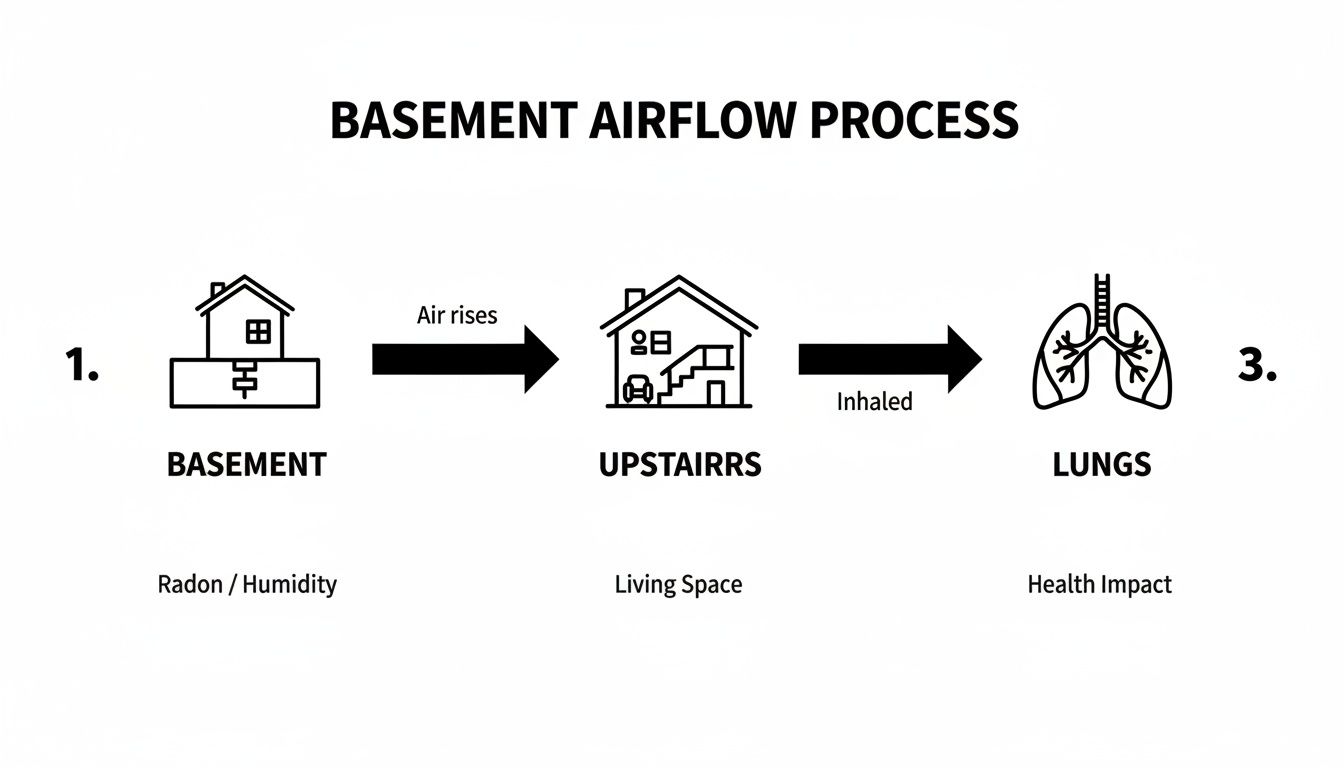
This "stack effect" means that any mould spores or damp, musty air from your basement are being shared with every room in your house. It directly impacts your family's health.
Finally, give your plumbing a once-over. A slow drip from a pipe fitting or a leaky washing machine hose might not seem like a big deal, but over weeks and months, it can create the perfect damp environment for mould to thrive behind a wall or under an appliance. A quick check for corrosion or drips can save you a massive headache later.
Controlling Humidity and Air Circulation
Once you've plugged any leaks, it's time to tackle the invisible threat: airborne moisture. High humidity is the number one thing mould needs to take hold in your basement. You can think of that damp, stagnant air as rolling out the welcome mat for mould spores. The mission is simple: keep the air dry and keep it moving.
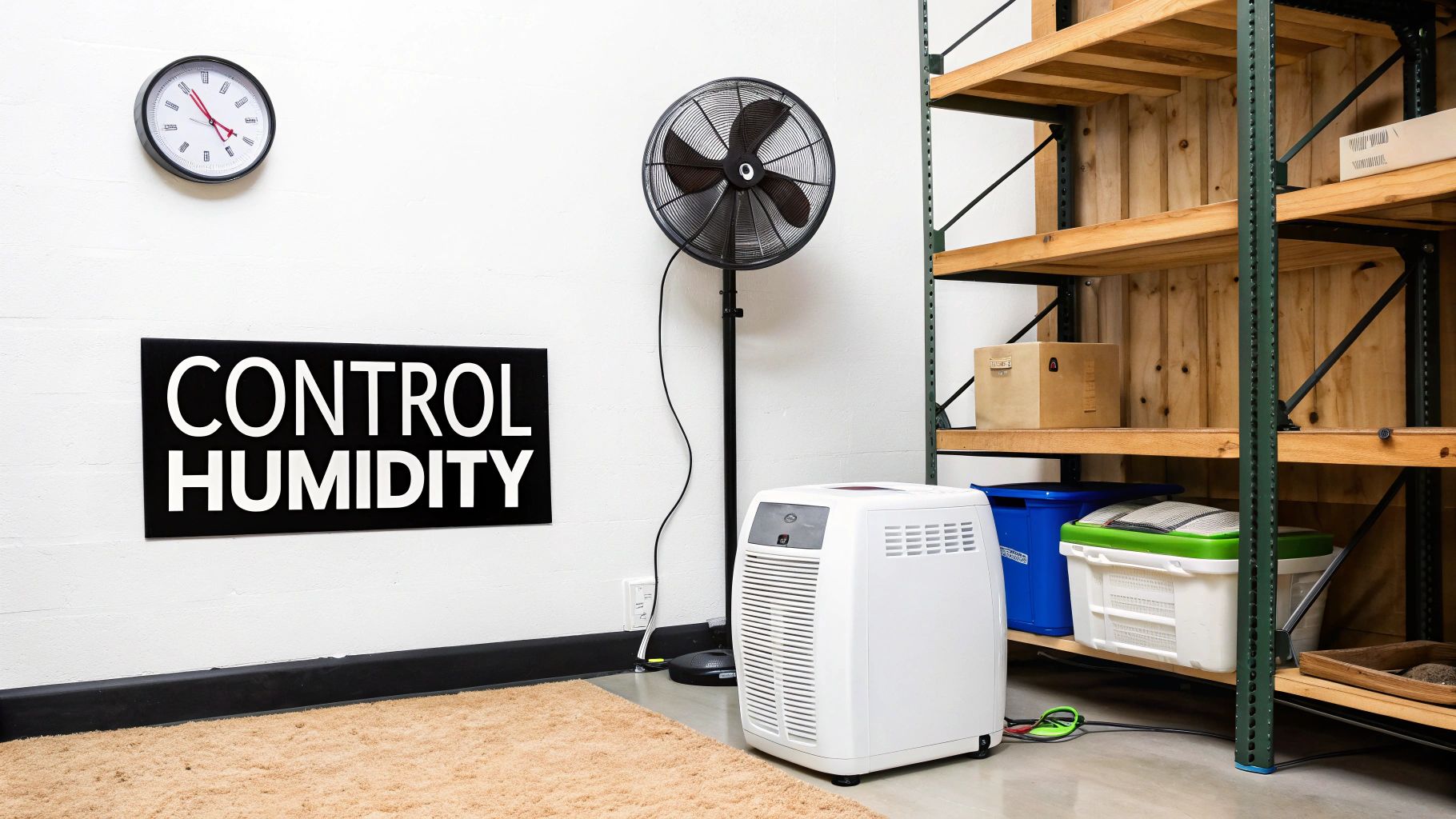
The sweet spot for basement humidity is somewhere between 30% and 50%. Anything higher than that and you're creating the perfect breeding ground. Gaining control over this is a core part of any real prevention plan, and effective basement dehumidification is key to protecting your home. A cheap hygrometer from Canadian Tire or Home Depot is all you need to keep an eye on the numbers.
Choosing and Using a Dehumidifier
A good dehumidifier is probably the most powerful weapon in your arsenal. For most of us in the GTA, dealing with those humid summers, this isn't optional—it's essential. It literally pulls moisture right out of the air, collecting it as water you can simply dump out.
The first thing to consider is the size of your basement. Dehumidifier capacity is measured in how many litres of water it can remove over 24 hours.
- Small Basements (up to 140 sq. metres): A 14-litre (30-pint) unit is usually perfect. These are ideal for smaller, finished spaces that just feel a bit damp.
- Medium Basements (140 – 230 sq. metres): This is where a 24-litre (50-pint) model shines. It’s the go-to size for the typical suburban home in our area.
- Large or Very Damp Basements (over 230 sq. metres): You'll want to step up to a 33-litre (70-pint) or even a commercial-grade unit for big, unfinished spaces or basements with a history of moisture problems.
Once you’ve got one, don't just stick it in the corner and forget it. For it to work best, it needs to be in a central spot with plenty of room for air to circulate all around it. If you need help picking one out, our guide on the best dehumidifiers for basements breaks down the top models.
Pro Tip: Look for a dehumidifier with a hose connection. This is a lifesaver. You can run the hose to a floor drain or your sump pump and never think about emptying that heavy bucket again.
Boosting Air Circulation and Eliminating Stagnant Zones
While technology is great, don't underestimate the power of simple airflow. Mould absolutely loves still, stagnant air, which you’ll always find in cluttered corners, behind the sofa, or deep inside closets. The fix? Get that air moving.
Even a single fan, placed strategically, can make an enormous difference. Set it on low and aim it at a known dead spot. This constant movement helps evaporate any lingering moisture and spreads the dry air from your dehumidifier around the entire basement.
It's also a good time to reconsider how you're storing things down there.
- Get Things Off the Floor: Never store cardboard boxes directly on the concrete. Use plastic shelves or even old pallets to lift everything up, letting air circulate underneath and stopping moisture from wicking up from the floor.
- Leave Space Around Walls: Pull all your furniture, boxes, and shelving at least a few centimetres away from the foundation walls. That small gap is all it takes to let the air pass through.
The Role of Insulation
Lastly, let's talk about insulation. During our humid summers, those cold basement walls are magnets for condensation. When warm, moist air hits a cold surface, it creates water droplets—the same way a cold glass of pop "sweats" on a patio.
Insulating your basement walls, especially with rigid foam board, is a game-changer. It creates a thermal break, which keeps the inside surface of the wall warmer and stops condensation from ever forming. This one upgrade can drastically reduce the amount of work your dehumidifier has to do, saving you money on hydro and making the whole space more comfortable and mould-resistant.
Your HVAC System: The Highway for Mould Spores
Think of your heating and cooling system as the lungs of your home. It breathes air in, conditions it, and pushes it out into every single room. But if your basement is damp, that system can quickly turn from an ally into an enemy, creating a superhighway for mould spores.
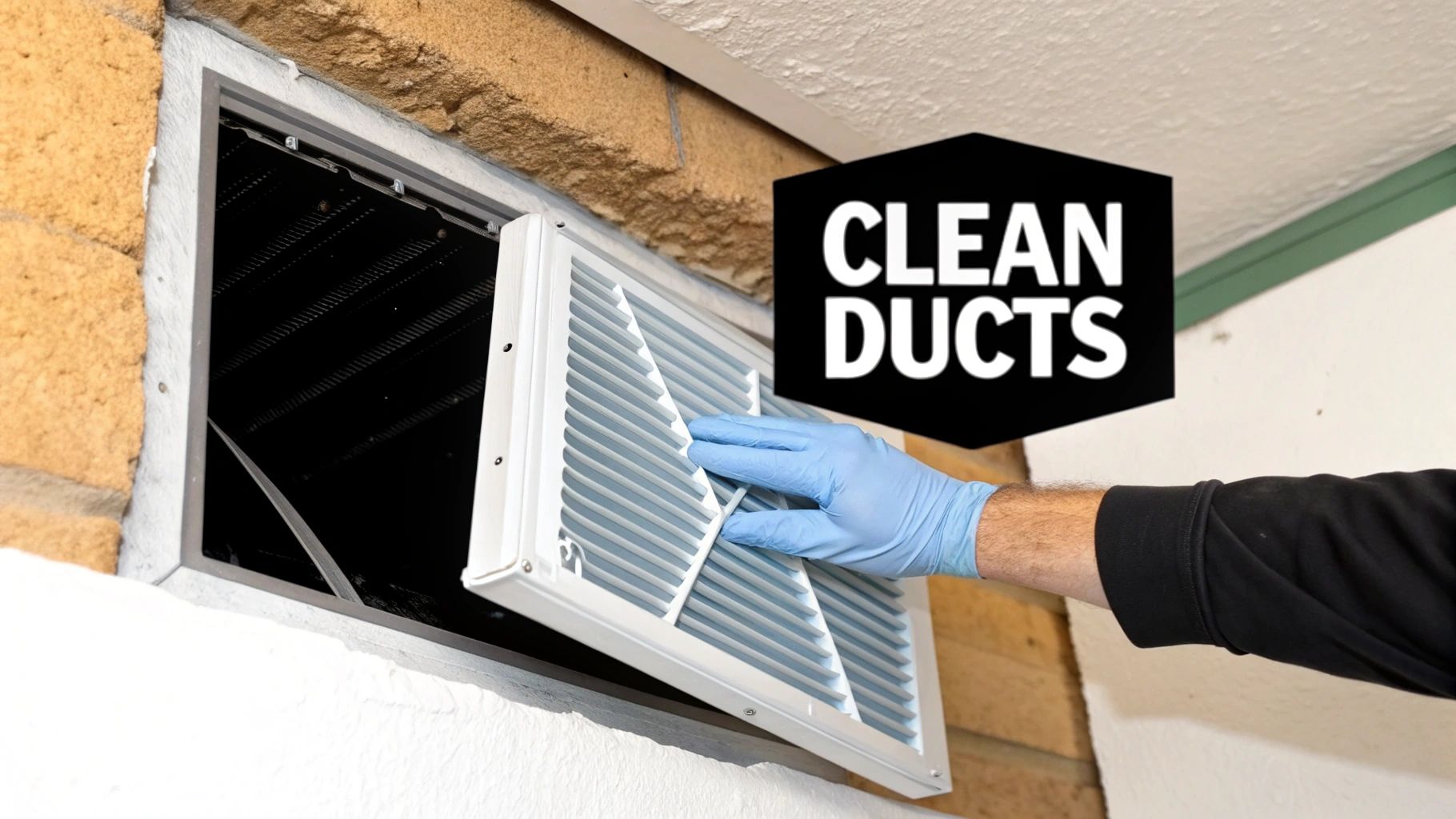
It’s a simple and relentless process. Your furnace's return air vents are often in the basement, pulling in the naturally cooler air from down there. If that air is also damp and carrying mould spores, your HVAC unit dutifully sucks it all in and distributes it everywhere—your kitchen, living room, and yes, even your bedrooms.
This is a critical piece of the puzzle in figuring out how to prevent mould in basement spaces from taking over your entire home. You could have a spotless main floor, but you’re just circulating the problem if the air supply itself is contaminated at the source.
When Your Ductwork Becomes a Breeding Ground
The situation gets a lot worse when you think about what’s inside the ductwork itself. Over the years, ducts collect a surprising amount of dust, pet dander, and other organic debris. This buildup is basically a layer of fertile soil, just waiting for the right conditions to grow something nasty.
Moisture is that final ingredient, and it often comes from your air conditioner. During a humid Greater Toronto Area summer, your A/C coils work overtime, creating a ton of condensation. Even a small amount of this moisture can find its way into the ductwork, turning all that settled dust into a damp, sludgy breeding ground perfect for mould.
Once mould sets up a colony inside your ducts, the problem accelerates. Every time the furnace or A/C kicks on, it blasts millions of spores out of the vents and straight into the air you breathe.
A study found that in homes with documented mould problems, the HVAC system was often a primary contributor to the cross-contamination of the entire building. Cleaning the source is essential, but if the distribution network is contaminated, you'll never truly solve the problem.
This is exactly why professional duct cleaning is more than just dusting—it's a critical health and safety measure. By physically removing the gunk and any existing mould, you eliminate the reservoir of spores and allergens, ensuring you’re breathing cleaner, healthier air. A thorough cleaning basically resets the entire system, breaking that cycle of contamination.
The Overlooked Threat of Your Dryer Vent
Another major source of basement humidity is often hiding in plain sight: your clothes dryer. A standard dryer pushes out a huge amount of hot, steamy air with every cycle. When the vent line is clear, all that moisture is safely exhausted outside.
The problem is, dryer vents are notorious for clogging up with lint.
A partially or fully blocked vent forces that humid air to back up and escape right into your basement. Just one load of laundry with a clogged vent can be like turning on a high-powered humidifier, jacking up the moisture levels in the entire room. That sudden spike in humidity is an open invitation for mould to start growing on nearby walls, ceilings, and anything you have stored down there.
Keep an eye out for these tell-tale signs that your dryer vent needs attention:
- Clothes take forever to dry. If you're constantly running a second cycle, the vent is almost certainly clogged.
- The laundry room feels hot and humid. This is a dead giveaway that the exhaust air isn’t getting outside.
- You smell something burning. This is a serious fire hazard caused by lint buildup getting too close to the dryer's heating element.
Regular, professional dryer vent cleaning is a simple maintenance task that not only prevents mould but also drastically reduces the risk of a house fire. For any homeowner in the GTA, it's a small investment with a huge payoff in safety and air quality.
Optimizing Ventilation for a Healthier Home
Beyond just cleaning, you need to ensure your home has a balanced ventilation system. Today's homes are built to be airtight, which is great for energy bills but terrible for trapping moisture and pollutants inside.
Systems like Heat Recovery Ventilators (HRVs) and Energy Recovery Ventilators (ERVs) are designed to fix this. They exhaust stale, humid indoor air while bringing in fresh outdoor air, all without killing your heating or cooling efficiency. Exploring the benefits of HRV and ERV systems for your home can be a game-changer for controlling humidity and maintaining great indoor air quality year-round. It's a proactive approach that helps your HVAC system move clean, dry air, making it much harder for mould to ever get a foothold.
Knowing When You Have an Active Mould Problem
Even with the best prevention plan, mould can be surprisingly persistent. The real trick is catching it early, before a small issue snowballs into a massive, costly remediation project. It really comes down to learning to trust your senses and knowing how to look beyond the obvious.
When we think of mould, we usually picture those big, ugly black splotches on a wall. But the truth is, the first signs are almost always much more subtle. Your nose is actually one of your best detection tools.
If you start noticing a persistent musty or earthy smell, especially in the basement or near your air vents, that's a huge red flag. Don't just write it off as "that old basement smell." What you're likely smelling are microbial volatile organic compounds (MVOCs)—gases that active mould colonies release.
Spotting the Subtle Warning Signs
Beyond that distinct odour, you need to look for the physical evidence of moisture damage, because water is always the precursor to mould. During your regular basement walk-throughs, keep a sharp eye out for these little clues.
- Changes to Walls and Paint: Look for any paint that's bubbling, peeling, or cracking. Even a faint discolouration that looks like an old water stain can mean moisture is trapped behind the drywall.
- Warped Materials: Moisture warps building materials over time. Check your wooden baseboards or any wall panelling to see if they are swelling or starting to pull away from the wall.
- Surface Condensation: On particularly humid days, check for condensation or "sweating" on cool surfaces like concrete walls, cold water pipes, or the inside of your basement windows. If this is happening consistently, you're creating the perfect breeding ground for mould.
For a deeper look at what to watch for, we've put together a full breakdown of the top warning signs of mold in your house in our detailed guide. Recognizing these early symptoms can save you a world of trouble.
When to DIY and When to Call a Pro
Finding a small patch of mould can set off alarm bells, but it doesn't always mean you need to call in a hazmat team. The decision to tackle it yourself versus calling in the experts really hinges on two things: how big the patch is and what kind of surface it’s on.
As a general rule, if you’ve found a mouldy patch that's less than one square metre (roughly 10 square feet) and it’s on a hard, non-porous surface like concrete, tile, or metal, it's something a homeowner can often manage. Just be sure to use proper personal protective equipment (PPE)—an N95 mask, gloves, and eye protection are non-negotiable—and clean the area thoroughly.
A word of caution: Never use bleach to clean mould on porous materials like drywall or wood. It might kill the surface mould you can see, but the water in the bleach will soak into the material and can actually feed the mould roots growing underneath, making the problem worse.
That said, some situations are immediate red flags that you’re out of your league and it’s time to call in professional mould remediation specialists.
The Red Flags for Professional Intervention
Some mould problems are simply too big, too hidden, or too dangerous for a DIY job. Trying to clean a large-scale infestation without the right training and containment equipment can be a disaster. You risk disturbing the mould, which sends a cloud of spores airborne, spreading the problem throughout your entire home.
Pick up the phone and call a professional immediately if you run into any of these scenarios:
- Widespread Growth: The mould covers an area larger than one square metre.
- Hidden Mould: You have good reason to suspect mould is growing inside your walls, underneath the flooring, or deep within your HVAC system. A pro has tools like moisture meters and borescopes to find what you can't see.
- Contaminated Porous Materials: If mould has gotten into drywall, insulation, or carpeting, these materials usually need to be carefully removed and replaced, not just cleaned.
- Health Symptoms: Someone in your family is dealing with unexplained allergies, respiratory issues, or other symptoms that seem to flare up at home. This could be a sign of mould exposure.
- Post-Flood Contamination: The mould appeared after a major water event, like a flood or sewer backup. This situation involves contaminated water and requires professional handling.
At the end of the day, your family's health and your home's integrity come first. If you're ever in doubt, erring on the side of caution and getting a professional assessment is always the smartest move.
Your Proactive Plan for a Healthy Basement
Keeping your basement free of mould isn't a one-and-done job. It's really about building simple, consistent habits that protect your home and your family’s health. Think of it like a regular maintenance schedule for your car—a little bit of effort now saves you from a world of trouble later on.
This plan is all about putting that knowledge into action. We’ll combine moisture control, humidity management, and air quality checks into a routine that’s actually manageable. Staying on top of these things puts you in the driver's seat, stopping mould before it even gets a foothold.
Your Seasonal Maintenance Checklist
A mould-resistant basement is much easier to maintain when you break down the tasks by season. Here's a simple checklist to keep you on track all year long.
Weekly Check-In:
- Take a quick peek at your hygrometer to make sure humidity is below 50%.
- Empty your dehumidifier’s collection bucket or just double-check that the drain hose is working properly.
Monthly Inspection:
- Do a quick walk-around. You're looking for any new leaks, musty odours, or damp spots from condensation.
- Check your furnace filter and give it a clean or swap it out. A clogged filter chokes your system's airflow, which can create bigger air quality problems. We've got more details on the right furnace filter replacement frequency in our handy guide.
Seasonal Tasks (Spring & Autumn):
- Get those eavestroughs and gutters cleared of leaves and gunk.
- Make sure your downspouts are pointing well away from the foundation—at least a couple of metres.
- Give the foundation a once-over for any new cracks that might need to be sealed up.
The goal here is consistency, not perfection. A few minutes each month is your most powerful weapon in the fight for a dry, healthy basement. This simple routine empowers you to catch small issues before they snowball into big, expensive problems.
At the end of the day, you're in control. These preventative steps are your absolute best defence against mould. And for the bigger jobs, like a deep duct cleaning to clear out any built-up spores and ensure your home's air is circulating cleanly, professional help is always just a call away.
Answering Your Top Questions About Basement Mould
Even with the best prevention plan, questions are bound to pop up. Here in Canada, with our wild swings in weather, homeowners are always running into specific basement mould situations. Let's tackle some of the most common questions we hear every day.
Can I Just Paint Over a Small Patch of Mould?
It's the ultimate "quick fix" that homeowners are tempted by, but trust me on this one: it's a big mistake.
Painting over mould doesn't kill it. It just hides it. Worse, it traps moisture against the surface, giving the mould a perfect, dark, and damp place to go wild underneath the paint. You've essentially just given it a food source and a protective blanket.
Before you even think about picking up a paintbrush, you have to kill the mould and completely fix the moisture source that allowed it to grow. Once that's done, then you can prep and repaint the area. Skip those steps, and the mould will push its way right back through the new paint, often angrier than it was before.
Think of it like this: Painting over mould is like putting a bandage on an infected wound without cleaning it first. You're hiding the problem, not healing it, and allowing the infection to spread unseen.
Are Air Purifiers Effective Against Basement Mould?
This is a great question. Air purifiers with a good HEPA (High-Efficiency Particulate Air) filter are fantastic for trapping airborne mould spores. They can make a real difference in your basement's air quality, catching spores before they can circulate through your HVAC system and the rest of your home.
But they're only one piece of the puzzle. An air purifier can't stop mould at its source. It does nothing about the damp wall or leaky pipe that’s causing the problem. Think of it as a defensive tool, not an offensive one. Use it to improve your air quality while you tackle the root cause—the moisture and the existing mould colony.
Is a Musty Smell Always a Sign of Mould?
That damp, earthy smell in a basement is the number one tell-tale sign of mould or mildew. It's the first thing most people notice. While it's possible for other things to cause a similar smell (like rotting wood or even sewer gas issues), it's highly unlikely.
Honestly, you should always work under the assumption that a musty smell means mould until you can prove otherwise. That odour is your home’s built-in alarm system. When you smell it, it’s time to start hunting for the hidden moisture source immediately. Don't just ignore it.
When it comes to the air you breathe, you can't afford to take chances. Ensuring your home's entire ventilation system is clean and clear of spores is a critical step in protecting your family's health. For professional duct and vent cleaning services in the Greater Toronto Area, trust the experts at Can Do Duct Cleaning. Learn more about how we can help create a healthier home environment for you.

