
When the cold Canadian winter hits, choosing the right gas heater for your garage is more than a luxury—it’s about turning a frigid, unusable space into a year-round workshop or hobby room. But the most important decision you'll make isn't about power; it's about safety. Proper ventilation is non-negotiable, which is why vented models are the only choice we recommend for enclosed spaces like garages.
Navigating Your Garage Heater Options
Trying to pick a gas heater for your garage can feel a bit overwhelming at first, but it gets a lot simpler once you understand the main types. Think of it like choosing the right tool for a specific job—each one has its own strengths. Your main choices are between forced-air unit heaters and infrared tube heaters.
You can forget about vent-free models; they just aren't safe for enclosed Canadian garages where air can get trapped.
This simple flowchart helps visualize the right way to think about your choice.
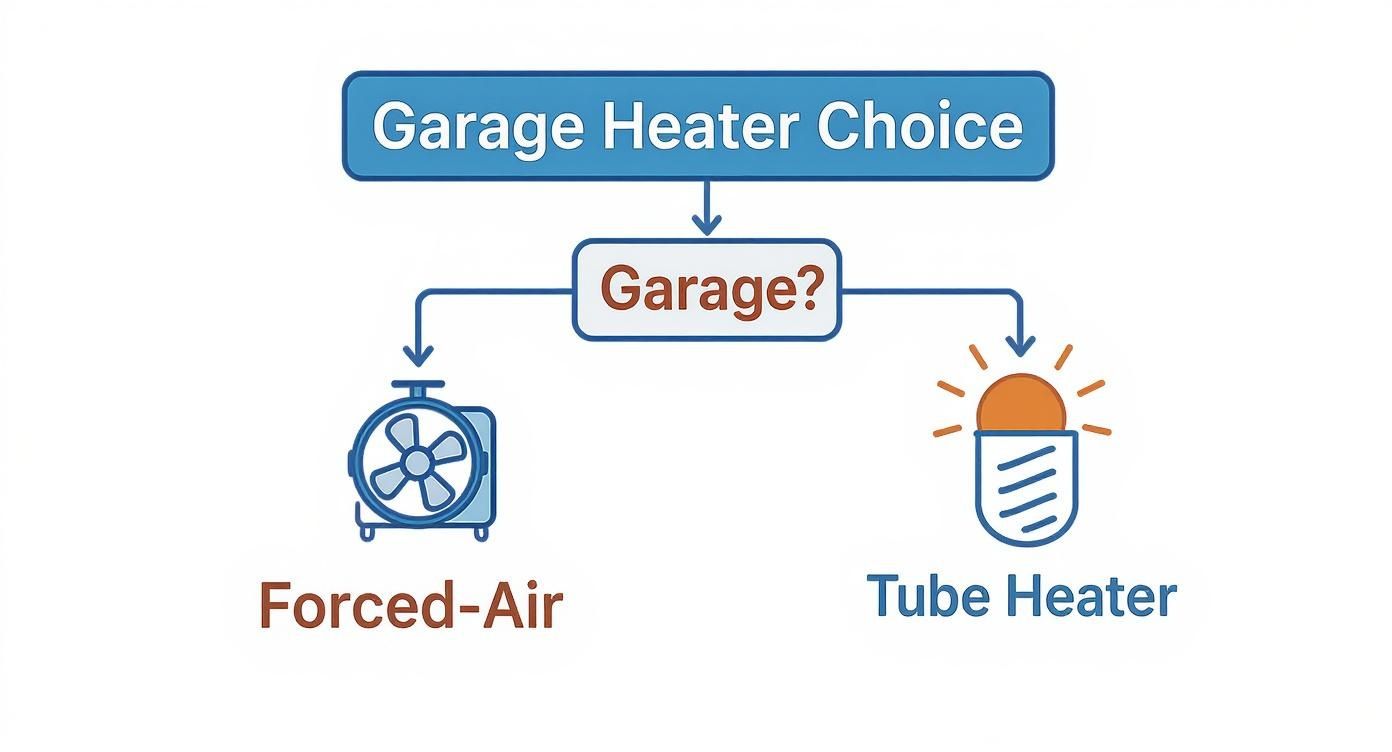
As you can see, the first and most critical step is committing to a vented system. That decision alone immediately narrows your options down to the two safest and most effective types for your garage.
To make things even clearer, here’s a quick breakdown of how the main heater types stack up.
Quick Comparison of Garage Gas Heater Types
This table gives you a side-by-side look at the primary types of gas heaters suitable for garages, focusing on the key factors for Canadian homeowners.
| Heater Type | Safety Level | Best Use Case | Installation Complexity | Typical Cost |
|---|---|---|---|---|
| Forced-Air (Vented) | High | Evenly heating the entire garage space quickly | Moderate to High | $$ – $$$ |
| Infrared Tube (Vented) | High | Targeted heating for specific workstations or drafty areas | Moderate to High | $$$ – $$$$ |
| Vent-Free | Low | Not recommended for enclosed garages due to safety risks | Low | $ |
Ultimately, the choice between forced-air and infrared comes down to how you plan to use your garage.
Forced-Air Unit Heaters
A forced-air heater is basically a powerful, compact furnace designed specifically for your garage. It works by pulling in cold air, heating it up internally with a gas-fired heat exchanger, and then using a fan to push that warm air throughout the space.
This method is incredibly effective for quickly and evenly raising the temperature of the entire garage. If your goal is to make the whole room comfortable so you can move around and work anywhere, a forced-air unit is a fantastic choice.
Infrared Tube Heaters
An infrared (or radiant) tube heater, on the other hand, operates more like the sun. Instead of heating the air, it emits infrared waves that travel in a straight line to directly warm up objects and people in their path—your workbench, your tools, your car, and you.
This creates a comfortable pocket of warmth without needing to heat the entire volume of air in your garage. That makes it a highly efficient option, especially if you have a dedicated workspace or a large, drafty garage where heating all that air would be a waste of energy.
The financial side of things can vary quite a bit. While costs differ by region and model, homeowners can generally expect to pay somewhere between $1,500 and $4,000 for a professional installation. Gas-powered units often have a higher upfront cost than electric models, but they usually make up for it with lower operating costs. Getting professional advice on furnace installation can help you figure out the best fit and budget for your home.
Calculating the Right Heater Size for Your Space
Choosing a gas heater for your garage isn't like picking up a portable space heater from the hardware store. One size definitely does not fit all.
If you pick a unit that's too small, it's like trying to warm your house with a hairdryer on a frosty morning. It’ll run constantly but will never quite get the job done, leaving you cold and frustrated. Go too big, and you've got a different problem. An oversized heater will blast your garage with heat, shut off, and then repeat the cycle over and over. This constant cycling is inefficient, wastes fuel, and creates uncomfortable temperature swings.
The key is finding that "just right" balance. To do that, we need to look beyond simple square footage and focus on what really matters: your garage's total volume.
Start with Garage Volume
First things first, you need to figure out the total cubic feet of your garage. It’s a simple calculation, but it’s the foundation for getting everything else right.
The Formula: Garage Volume = Length (ft) x Width (ft) x Ceiling Height (ft)
Let's say you have a standard two-car garage. It might be 20 feet wide by 20 feet long with a 10-foot ceiling. The math is straightforward: 20 x 20 x 10 gives you a total volume of 4,000 cubic feet.
This number is your starting point for figuring out how much heating power—measured in British Thermal Units (BTUs)—you’ll need.
Factor in Canadian Conditions
Now comes the part where we adjust for the realities of a Canadian winter. How much heat you need depends on two big things: how well-insulated your garage is and how cold it gets outside.
Here’s how to dial in your calculations:
- Desired Temperature Rise: Figure out how much warmer you need the garage to be. If the forecast calls for -15°C and you want to work comfortably at 15°C, you need to raise the temperature by 30°C.
- Insulation Level: This is a huge factor. Is your garage drafty with an old wooden door that lets in the wind? Or is it modern, fully drywalled, and well-sealed? A poorly insulated space bleeds heat and needs a much more powerful heater.
- BTU Calculation: A good rule of thumb is to multiply your garage's volume by a specific factor based on its insulation. For a drafty, uninsulated garage, you might use a multiplier of 5. For a well-insulated space, a factor of 3 might be all you need.
Let's plug these numbers into our 4,000 cubic foot garage example:
- Poorly Insulated Garage (Drafty): 4,000 cu ft x 5 = 20,000 BTUs
- Well-Insulated Garage (Sealed): 4,000 cu ft x 3 = 12,000 BTUs
Look at that difference! Insulation alone can nearly double the heating power required. Taking the time to size your heater correctly ensures it runs efficiently without struggling to keep up.
For more complex projects, especially if you're trying to integrate the heater with other systems, understanding the details of a professional furnace and installation can give you a clearer picture of how to get the best performance. It ensures you’re not just buying a heater, but investing in a system that’s perfectly matched to your needs.
Understanding Venting and Installation Safety
Getting a gas garage heater installed properly isn't just a good idea—it’s the single most important thing you can do for safety and performance. This is definitely not a weekend DIY job. When you're dealing with gas lines and combustion, you need an expert's touch to keep your home and family safe.
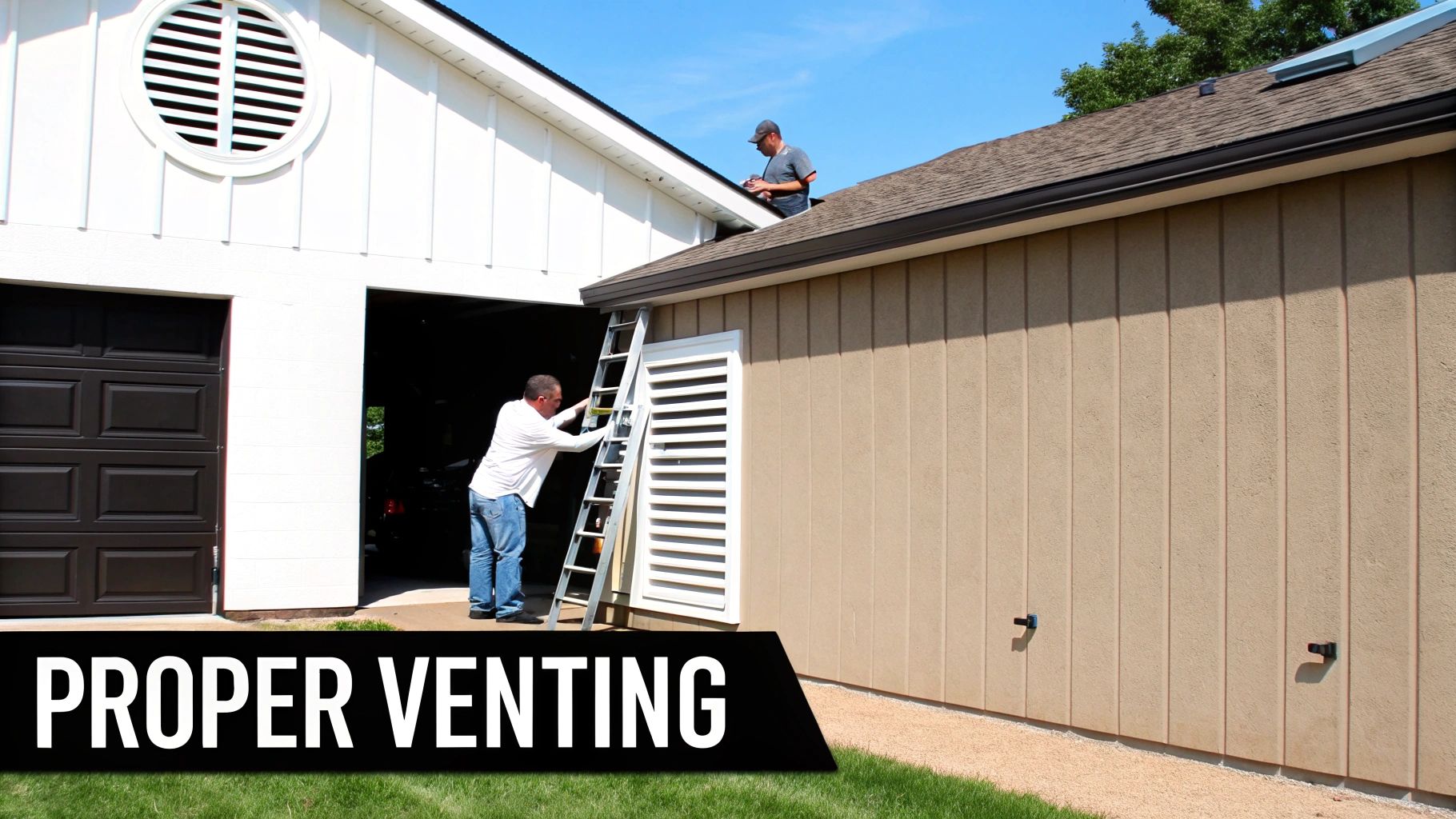
Think of the heater's vent like the exhaust pipe on your car. It has one job: to get harmful fumes, like carbon monoxide, out of your garage and away from the air you breathe. It’s a process that has to be done perfectly.
Venting Routes: Wall vs. Roof
There are two main ways to vent a gas heater, and the right one for you really comes down to your garage's layout. A pro will help you figure it out, but it's good to know the basics.
- Direct Vent (Wall Venting): This is the go-to method for most setups. A special double-walled pipe goes horizontally right through an outside wall. The inside pipe pushes exhaust out, while the outer pipe pulls in fresh air for the heater to burn. It's a closed, super-efficient system.
- Vertical Vent (Roof Venting): If your heater can't be placed near an exterior wall, this is the answer. The pipe runs straight up through the ceiling and out the roof. You'll often see this in larger garages or for specific heater models.
No matter which way you go, the goal is always to keep the combustion process totally separate from your indoor air. It's a technical job that’s similar in spirit to a professional dryer vent installation, where getting the routing and sealing just right is crucial for safety.
Why Professional Installation is Non-Negotiable
Here in Canada, the law is clear: any work involving a gas line must be done by a licensed and certified gas technician. And for good reason.
A licensed tech does more than just hook up pipes. They'll set the correct gas pressure, hunt for leaks, confirm the venting is flawless, and ensure the entire setup meets all local building codes and the manufacturer’s rules. Trying to do this yourself can lead to gas leaks, a fire, or deadly carbon monoxide poisoning.
A pro will also establish the proper clearance-to-combustibles. This is the mandatory safety buffer of empty space needed around the heater to keep flammable stuff—like wood, paint thinner, or gas cans—from catching fire. They’ll also handle pulling any necessary permits from your city, making sure your installation is 100% by the book.
It's also worth noting that the rules around gas appliances are changing. For example, some jurisdictions are starting to phase out new gas furnaces and water heaters to reduce emissions, a trend that could one day include garage heaters. Staying on top of these regulations is part of a professional's job, ensuring your investment is safe and compliant for the long haul.
Protecting Your Workshop from Carbon Monoxide
Any time you burn fuel—whether it's the natural gas powering your heater or the gasoline in your car—you get carbon monoxide (CO) as a byproduct. Think of it as the invisible exhaust from the combustion process. Out in the open, it's no big deal and just drifts away. But inside a sealed-up garage, it can build up to deadly levels frighteningly fast.

There’s a good reason this gas is called the "silent killer." You can't see it, you can't taste it, and you can't smell it. When you breathe it in, CO hitches a ride on your red blood cells, blocking them from carrying oxygen and essentially starving your body's most vital organs. This is exactly why a properly vented gas heater for your garage isn't just a good idea—it's non-negotiable.
Your First Line of Defence: A CO Detector
Putting a carbon monoxide detector in your garage is one of the smartest, simplest things you can do. This little device is the only surefire way to know if CO is creeping up to dangerous levels.
To make sure it's working effectively, just follow these placement tips:
- Height Matters: Mount the detector according to the manufacturer's directions, usually on a wall or ceiling. A good rule of thumb is to place it at least 5 feet off the floor, since CO is a bit lighter than air and tends to mix around.
- Distance from the Heater: Keep the detector a good 15-20 feet away from the heater itself. This is key to preventing false alarms, as heaters can release a tiny, harmless puff of CO when they first kick on.
- Keep it Clear: Never tuck it behind shelves, curtains, or anywhere airflow is blocked. It needs to be out in the open to properly sample the air.
Think of a carbon monoxide detector as your workshop's most important safety gadget. It’s an electronic watchdog that’s always on duty, sniffing the air for this invisible threat. It will sound an alarm long before you'd ever feel symptoms, giving you critical time to get out into fresh air.
Spotting the Subtle Warning Signs
While your detector is the main line of defence, your own eyes can also catch problems with your gas heater before they become serious. A healthy, efficient heater produces next to no CO, but a malfunctioning one is a different story.
Keep an eye out for these tell-tale signs of incomplete combustion:
- Flame Colour: A happy natural gas flame is a steady, vibrant blue. If you see a weak, flickering, or yellow/orange flame, something’s wrong with the fuel-to-air mix, and that can dramatically increase CO production.
- Soot and Stains: Black sooty streaks on or around your heater are a major red flag. It’s a clear sign that fuel isn’t being burned up completely.
- Excessive Moisture: A little condensation can be normal, but if you’re seeing heavy moisture build up on your windows and walls, it could point to a venting issue.
If you spot any of these problems, shut the heater off immediately and call a licensed HVAC professional. To get a more complete picture of your garage’s environment, you might also consider an at-home air quality testing kit to check for other potential contaminants floating around.
Comparing Costs and Long-Term Energy Efficiency
When you’re thinking about a gas heater for your garage, it’s easy to get fixated on the price tag. But that initial purchase price is only one part of the story. The real cost comes down to the total cost of ownership—that’s the unit itself, the professional installation, and what you’ll be paying to fuel it month after month.
If your home already has a natural gas line, you’re in luck. It’s almost always the most affordable way to heat your garage. For detached garages or rural spots without access, propane is a great, flexible alternative, but it comes with a higher fuel cost and the hassle of refilling tanks.
What Is an AFUE Rating?
The key to understanding your long-term running costs is a little acronym: AFUE, which stands for Annual Fuel Utilization Efficiency.
Think of it like the "L/100 km" rating on a car. It tells you exactly how much of the fuel you buy actually gets converted into warmth for your space.
An 80% AFUE rating means that for every dollar you spend on gas, 80 cents goes directly to heating your garage. The other 20 cents is lost as exhaust through the vent. A higher AFUE means less waste and more money in your pocket.
A high-efficiency unit might have a bigger price tag upfront, but those fuel savings can really add up over the life of the heater.
Estimated Annual Heating Cost Comparison
To put this all into perspective, let's look at the estimated annual costs to heat a typical two-car garage in Southern Ontario through a cold winter. Of course, local utility rates and fuel prices can change, but this gives you a solid idea of how the numbers stack up.
| Heating Type | Average Efficiency | Estimated Cost per Winter Season | Pros & Cons |
|---|---|---|---|
| Natural Gas Heater | 80-95% AFUE | $400 – $650 | Pro: Most affordable fuel. Con: Requires existing gas line. |
| Propane Heater | 80-95% AFUE | $1,100 – $1,600 | Pro: Works anywhere. Con: Expensive fuel and tank refills. |
| Electric Heater (240V) | 100% at the unit | $700 – $1,200 | Pro: Cheaper installation. Con: High electricity costs in Ontario. |
While an electric heater is technically 100% efficient (all the electricity becomes heat), the high cost of electricity in Ontario often makes natural gas the clear winner for anyone looking for consistent, affordable warmth.
This cost advantage is why natural gas is so common. For example, in California, 84.4% of homes use it for water heating alone, which just goes to show how popular it is where the infrastructure exists. You can see more about regional energy trends over at the CPUC website.
Essential Maintenance for Your Garage Heater
A good quality gas heater is built tough, but just like the engine in your car, it needs some regular TLC to perform its best and keep you safe. Staying on top of maintenance is the smartest way to protect your investment, sidestep expensive breakdowns, and make sure your workshop or garage stays toasty all winter long.
It really boils down to two things: simple monthly checks you can easily do yourself, and one critical annual tune-up from a pro.
Simple Monthly DIY Checks
Think of these as a quick monthly walkthrough. It only takes a few minutes, but it’s your first line of defence against small problems turning into big, costly ones.
- Clear the Area: Your heater needs its personal space to breathe. Make sure the zone around the unit is totally free of clutter—especially anything flammable. That means no paint cans, solvents, or shop rags nearby. A good rule of thumb is to maintain at least one metre of clearance on all sides.
- Inspect the Vents: Pop outside and take a quick look at where your heater vents. You're checking for blockages like leaves, snow buildup, or even birds' nests. Anything obstructing the vent can restrict airflow and create a seriously dangerous backup.
- Look and Listen: Turn the heater on and just observe for a minute. If you can see the flame, it should be a steady, consistent blue. A yellow, flickering flame is a red flag. At the same time, listen for odd noises like rattling, banging, or screeching, which could signal a failing fan motor or loose parts.
The Non-Negotiable Annual Tune-Up
While your monthly once-over is great, it’s no substitute for a deep dive by a certified technician. Honestly, getting a professional tune-up once a year is the single best thing you can do for your heater's lifespan and your family's safety.
A licensed HVAC technician has the tools and training to perform critical safety and performance checks that are off-limits for homeowners. They'll clean the burners and ignitors, verify the gas pressure is correct, inspect the heat exchanger for dangerous cracks, and test every single safety control.
This annual service guarantees your gas heater for your garage is running at peak efficiency. More importantly, it confirms the unit isn't producing unsafe levels of carbon monoxide. To see what's involved in a professional visit, our furnace maintenance checklist gives you a great behind-the-scenes look. It’s a small price to pay for total peace of mind.
Common Questions About Garage Gas Heaters
When you start digging into the world of gas garage heaters, a few key questions almost always pop up. Getting straight answers is the best way to feel confident about keeping your workspace safe and warm. Let's clear the air on some of the most common ones we hear from homeowners.
Can I Install a Gas Garage Heater Myself in Canada?
Let's cut right to the chase: absolutely not. In Canada, any work involving a gas line—whether it's a new connection, a modification, or a service call—must be handled by a licensed and certified gas technician. Period.
This isn’t just red tape; it's a non-negotiable safety rule. A DIY installation gone wrong can lead to catastrophic gas leaks, fire, or deadly carbon monoxide poisoning. When you hire a pro, you’re not just paying for labour—you’re buying peace of mind that the job is done to code, keeping your property and family safe.
Is Natural Gas or Propane Better for a Garage?
This one really boils down to what’s available at your property. If your home is already connected to a natural gas line, tapping into it is almost always the cheaper and more convenient way to fuel your garage heater.
But what if you're not on the grid? Propane is a fantastic work-around, especially for detached workshops or homes in rural areas. While propane itself costs more per unit than natural gas, its flexibility means you can get powerful, reliable heat just about anywhere.
How Often Does My Garage Heater Need Service?
We recommend scheduling a professional inspection and tune-up for your gas garage heater at least once a year. The ideal time is in the autumn, right before you’ll need to start relying on it.
Think of it like a pre-winter check-up. An annual service call ensures your heater is running efficiently and, more importantly, safely. A technician can clean a dirty burner or recalibrate a faulty sensor—small fixes that prevent major headaches and costly breakdowns down the road.

