
Before a single tool comes out of the truck, a proper air ducts installation starts on paper. This is the planning and inspection phase, and honestly, it’s where the success of your entire project is decided. Get this right, and you're setting yourself up for an efficient system that keeps your home comfortable for years.
Laying the Groundwork for Your Ductwork Project
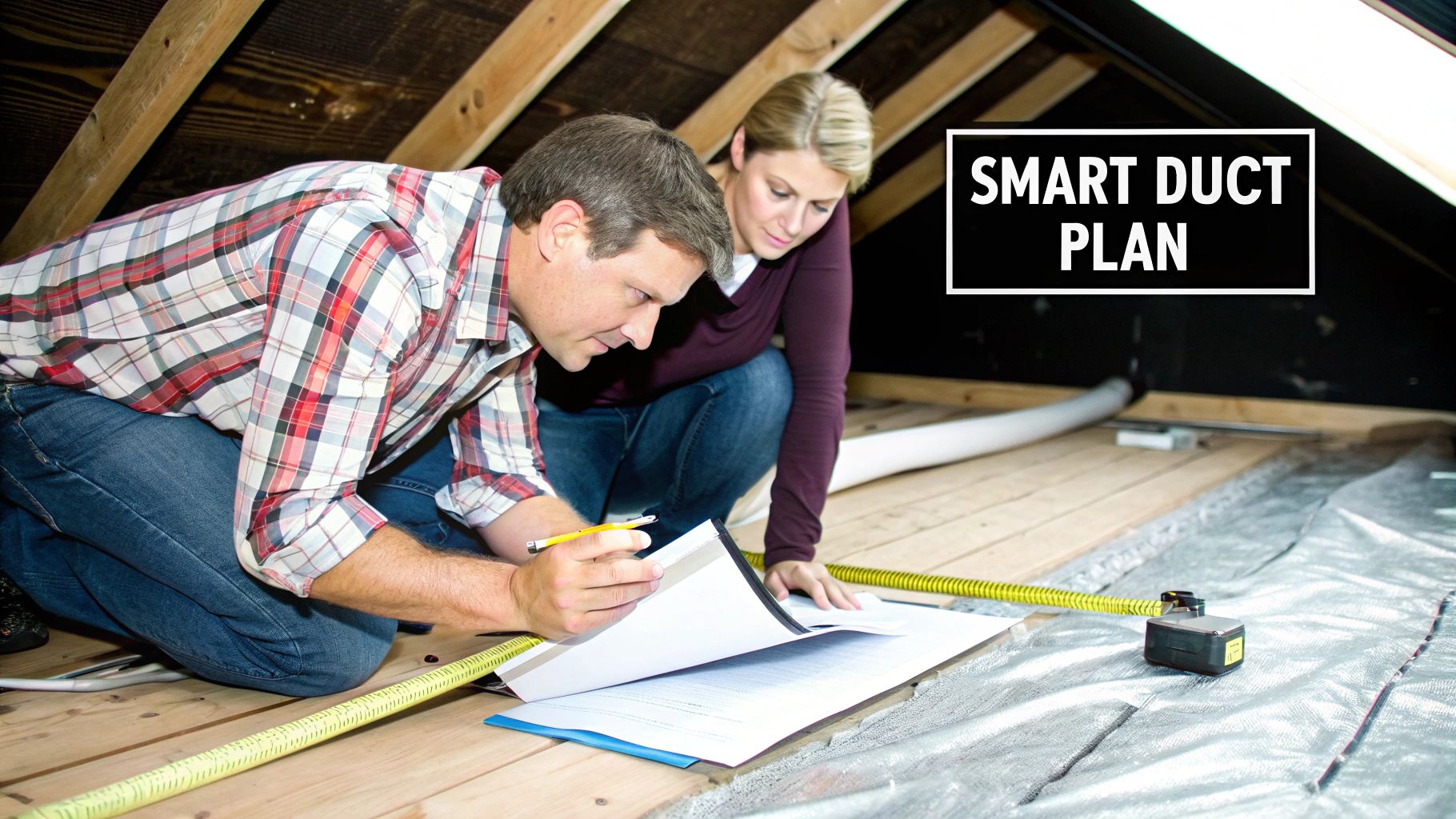
A top-notch ductwork installation is all about smart, meticulous planning. It starts with mapping out the most direct and efficient routes for the ducts to travel through your home. This isn't just about connecting Point A to Point B; it's a strategy to guarantee balanced airflow, stop energy from leaking out, and ultimately keep your utility bills in check.
It's also key to remember that ducts don't work in a vacuum. They're a critical piece of your entire HVAC puzzle, so a solid plan involves understanding and mastering HVAC unit installation as a whole.
New Construction vs. Retrofit Projects
The game plan for ductwork changes completely depending on whether you're building from scratch or working with an existing house.
With new construction, you’ve got a blank canvas. Duct pathways can be designed right into the home's skeleton, tucked away neatly within the framing. This allows for perfect placement and uncompromising airflow from the get-go.
Retrofitting an older home? That's a whole different beast. Here, installers have to be creative problem-solvers, navigating around existing walls, floor joists, plumbing, and wiring. This often means finding clever routes through closets, attics, or crawl spaces, all while causing minimal disruption and keeping the home’s structure sound.
For a retrofit, a professional site inspection isn't just a good idea—it's essential. An expert eye can spot hidden obstacles, check the state of your insulation, and flag structural issues a homeowner would likely miss. This bit of foresight can save you from some seriously expensive headaches later on.
What a Professional Site Inspection Covers
When a qualified technician inspects your home, they’re doing a lot more than just taking measurements. They're piecing together a strategic plan for a successful installation.
A comprehensive inspection will always cover these bases:
- Spotting Obstructions: They’ll hunt for any plumbing lines, electrical wires, or structural beams that could get in the way of the planned duct routes.
- Checking Structural Integrity: This involves making sure the joists and walls can handle the weight and presence of new ductwork without being weakened.
- Evaluating Insulation: The technician will check the R-value and condition of insulation where ducts will run. Skimping here means your conditioned air loses heat (or cool) before it even reaches the vent.
- Mapping out Airflow: They’ll pinpoint the best spots for supply and return vents to ensure every room gets even temperature distribution, eliminating those annoying hot and cold spots.
This upfront planning is truly the foundation of the whole project. Taking the time to understand your home’s unique quirks and tackle potential problems early on is how you build an efficient, long-lasting HVAC system. It also gives you the insight needed to set a realistic budget and timeline, which is a big part of understanding the air ducts system you shouldn’t be ignoring.
Choosing the Right Ductwork Materials and Design
When it comes to your air ducts installation, the materials and layout you choose have a massive impact on your comfort, energy bills, and even your home’s air quality. California homes are all unique, with their own space constraints and climate challenges. That's why picking between flexible ducts, classic sheet metal, or quiet fiberglass-lined systems is one of the most important calls you'll make.
For instance, flexible ducts are a popular, cost-effective choice, running about CA $3–$5 per foot. They're great for snaking through tight attics or awkward crawl spaces. The downside? They can sometimes be a bit noisy and may sag over time, which can mess with airflow if not installed correctly.
Material Options and Tradeoffs
Let's break down the most common ductwork materials you'll see in California homes. Each one has its pros and cons, so it's all about finding the right fit for your specific needs and budget.
Here’s a quick look at how these materials stack up.
Comparing Ductwork Materials and Costs in California
| Material Type | Average Cost per Linear Foot (CA) | Best Use Case | Key Benefit |
|---|---|---|---|
| Flexible | CA $3–$5 | Tight spaces like attics | Easy installation |
| Sheet Metal | CA $8–$12 | Main trunks and long runs | Durability and low leakage |
| Fiberglass-Lined | CA $10–$15 | Noise-sensitive areas | Sound absorption |
Rigid sheet metal is the workhorse of ductwork, built to last for decades, but it comes with a higher price tag of around CA $8–$12 per foot. If noise is a big concern—say, for ducts running near bedrooms or a home office—fiberglass-lined options are fantastic for their sound-dampening properties.
“Choosing the right duct material can boost energy efficiency by 20% and reduce noise in critical zones.”
Ultimately, every material has its place. The trick is to match its performance with your home’s layout.
Layout Designs and Airflow Balance
It’s not just about the material; it’s how you lay it out. The two classic designs are trunk-and-branch and radial. A trunk-and-branch system uses a large central duct (the trunk) to feed smaller ducts (the branches), kind of like a tree. A radial design, on the other hand, runs individual ducts from a central hub directly to each vent.
- Trunk-and-branch is great for ensuring even air distribution along the main lines.
- Radial systems are excellent for minimizing pressure drops, especially in homes with long runs.
- No matter the design, precise sizing is non-negotiable to avoid those annoying hot and cold spots.
Of course, real-world homes often have quirks. Cramped spaces might mean your contractor has to get creative and use a hybrid layout to weave ducts through joists and other obstacles. Always ask your installer how they plan to size and balance each run to guarantee you get the results you're paying for.
Sealing and Insulation Best Practices
Think of unsealed ducts as a leaky bucket. You could be losing up to 30% of your heated or cooled air before it even reaches the vents! That’s why proper sealing is absolutely critical. Mastic sealant is the gold standard for creating truly airtight joints that last.
For a deep dive into sealing techniques, check out our guide on mastic sealant applications for ductwork.
Here are a few pro tips for sealing and insulating:
- Reinforce mastic seals on flexible duct joints with foil tape.
- Always wrap insulated ducts with at least R6 material to stop condensation in its tracks.
- Give your duct joints a quick look once a year to catch any wear or cracks early on.
For homeowners looking to maximize their system's performance, advanced solutions like Aeroseal duct sealing can make a significant difference by sealing the system from the inside out.
Don't forget insulation! Wrapping your ducts helps maintain air temperature and is especially important for preventing mould in California's more humid areas. Talk to your installer about using high-density options in exposed areas like attics or exterior walls.
Matching Materials to Space Constraints
Got a crawl space with very little headroom? Micro-ducts or slim-profile ducts can be a lifesaver. For attic installations, flexible ducts are often the go-to because they can easily bend around trusses and rafters. It’s a conversation worth having with your provider—discussing access points and thinking about future serviceability now will save you headaches later.
One final design tip from the field: make sure your installer includes easy-access panels at key junctures. You’ll thank them later when it comes time for cleaning, repairs, or installing smart home sensors.
When it all comes down to it, a successful air ducts installation is about matching the right materials and design to your home’s unique character.
A local Can Do Duct Cleaning expert can help you customize a ductwork design that delivers peak performance.
A Homeowner's Look Inside the Installation Process
Ever wondered what's actually happening behind your walls and ceilings during a ductwork installation? It's far more than just connecting a few tubes. A professional installation is a meticulous process of building the "lungs" of your home's HVAC system.
The whole thing starts with what we in the business call the "rough-in." This is where the main arteries—the large trunk lines—are installed. These are the superhighways that carry heated or cooled air directly from your furnace or air handler. Following the design plan to the letter, technicians will strategically route these trunks through the skeleton of your home, usually in the basement, attic, or a crawlspace.
This simple diagram shows how a solid plan and the right materials set the stage for a successful hands-on installation.
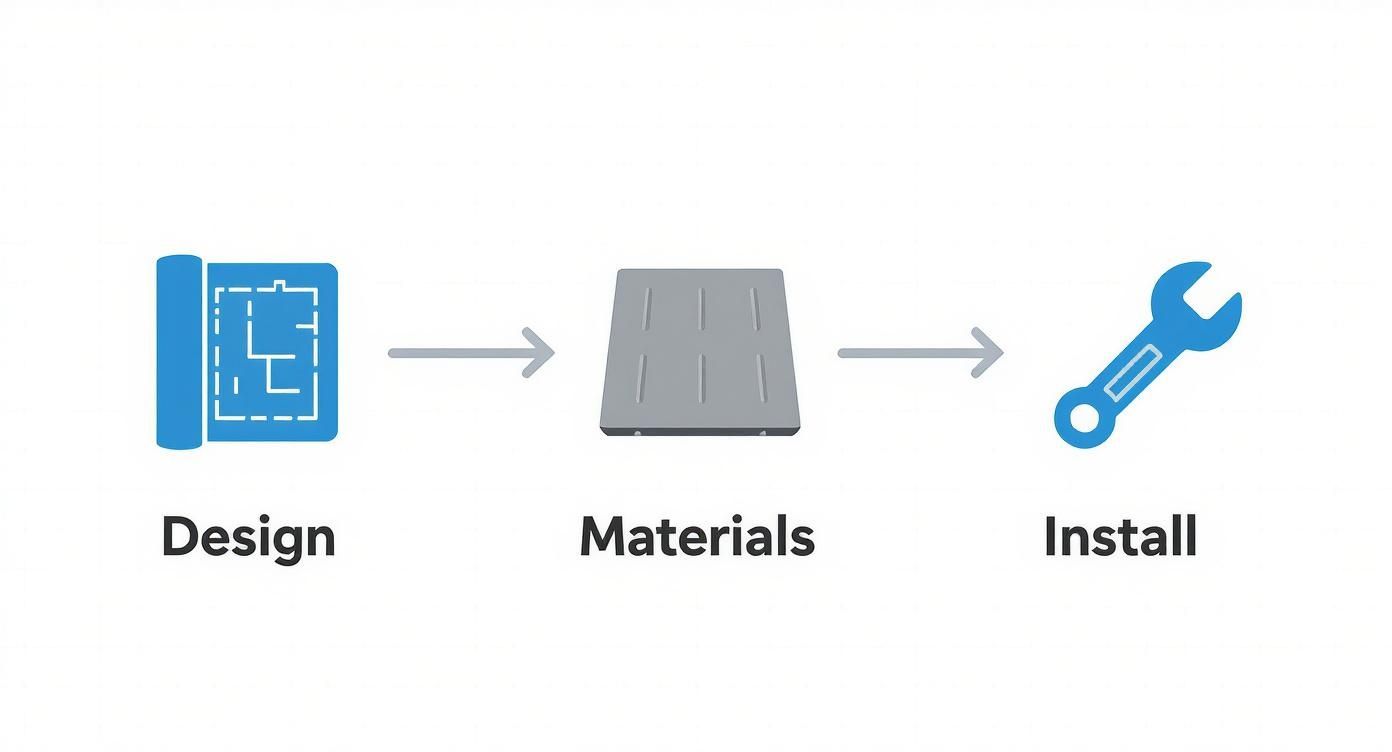
Each step logically follows the one before it, showing you can’t have a great installation without a great design first.
Connecting the Branch Lines
With the main trunk lines securely in place, the crew moves on to running the smaller branch ducts. Think of these as the local roads that deliver air from the main highway right into each room of your house.
Every branch line ends at a "boot," which is the metal fitting that connects the ductwork to the register or vent you see on your floor, wall, or ceiling. Getting this part right is all about precision—the placement has to be perfect to ensure air is delivered efficiently and evenly throughout the space.
The Critical Role of Sealing Every Joint
Here’s what truly separates a top-notch job from a mediocre one. Every single connection—where ducts join together, connect to the furnace, or meet the register boots—needs to be sealed airtight. Even the smallest gaps can cause massive air loss.
Leaky ducts can waste up to 30% of your home's conditioned air, forcing your furnace and A/C to work overtime and inflating your energy bills. This isn't just about doing a tidy job; it's about making your system as efficient as possible.
Pros use a gummy, paint-on substance called mastic sealant to create a permanent, airtight bond at every seam. Sometimes, they'll also use a special high-quality foil tape for extra reinforcement. Skipping this step is a huge red flag, as it means the conditioned air you’re paying for is just leaking into your attic or crawlspace.
Insulation and Final Checks
Once everything is sealed tight, the ductwork gets wrapped in insulation. In Canada, with our dramatic temperature swings, this step is non-negotiable. Good insulation stops your cool air from warming up (and warm air from cooling down) on its journey through the ducts. It’s also your best defence against condensation, which can lead to moisture, mould, and bigger problems down the line.
The final step is connecting the registers and grilles and firing up the system for testing. Installers will go to every vent to check the airflow, making sure it's strong and balanced across the entire house. A well-installed system doesn't just promise comfort; it sets you up for better indoor air quality for years to come. To keep it that way, our guide explains how to clean air ducts and maintain peak performance.
Understanding Costs, Permits, and Timelines in California
Let's talk about the big two: money and time. Getting new air ducts installed is a major home project, and you need a realistic picture of the budget and schedule before you dive in. The final bill can swing pretty wildly based on a few key things, meaning no two jobs are ever quite the same.
The main cost drivers? Your home's size, the type of ducts you pick (like flexible vs. rigid metal), and just how tricky the installation is. A straightforward job in a brand-new build is always going to be cheaper than retrofitting ductwork into an older home with tight crawlspaces and unexpected obstacles.
Breaking Down California Ductwork Costs
California is its own beast when it comes to pricing. Labour costs and high demand mean you'll likely pay more than the national average. Take the Bay Area, for example—it's one of the most expensive places for HVAC work in the country, with costs often running 35% higher than average.
For a typical 1,500 square foot home there, you could be looking at a full ductwork replacement costing anywhere from $4,500 to $7,200. That’s a hefty initial investment, but the EPA points out that properly installed and sealed ducts can cut your heating and cooling bills by 20-30%. You can dig deeper into HVAC ductwork costs in the Bay Area to see a more detailed breakdown.
And remember, that price is just for the installation. Don't forget to budget for future upkeep like professional cleaning. To get a ballpark figure for that, check out our guide on the average cost of duct cleaning.
Navigating Permits and Timelines
In California, you can bet that any new ductwork installation will require a building permit. This isn't just red tape; it's a crucial safety step. The permit triggers an inspection by a city official who makes sure the work meets all local building codes for safety and energy efficiency.
Any reputable, licensed contractor will handle the entire permitting process for you. It's part of their job. They know the local rules, manage the paperwork, and schedule the inspections. If a contractor ever suggests skipping the permit to save a few bucks, that's a massive red flag.
So, how long will your house be a work zone? For an average-sized home, a full ductwork replacement usually takes about 2 to 4 days. That timeline can stretch, though, depending on a few things:
- Project Complexity: Wriggling new ducts through an old, existing structure takes more time.
- Crew Size: A bigger, more experienced team can often get the job done faster.
- Inspection Schedules: The project has to pause and wait for the city inspector's availability.
A good contractor will give you a clear, day-by-day timeline before they start, from tearing out the old ducts (if needed) to the final system check. That kind of transparency is what makes for a smooth, stress-free project.
Finding and Vetting a Qualified HVAC Contractor

Let's be blunt: your choice of contractor is the single most important decision you'll make for a successful air ducts installation. An experienced pro will design a system that keeps your home comfortable and your bills low. A bad one can leave you with leaky ducts, terrible airflow, and a decade of headaches.
Hiring the right person isn't just a purchase—it's an investment in your home.
So, where do you start? Kick things off the old-fashioned way by asking for recommendations from neighbours, friends, or local online community groups. A referral from someone you trust is gold because it’s based on a real experience. After that, head online to sites like the Better Business Bureau (BBB) or HomeAdvisor to build a shortlist of potential pros.
Verifying Credentials in California
Before you even pick up the phone for a quote, it’s time to do some digging. In California, any HVAC project valued at $500 or more requires the contractor to have a valid C-20 license for Warm-Air Heating, Ventilating and Air-Conditioning. You can—and absolutely should—check their license status directly on the Contractors State License Board (CSLB) website.
Beyond licensing, any contractor worth their salt will carry two crucial types of insurance. Don't be shy about asking for proof.
- General Liability Insurance: This is your safety net. It protects your property from any accidental damage that might happen during the job.
- Workers' Compensation Insurance: This protects you. If one of their team members gets hurt on your property, this insurance covers them, meaning you aren't held liable.
A true professional will have these documents ready and will gladly show you. If they hesitate, that's a major red flag.
A contractor's deep understanding of local California building codes is non-negotiable. These regulations exist to keep your system safe and efficient. An installer with solid local experience will handle the permit process seamlessly and ensure the final work passes inspection without any drama.
Essential Questions to Ask Potential Contractors
Once you’ve narrowed your list down to a few licensed and insured candidates, the interview process begins. This is your chance to see who really knows their stuff and who's just giving you a sales pitch.
Go into the conversation prepared. Ask them how they approach system design—what’s their process for sizing ducts and planning the layout to ensure the best airflow? Ask why they recommend certain materials for your specific home. You’ll also want a clear breakdown of the project timeline and a detailed explanation of their warranty on both parts and labour. Their answers will tell you everything you need to know about their expertise.
Unfortunately, the industry has its share of shady operators. It’s a good idea to know what you’re up against. Getting familiar with the warning signs of common duct cleaning scams can help you weed out dishonest contractors before they even step foot in your home.
Understanding Contractor Costs and Red Flags
Quality work isn't cheap, especially in California's market. On average, you can expect an hourly rate for a duct installer to be around $26.36, but that can easily climb to over $31 an hour in places like the Bay Area. Knowing the typical labour costs helps you gauge whether a quote is fair or too good to be true. You can find more details in the regional wage data for duct installers in California.
Be skeptical of any quote that's drastically lower than the others. A rock-bottom price often means they're cutting corners, using cheap materials, or are simply inexperienced.
Finally, trust your gut. Avoid any contractor who uses high-pressure sales tactics like "limited-time offers" or demands a huge cash deposit upfront. A reputable pro will give you a detailed, written estimate and all the time you need to make the right decision.
Common Questions About Installing New Ductwork
It’s completely normal to have a few questions before diving into a project like installing or replacing your home’s ductwork. After all, it's a big job. Getting clear answers upfront helps you know exactly what to expect, so let’s get into some of the most common things homeowners ask.
How Long Does an Installation Take?
This is usually the first question on everyone's mind: how long will my house be a construction zone? For a typical single-family home, a full ductwork replacement usually takes somewhere between 2 to 4 days.
If it's a new build, the process can be faster since the walls are open. But if you’re retrofitting an older home with tight crawl spaces or tricky layouts, it could take a bit longer to get everything just right.
Signs Your Old Ducts Need Replacing
Wondering if it's even time for an overhaul? Your house will usually give you some pretty clear hints when your ductwork is on its last legs.
Keep an eye out for these tell-tale signs:
- Hot and Cold Spots: Some rooms are freezing while others feel stuffy and warm, no matter what you do with the thermostat.
- Skyrocketing Energy Bills: If your heating and cooling costs suddenly jump without a clear reason, leaky ducts are a likely culprit.
- Weird Noises: Your vents shouldn't be making rattling, banging, or whistling sounds. That's a sign something is loose or damaged.
- Visible Damage: You can often spot the problem yourself. Look for obvious tears, kinks, mould, or rust on the ducts in your attic or basement.
The bottom line is that old, leaky ducts don't just make you uncomfortable—they're actively costing you money every month. A new, well-sealed system is an investment that pays off in both comfort and lower energy bills.
How Often Should New Ducts Be Cleaned?
Once your new system is in place, you can pretty much forget about it for a while. The standard advice is to get your air ducts inspected and professionally cleaned every 3 to 5 years.
That said, you might want to do it more often if you have pets that shed, smokers in the house, or family members with bad allergies or asthma.
Keeping your ducts clean is becoming a bigger deal as more attention is paid to indoor air quality. In fact, there's a growing trend across the country for better home ventilation. The market for high-quality ventilation equipment in the Western USA is projected to expand at a rate of 7.5% each year through 2035. This just shows how important healthy indoor air is becoming for homeowners. You can read more about these market trends in ventilation equipment to see where things are headed. A professionally installed system is your first and best step.
Ready to ensure your home has a perfectly designed and installed ductwork system? The experts at Can Do Duct Cleaning have over 30 years of experience creating comfortable, energy-efficient homes. Contact us today for a thorough on-site inspection at https://www.candoductcleaning.com.

