
When most homeowners think about cleaning their air ducts, they picture wiping down a dusty vent cover. But a proper clean goes much deeper, targeting the buildup of dust, allergens, and grime throughout your entire HVAC system. For a DIY approach, it often involves shutting down the system and using a powerful vacuum with a brush to tackle the registers and any accessible ductwork. The whole point is to boost your indoor air quality and give your furnace and air conditioner a chance to run more efficiently.
Why Cleaning Your Air Ducts Matters In Canada
It’s a classic case of "out of sight, out of mind." The network of ducts hidden in your walls and ceilings is easy to ignore, but it has a massive impact on your home’s health and your family's comfort. For those of us living in Canada, our dramatic seasons pose a unique challenge to HVAC systems.
First, you have our humid summers, which can create the perfect cool, dark environment inside your ductwork for mould and mildew to take hold. Then, our long, dry winters kick in, and the furnace works nonstop, circulating air—and every little particle in it—all through your home.
The Unseen Buildup In Your Vents
Over the years, your air ducts can become a collection point for a shocking amount of gunk. We're not talking about a light dusting; it's a cocktail of contaminants that can seriously affect your home and family.
Here are some of the usual suspects we find inside Canadian ductwork:
- Dust and Dust Mites: The main ingredient in household dust, and a major trigger for anyone with allergies or asthma.
- Pet Dander and Hair: If you have pets, their dander gets pulled into the system and recirculated over and over again.
- Pollen and Outdoor Allergens: These sneak in through open doors and windows and eventually find a home in your ducts.
- Mould and Mildew Spores: Any moisture from humidifiers or A/C units can lead to microbial growth if things aren't perfectly maintained.
This mess doesn't just stay put. Every time your furnace or air conditioner turns on, it blasts these particles right back into the air you’re breathing. This can make allergy symptoms worse and impact everyone's respiratory health. Looking into different methods for improving indoor air quality can give you a more complete game plan for a healthier home.
More Than Just Air Quality
The trouble with dirty ducts goes beyond what you’re breathing in. When your ductwork is choked with debris, it makes your HVAC system struggle to push air through. That extra strain means higher energy use, which shows up on your monthly utility bills.
Think of it like a clogged artery for your home. When airflow is restricted, your furnace and AC have to run longer and harder to keep you comfortable. That not only lowers their efficiency but can shorten their lifespan, too.
In the Greater Toronto Area alone, the scale of this is huge. A typical air duct cleaning for an average-sized home will pull out between 2.2 and 2.7 kilograms of dust and debris. That's a figure you'll hear from experienced companies across the GTA—it’s a powerful visual of just how much can accumulate unseen.
At the end of the day, understanding the real air duct cleaning benefits makes it clear why this is a vital part of home maintenance in Canada, not just an optional extra. It’s about protecting your family’s health, making your home more efficient, and ensuring your space is as clean and comfortable as it can be.
Assembling Your Duct Cleaning Toolkit
We've all been there—starting a DIY project only to realize halfway through that you don't have the right gear. It turns a productive afternoon into a frustrating mess, and when it comes to your home's ductwork, it can even lead to damage. Having the proper tools isn’t just about making the job easier; it’s about doing it safely and actually getting results.
This isn't a job for your standard household vacuum and a duster. You're dealing with a complex system hidden behind your walls, one that directly impacts the air you breathe every day.
Core Cleaning Tools
The workhorse of your DIY setup will be a powerful vacuum. Your regular vacuum, even a high-end one, just doesn't have the suction or the reach to pull gunk out from deep inside your ductwork. You'll need a heavy-duty shop vac to even stand a chance.
Next up are the brushes. You can't just use any old scrub brush; you need a set specifically designed for ducts. These kits usually come with long, flexible rods that can navigate the twists and turns of your ventilation system, plus different brush heads to fit various duct sizes.
- Powerful Vacuum: Grab a shop vac with at least 5 peak horsepower. Anything less won't create enough suction to be effective.
- Duct Cleaning Brush Kit: Look for a kit that lets you connect flexible rods to extend your reach. You'll want a mix of stiff and soft bristles for different types of debris.
- Long Hose Attachments: Make sure your vacuum hose is long and narrow enough to get past the register opening and into the main duct line.
Essential Hand Tools and Supplies
Beyond the main equipment, a few basic hand tools are absolutely necessary. You’ll be removing every single supply and return air register cover, and you never know what kind of screws the last person used.
A multi-bit screwdriver or a power drill with a good set of bits will save you a ton of hassle and prevent stripped screws. You’ll also need a way to seal off the vents you aren't currently working on. This is crucial for maintaining vacuum pressure. Simple painter's tape and old towels or cardboard will do the trick.
Don’t forget one of the most important items: a new furnace filter. The very last thing you should do after cleaning is pop in a fresh, high-quality filter. For most Canadian homes, a filter with a MERV rating between 8 and 11 offers the best balance of solid filtration and good airflow.
Safety Gear You Cannot Skip
Now for the most important part: protecting yourself. You’re about to stir up years of accumulated dust, pet dander, allergens, and maybe even mould spores. Breathing that stuff in is a serious health risk.
- Dust Mask or Respirator: An N95-rated mask is the minimum you should be wearing to protect your lungs.
- Safety Goggles: Fine dust gets everywhere, and you do not want it in your eyes.
- Gloves: A decent pair of work gloves will save your hands from sharp metal edges and screws inside the vents.
It's important to be realistic about what you can achieve with DIY tools versus what the professionals use. There's a significant gap in technology and power. For a closer look at the high-tech gear the pros rely on, you can learn more about specialized duct cleaning equipment and understand why it delivers such a deep clean.
Here’s a quick comparison to put things in perspective.
DIY vs Professional Duct Cleaning Tools
| Tool | DIY Homeowner Version | Professional Equipment | Effectiveness Note |
|---|---|---|---|
| Suction Power | High-powered shop vacuum | Truck-mounted vacuum system | A professional system is exponentially more powerful, pulling debris from the entire system at once. |
| Agitation Tool | Hand-operated flexible brushes | High-pressure air whips & rotating brushes | Air whips and power brushes dislodge stubborn, caked-on debris that manual brushing often misses. |
| Inspection | Phone camera or torch | Specialized snake cameras | Pros can see deep into the ducts to confirm all contaminants are removed, which is impossible with a torch. |
| Containment | Sealing registers with tape/towels | Zone bags and negative air pressure machines | Professional containment ensures no dust or debris escapes back into your home during the cleaning process. |
While a DIY approach can remove some of the surface-level dust, it just can't match the thorough, system-wide cleaning that professional-grade equipment provides.
A Realistic Walkthrough Of The Cleaning Process
Alright, you’ve got your gear assembled, and now it’s time to get your hands dirty. Let me be clear: a good DIY duct cleaning is all about being patient and methodical. Rushing through this will just make a mess and won't get you the results you want. Let's walk through it, focusing on doing this safely and effectively.
Before you even think about touching a vent, your number one priority is to kill the power to your entire HVAC system. I don't just mean turning off the thermostat. You need to go to your electrical panel and flip the breaker for your furnace or air handler. This is a non-negotiable safety step. It ensures the system can’t suddenly turn on while your hands are in there, which would be both dangerous and a fantastic way to blast dust all over your house.
Once the power is confirmed off, it's time to prep the house. The whole idea here is to create a one-way street for all that dust, directing it straight into your shop vac. To do that, you'll need to block off every single supply register in your home, leaving only the one you're working on open. You don't need anything fancy—paper towels or pieces of cardboard cut to size, held in place with painter's tape, will do the trick.
Beginning The Cleaning Sequence
Your first stop is the furnace's blower compartment. This is the heart of your HVAC system, and if you ignore it, you’ll just blow dust right back into your freshly cleaned ducts. Pop it open and give the fan blades and the compartment a thorough cleaning with a soft brush and your vacuum.
With the main unit handled, you can now start on the ducts themselves. The strategy is simple but crucial: start at the register furthest from the furnace and work your way back towards it. This ensures you're always pulling debris towards the main unit, not accidentally pushing it deeper into another part of the system.
This visual guide breaks down the essential gear you'll need to get the job started right.
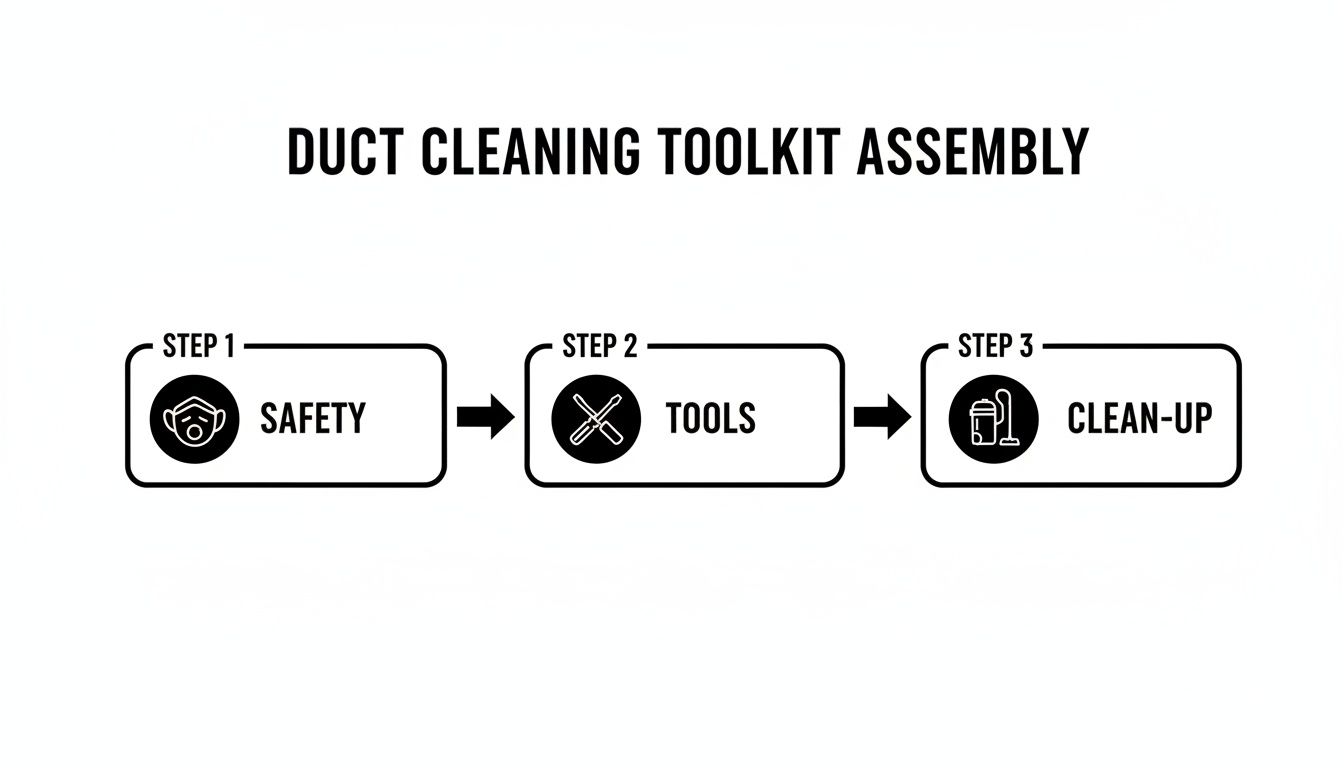
As you can see, it all flows from safety prep to the tools for the job and finally to the cleanup equipment that contains the mess.
Techniques For Supply And Return Vents
Okay, now for the vents. Unscrew the register covers one at a time and give them a good wash with soap and water. Set them aside to dry while you work on the ductwork itself.
With the register open, feed your vacuum hose as deep as you can get it. Turn on the vacuum. Now, take your flexible brush and start scrubbing the inside walls of the duct. It’s this two-part attack—the brush dislodging the gunk and the vacuum immediately sucking it away—that really gets the ducts clean.
Pro Tip: Before you start scrubbing, use your phone’s camera. Shine a torch down the vent and snap a quick "before" photo. It gives you a great visual baseline, so you can see for yourself how much progress you've made and spot any areas you might have missed.
You’ll hear dust and debris rattling up the hose as you work. Keep at it until the rattling stops. Once a vent is done, pull your tools out, seal it up with your cardboard and tape, and move on to the next one. This systematic approach is the only way to do it right. You can find more easy home maintenance tips that explain how to clean air ducts in more detail.
Managing The Mess And Staying Safe
Let’s be honest—this is a dusty job. No matter how well you seal the vents, some fine particles will escape. Keep your N95 mask and safety goggles on at all times.
A good rule of thumb is to clean the supply ducts (the ones that blow air out) first. Then, tackle the larger return air ducts (the ones that suck air in). The return side is usually the dirtiest since it’s where all the household dust enters the system. Use the exact same brush-and-vacuum method here.
The desire for cleaner indoor air isn't just a trend; it's a necessity, especially in places like the GTA. Consider this: demand for air duct cleaning has exploded in the Greater Toronto Area since 2005. It has grown from a niche $5 billion global industry into a local essential, with over 100 companies in Ontario serving homes and businesses. For a typical home up to 185 square metres, a professional clean from a reputable company can cost between $400 and $600.
Final Steps And System Restart
Once you’ve worked your way through every single supply and return vent, you’re on the home stretch. Head back to the furnace for the most critical final step: installing a brand-new, high-quality furnace filter. If you skip this, you’ll undo all your hard work the second you turn the system back on.
With the new filter locked in place, go around and remove all your temporary seals and screw the clean, dry register covers back on. Now you can finally head back to the electrical panel and flip the breaker on.
Turn the fan on at your thermostat (not the heat or AC) and let it run for 10-15 minutes. This will push out any last bits of loose dust. A final vacuum around each register is the perfect finishing touch. Remember, good preparation is half the battle; check out our guide on preparing the house for duct cleaning service for more tips to make the job go smoothly.
Knowing When To Call In A Professional
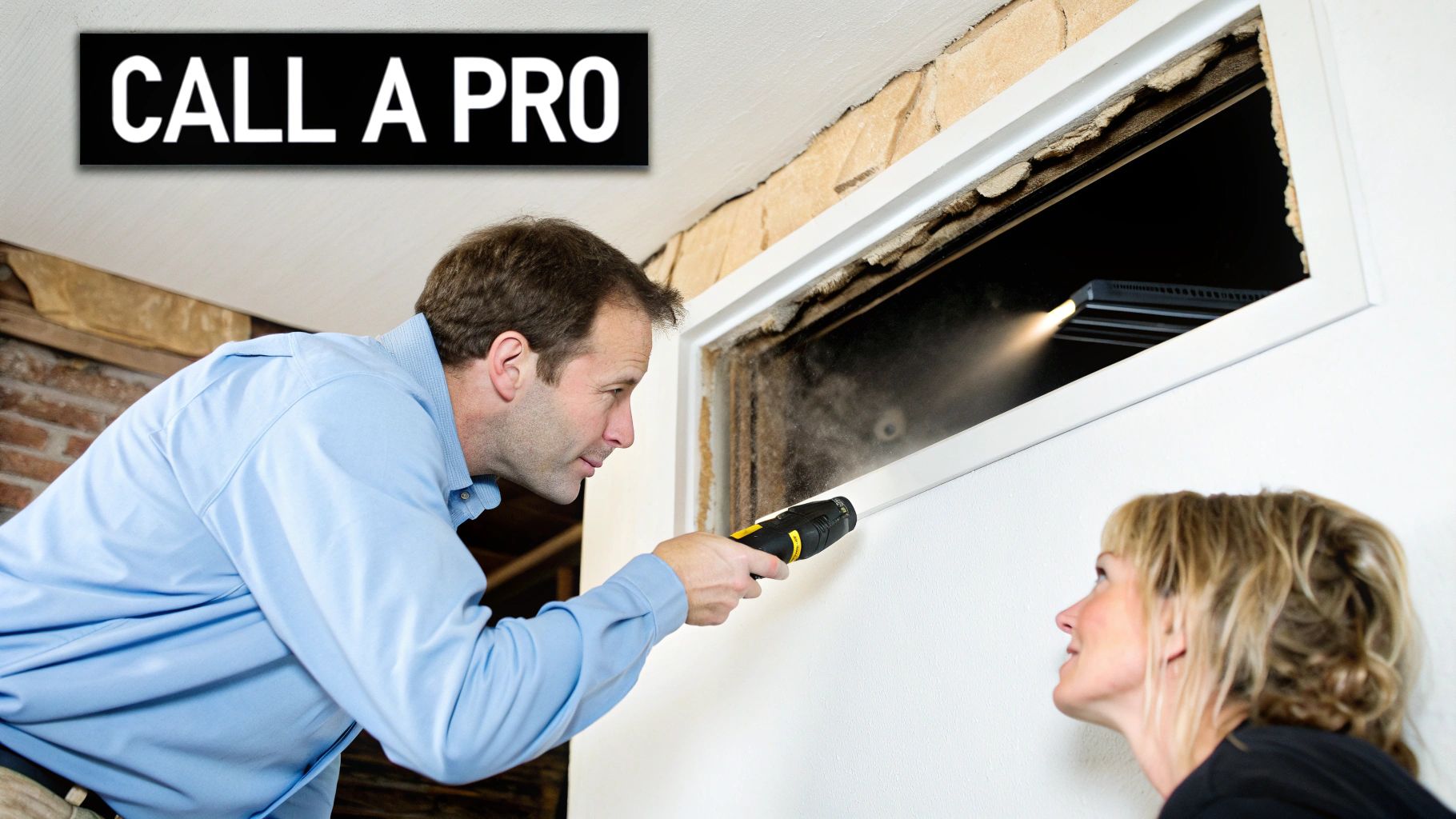
The DIY spirit is great, but every home project has its limits. Knowing when to put down the tools and pick up the phone is the mark of a smart homeowner, especially when it comes to your home's HVAC system. A good DIY clean can absolutely tackle surface-level dust, but some situations are just out of scope for a shop vac and a brush kit.
Recognizing these red flags is about more than just cleanliness; it's about protecting your home and your family's health. It’s understanding when you need a deeper, more powerful solution to actually solve the problem, not just mask the symptoms.
Post-Renovation Dust And Debris
Just wrapped up a big home reno? If so, your ductwork has probably inhaled a ton of construction debris. We're talking about drywall dust, sawdust, and insulation fibres—all notoriously fine and invasive materials that settle deep within your system.
This isn't your average household dust. It's heavy, abrasive, and can seriously clog your HVAC components, tanking your system's efficiency and your air quality. Your standard shop vac just doesn't have the muscle to pull this dense gunk out from the entire length of your ductwork, leaving the worst of it behind.
Suspected Mould Growth
One of the biggest red flags you can encounter is the possibility of mould. If you're smelling a musty, earthy odour coming from your vents, or if you can see black or greenish growth around the registers, it's time to stop everything.
Don't try to clean mould yourself. Disturbing the colonies with a brush or a regular vacuum can blast millions of spores into your home's air, turning a contained issue into a house-wide disaster.
Professional mould remediation is a different ball game entirely. It requires proper containment, specialized chemical treatments, and specific protocols to safely kill and remove the growth without cross-contaminating your home.
Persistent Odours And Allergies
Sometimes, the signs are less obvious but just as frustrating. You’ve already done a thorough DIY clean, but that stale, lingering smell just won't quit. Or maybe your family’s allergies and asthma symptoms haven't improved one bit.
These are telltale signs that the real problem is hiding deeper in the system than you can reach. Professionals use high-powered, truck-mounted vacuums that create massive negative pressure, yanking contaminants out from every last nook and cranny. That's a level of suction a DIY setup simply can't touch.
If this sounds like your situation, it’s a good idea to look into hiring a reputable air duct cleaning company that can get the job done right.
Complex Or Older Ductwork
Not all duct systems are straightforward. Older homes often have more complex, fragile, or partially inaccessible ductwork. The materials can be brittle, and it's surprisingly easy to accidentally puncture or damage them with DIY tools, leading to expensive repairs.
Likewise, even some newer homes have tricky layouts that are tough to navigate without specialized gear. The pros use tools like snake cameras to inspect the system first, spotting potential issues and ensuring they can do a safe and complete cleaning.
Here in the Greater Toronto Area, our local climate and housing stock create unique conditions inside our homes. That's why experts across the GTA unanimously recommend professional air duct cleaning every 2-3 years for the best indoor air quality. This guideline, which lines up with NADCA standards tailored for Ontario, is even more important for homes with recent renovations, pets, or family members with allergies. In these cases, calling a pro isn't just a convenience—it’s a crucial step in maintaining a healthy home.
Keeping Your Ducts Cleaner For Longer
Getting your air ducts deep-cleaned is a massive win for your home’s air quality. But how do you keep them that way? The real goal isn't just to clean them, but to keep that fresh, clean feeling going for as long as possible.
A little proactive maintenance goes a long way. It can dramatically slow down how quickly dust and contaminants build up, which means your next professional cleaning will be more effective and your air will stay healthier all year. This isn't about doing a full clean every few months—it's about building simple, consistent habits that really pay off.
Your Monthly Maintenance Checklist
Think of this as a quick health check for your HVAC system. These little tasks only take a few minutes each month, but they are your first line of defence, trapping dust and debris before it has a chance to settle in your ductwork.
- Change Your Furnace Filter: Honestly, this is the single most important thing you can do. A clogged filter can't do its job, forcing your whole system to work harder. Get in the habit of replacing it every 30-90 days. If you have pets or live with someone who has allergies, you'll want to stick closer to the 30-day mark.
- Wipe Down Vent Covers: Grab a damp cloth and give your supply and return air registers a quick wipe. It’s a simple thing, but it stops that loose dust sitting on the grilles from getting sucked right back into the system the next time the fan kicks on.
- Inspect Your Dryer Vent: Take a peek at the exterior dryer vent cap. Make sure it's clear of lint and other obstructions. A blocked dryer vent is more than just an efficiency problem for your appliance; it can also mess with the air pressure throughout your home.
A clean furnace filter is basically the gatekeeper for your entire HVAC system. A study from the American Society of Heating, Refrigerating and Air-Conditioning Engineers (ASHRAE) even found that just by replacing the filter regularly, you can significantly slash the amount of particulate matter circulating through your home's ductwork.
Seasonal Checks For Canadian Climates
Here in Canada, our HVAC systems go through a lot as the seasons change. A couple of quick checks as we switch from heating to cooling (and back again) can help you catch small issues before they snowball into big, expensive problems.
For example, when spring finally arrives, take a walk outside and clear away any leaves, branches, or debris that have piled up around your air conditioning unit over the winter. Your AC needs to breathe, and proper airflow is key to its efficiency.
Likewise, before the winter cold sets in, do a quick tour of your house. Make sure all your heating registers are open and not blocked by furniture or rugs. This ensures heat gets distributed evenly, helping your furnace run more efficiently and saving you a few dollars on those heating bills. For a deeper dive, our article offers a complete overview of how to maintain your air duct systems year-round.
Annual And Long-Term Habits
Finally, a few long-term habits can make a huge difference in the air you breathe.
Try to keep the area around your indoor furnace or air handler clean and uncluttered. It's tempting to use that space for storage, but clutter can restrict airflow and just creates a dusty environment right at the source of your home's circulation.
It's also a smart idea to schedule a professional inspection every few years, even if you don't think you need a full cleaning. An expert can spot things you might miss, like minor leaks or blockages, ensuring your system stays in top shape for years to come.
Common Air Duct Cleaning Questions Answered
Even with a solid plan, it’s completely normal to have some questions before diving into your home's ductwork. Getting your facts straight is key to making a smart decision for your HVAC system. Let's tackle some of the most common questions we hear from homeowners across Canada.
How Often Should I Clean My Air Ducts In A Canadian Home
A good rule of thumb for most Canadian homes is to schedule a professional cleaning every 3 to 5 years. This is typically enough to keep the usual accumulation of dust and allergens in check.
That said, you'll want to think about cleaning them more often—say, every 2 to 3 years—if your situation calls for it. Do you have pets who leave fur everywhere? Do family members struggle with serious allergies or asthma? Did you just finish a big reno? Construction dust is incredibly fine and can gum up your system fast, spreading grit through every room.
Can I Accidentally Damage My HVAC System
Absolutely. While wiping down your vents and registers is a safe and easy DIY job, you can run into real trouble when you try to go deeper without the right tools and know-how.
Shoving a standard vacuum hose or a flimsy brush too far into your ductwork is asking for problems.
- You could easily puncture the flexible duct lines common in many attics and basements.
- It's surprisingly easy to knock sensitive components like dampers or sensors out of alignment.
- Worst-case scenario? You dislodge a massive chunk of debris only to have it create a total blockage further down the line, killing your airflow.
Professional gear is built to snake through the complex layout of a residential HVAC system without causing damage. Honestly, this is one of the biggest reasons to call an expert for a full system clean—it’s just the safer bet.
Is Air Duct Cleaning Really Worth The Money
For most people, the answer is a definite yes. The investment pays dividends in both comfort and cost savings. The first thing our customers usually notice is how much less they have to dust. But more importantly, they feel an improvement in their home's air quality, which is a game-changer for anyone with respiratory issues.
There's also a financial upside. Clean ducts allow air to flow freely, so your furnace and AC don't have to work overtime just to keep you comfortable. That translates to lower energy bills and less wear and tear on your very expensive equipment over the long run.
What's The Deal With Those Cheap Duct Cleaning Specials
You know the ones—the flyers offering a whole-home cleaning for a price that seems too good to be true. It usually is. Be very skeptical of these "blow-and-go" outfits.
They often show up with portable equipment that simply lacks the power to pull debris from your entire system. They'll clean the first few feet of your vents—the only parts you can see—and call it a day, leaving the main trunk lines untouched. These deals are often just a foot in the door to hard-sell you on services that should have been included from the start.
A legitimate company will give you a clear, detailed quote, use a powerful truck-mounted vacuum system, and gladly show you before-and-after photos as proof of their work. In most major Canadian cities, you should expect to pay several hundred dollars for a proper, thorough job.
For a truly deep and safe clean that protects your investment and improves your family’s health, trust the experienced technicians at Can Do Duct Cleaning. We use professional-grade equipment to ensure every corner of your HVAC system is spotless. Learn more about our services at https://www.candoductcleaning.com.

