
Your air conditioner is only half of the story. The other half is the hidden network of pathways that carries cool air all through your home—the ducts for air conditioner systems.
Think of it like this: if your AC unit is the heart, the ductwork is the circulatory system. It’s the critical connection between the machine that makes the cold air and the rooms where you actually feel it. Without well-designed and properly maintained ducts, even the strongest, most expensive air conditioner will fall flat.
The Unseen Network Powering Your Home Comfort
Imagine the branching network of tubes tucked away in your ceilings, walls, and floors. These are the arteries that carry cooled air from your AC to every single room. For most of us here in the Greater Toronto Area, this system is completely out of sight, which means it’s usually out of mind, too.
But this unseen network has a huge impact on your comfort, the quality of the air you breathe, and how much you pay on your summer hydro bills. When something goes wrong with the ducts, you’ll feel the effects all over the house, even if the problem seems small.
Why Healthy Ductwork Matters
It’s easy to blame the air conditioner when things get stuffy or expensive, but more often than not, the real culprit is the ductwork. Leaky, dirty, or poorly installed ducts can quietly sabotage your home's comfort and efficiency.
Here’s why paying attention to your ducts is a smart move:
- Energy Efficiency: When ducts have leaks, cracks, or disconnected joints, all that precious cool air escapes into your attic or crawlspace instead of your living room. Your AC has to work overtime just to keep up, which means higher hydro bills.
- Consistent Comfort: Are some rooms freezing while others feel like a sauna? That's a classic sign of bad ductwork. Inefficient airflow is one of the biggest reasons for those annoying hot and cold spots, a common frustration during our humid Toronto summers.
- Indoor Air Quality: Leaks don’t just let air out; they also pull junk in. Return ducts with gaps can suck up dust, pollen, and insulation fibres from your walls and attic, spreading them throughout your home every time the system kicks on.
"A home's duct system is the pathway for all the air that you breathe. The integrity of that system directly impacts both your energy bills and your family's health."
The numbers on this are pretty startling. Here in the GTA, neglected ducts can slash your system’s efficiency by up to 40%. They can also leak as much as 30% of the cooled air before it even gets to you. It's a massive waste of energy and money, hitting households that can least afford it the hardest. The Canadian Climate Institute has some great insights on Canada's broader heating and cooling challenges.
Getting a handle on the basics is the first step to a more comfortable and efficient home. For a deeper look into the specifics, check out our detailed guide on professional ductwork services.
Decoding the Different Types of AC Ductwork
Not all ductwork is created equal. The type running through the walls and ceilings of your home has a massive impact on your air conditioner's performance and your hydro bills. Knowing what kind of ducts for your air conditioner you have helps you understand their unique strengths and where they might fall short.
For most homeowners across the GTA—from older Scarborough bungalows to modern Ajax townhouses—the ductwork is usually one of three main types. Think of them like different roads for a journey: some are straight, high-speed highways, while others are winding local routes designed to get around tricky spots.
Rigid Ducts: The Gold Standard
Consider rigid ducts the 401 of your home's HVAC system. They are the main arteries, built for moving large volumes of air quickly and efficiently.
Typically made from galvanized steel or aluminum, these ducts have a smooth, solid interior that lets air flow with almost no resistance. Their sturdiness makes them the go-to choice for the primary "trunk lines" of any duct system—the large channels you often see running through basements, utility closets, and garages. Because they are so tough and less prone to damage, they can last for decades with proper care.
Their efficiency and long lifespan are why we call them the gold standard. Rigid ducts ensure the maximum amount of cool air gets where it needs to go without losing pressure or energy along the way.
But no matter the type, when ducts have problems, the consequences ripple through your home.
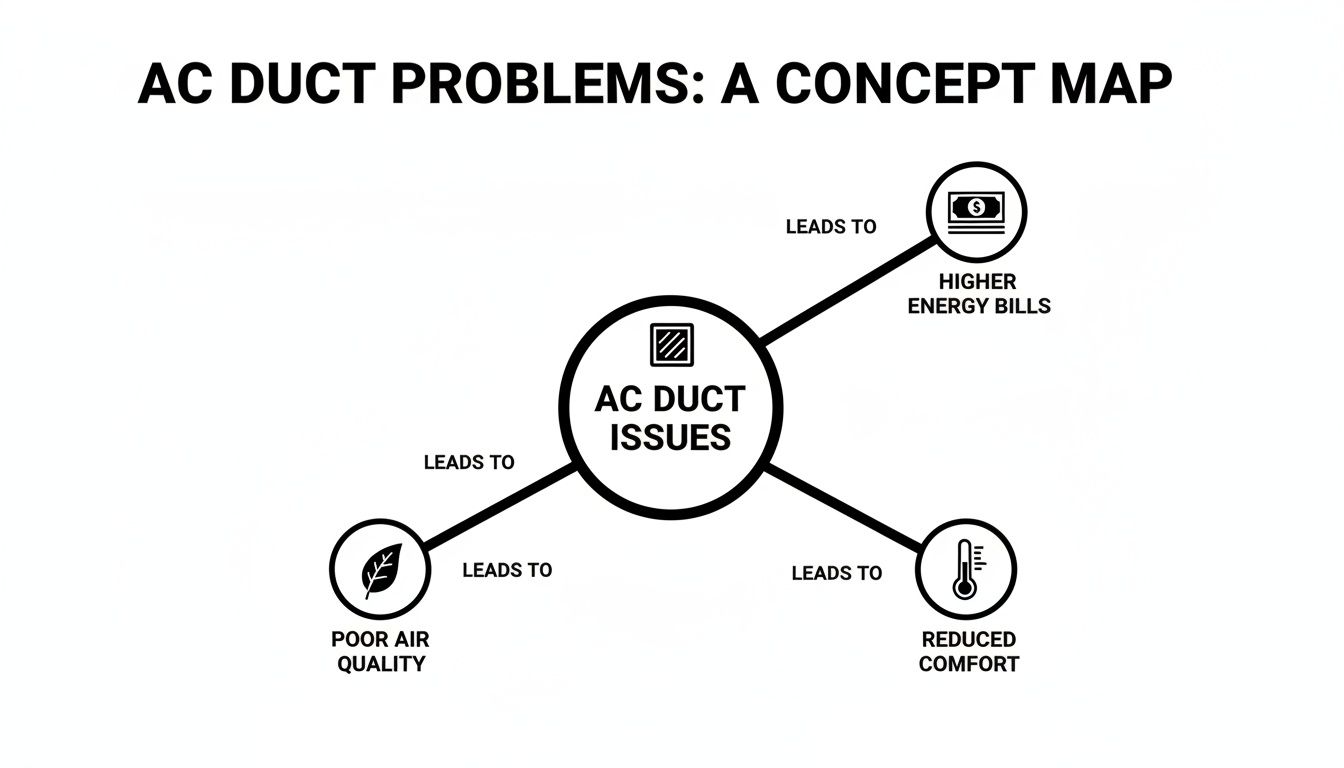
As you can see, issues inside your ductwork directly branch out to hit your wallet, your comfort, and your family's well-being.
Flexible Ducts: Navigating Tight Spaces
If rigid ducts are the highways, flexible ducts are the winding side streets. Often called "flex ducts," they're made from a wire coil covered in a pliable plastic and wrapped in insulation. Their whole purpose is to bend, snake, and squeeze around obstacles where a rigid duct just won't fit.
Their biggest advantage is versatility. You'll find flex ducts connecting the main trunk lines to individual room vents, especially in homes with complex framing or very little space to work with.
But that flexibility comes at a price. The ribbed interior of a flex duct creates more friction than a smooth metal one, which can slow down airflow. They're also much more likely to get kinked, torn, or sag over time if they aren’t installed perfectly, which can choke off the air to a room completely.
Proper installation is everything here. Support straps have to be placed just right to prevent sagging, and any bends need to be gentle and sweeping to avoid creating bottlenecks that make your air conditioner work overtime.
Fibreglass Duct Board: A Hybrid Solution
Fibreglass duct board is a clever two-in-one product, acting as both the duct and its own insulation. It's made of rigid panels of compressed fibreglass, often with a foil vapour barrier on the outside, which are cut and pieced together to form airtight channels.
This material is a popular choice for its excellent insulating properties and its ability to absorb sound, leading to a much quieter HVAC system. It’s also lighter than sheet metal, which can make installation a bit easier in certain scenarios.
The trade-off is durability. Fibreglass duct board is not nearly as tough as its metal cousins. It's particularly vulnerable to moisture damage from a leak, which can quickly lead to mould growth and cause the material to break down. Regular inspections are crucial to make sure it stays in good shape.
Knowing the differences between these materials helps you spot potential issues before they become big problems. Here’s a quick breakdown to help you compare.
Comparing Common AC Duct Materials in GTA Homes
This table offers a side-by-side look at the most common ductwork materials found in homes around the Greater Toronto Area, focusing on what matters most to homeowners.
| Duct Material | Average Lifespan | Pros | Cons | Best For |
|---|---|---|---|---|
| Galvanized Steel/Aluminum (Rigid) | 20-25+ years | Extremely durable, smooth interior for maximum airflow, low risk of damage. | Higher initial cost, requires more space for installation. | Main trunk lines and straight runs in basements, attics, and utility closets. |
| Flexible Ducts (Flex) | 10-15 years | Highly versatile, can fit into tight or awkward spaces, lower installation cost. | Prone to kinks, tears, and sagging; reduced airflow due to ribbed interior. | Connecting main ducts to room registers, especially around obstacles. |
| Fibreglass Duct Board | 15-20 years | Excellent thermal insulation, superb sound dampening, lightweight. | Susceptible to moisture damage and mould growth, less durable than metal. | Homes where noise reduction is a priority and in dry, protected areas. |
Ultimately, most homes in the GTA use a combination of these materials to create an effective and efficient system.
Understanding what’s running through your walls is the first step to better home comfort. If you’re thinking about an upgrade or replacement, learn more about our professional air duct installation services to ensure your home gets the right materials for the job.
Why Duct Sizing and Design Dictate AC Performance
Think about trying to water your garden with a tiny coffee stirrer. You’d get a pathetic little trickle at way too much pressure, and it would take all afternoon. Now, picture using a massive fire hose. You'd get a clumsy gush of water that floods the ground at your feet but never reaches the back of the garden.
Your ducts for air conditioner systems work exactly the same way.
Proper sizing and design aren't just technical details that HVAC installers worry about—they're the absolute foundation of your home's comfort and your AC's health. The entire network has to be perfectly calibrated to move the right amount of air at the right speed. Get this balance wrong, and you’re basically setting your system up for a lifetime of frustration and expensive repairs.
The Science of Airflow and Pressure
When a professional designs a duct system, they're really focused on two things: airflow and static pressure.
Think of airflow, measured in Cubic Feet per Minute (CFM), as the volume of cool air your AC is pushing out. A typical three-ton air conditioner, which is common in many GTA homes, needs to move around 1,200 CFM of air to work properly.
Static pressure, on the other hand, is the resistance that air runs into as it travels through the ducts—it’s like the friction inside the hose.
A well-designed system balances these two forces perfectly. The ducts are big enough to handle the required CFM without choking the system, but also narrow enough to maintain the pressure needed to push that cool air all the way to the furthest rooms, like that upstairs bedroom that always feels like a sauna in July.
What Happens When Sizing Is Wrong
Improperly sized ducts for an air conditioner create a whole host of problems that often get misdiagnosed as a broken AC unit. The consequences are bigger than you’d think, hitting everything from your comfort to your hydro bill.
Here’s a breakdown of what happens when the design is off:
- Undersized Ducts: This is the "coffee straw" problem. The ducts are too narrow for the volume of air your AC is trying to force through. This creates sky-high static pressure, making the blower motor work incredibly hard just to keep up. That strain leads to early motor failure, a lot more noise, and a major spike in your energy bills.
- Oversized Ducts: And here’s the "fire hose" issue. The ducts are way too wide, so the air moves too slowly. It loses momentum and velocity, often just dumping into the rooms closest to the AC unit while the rest of your home stays warm. This leads to frustrating hot and cold spots and does a poor job of controlling humidity—a huge deal during Southern Ontario's sticky summers.
A correctly sized duct system is non-negotiable for efficiency. Research shows that poorly designed ducts can force an AC unit to work up to 50% harder than it should, drastically shortening its lifespan and inflating your hydro bills.
The Manual D Calculation: The Blueprint for Perfect Airflow
To get it right, professionals rely on a set of industry-standard calculations known as "Manual D." This isn't just a suggestion; it's the essential blueprint for designing a duct system that actually works. A Manual D calculation takes everything into account:
- The size and cooling output of your AC unit (measured in BTUs).
- The total length and layout of the ductwork.
- Every single twist, turn, and bend in the system.
- The type of material used (e.g., sheet metal vs. flexible ducts).
- The specific design of the vents and registers in each room.
Without these precise calculations, any duct installation is just a shot in the dark. For homeowners in the GTA, this is especially critical. Central air conditioner installation costs in our area typically range from $4,000 to $12,000, but bad duct sizing can inflate your long-term operating costs by 25% or more.
In Southern Ontario's Zone 5 climate, many older homes in places like Hamilton or Scarborough are stuck with undersized or leaky ducts, which kills efficiency and wastes energy like leaving a window wide open all summer.
Effectively sealing these improperly designed systems is also a major challenge. You can learn more about the critical role of using mastic sealant on your ductwork to create an airtight seal, which is the first step toward reclaiming all that lost efficiency.
Warning Signs Your AC Ducts Need Professional Attention
Your ductwork has its own way of telling you something’s wrong, often sending out quiet distress signals long before a total breakdown. The trick is learning to spot these clues early. This can save you a bundle on expensive repairs and keep you from sweltering through an uncomfortable summer day.
While a complete loss of airflow is obviously a major problem, most issues with ducts for air conditioner systems start much smaller. Think of it as your home's respiratory system trying to tell you it's not feeling well.

Financial and Comfort Clues
Often, the first place homeowners spot a problem is in their monthly bills. If your summer hydro bill suddenly skyrockets for no clear reason, that’s a massive red flag. When your precious cooled air escapes through leaky ducts, your AC unit has to work overtime just to keep up, sending your energy consumption through the roof.
Uneven temperatures are another classic symptom. Does the main floor feel like a meat locker while the upstairs bedrooms are still hot and stuffy? Your ductwork is the likely culprit. This kind of imbalance usually points to blockages, disconnected sections, or a poor design that’s failing to deliver cool air where it’s needed most.
Sensory Warning Signs
Your own senses are surprisingly effective tools for diagnosing duct problems. Next time your air conditioner kicks on, just listen. Do you hear anything out of the ordinary?
- Whistling or Hissing: These high-pitched sounds are a dead giveaway for a leak or a small hole where air is being forced out under pressure. It can also mean a flexible duct has been crushed, restricting airflow.
- Rattling or Banging: Louder, more aggressive noises might mean you’ve got loose connections, debris rattling around inside, or even entire sections of duct that have separated.
Beyond what you can hear, pay attention to what you smell. A persistent musty or mouldy odour wafting from the vents is a serious concern. It’s a sign that moisture is trapped somewhere in the system—creating a perfect breeding ground for mould and mildew.
Your home shouldn't require constant dusting. If you find yourself wiping down surfaces more frequently than usual, it's often a sign that your return ducts are pulling in dust from your attic or walls and circulating it throughout your home.
Finally, just look at the dust levels in your house. If you clean and a thick layer of dust reappears on your furniture in no time, that’s a tell-tale sign of leaky return ducts. These leaks suck in unfiltered, dusty air from attics, crawlspaces, and behind walls, and then happily blow it all over your home.
You can learn more by checking out our guide on the top signs you need air duct cleaning. If any of these symptoms sound familiar, it’s time to stop guessing and have a professional take a look.
Ductwork Costs and Timelines in the GTA: What to Expect
When it comes to maintaining the ducts for your air conditioner, the last thing you want is a surprise bill. Knowing the potential costs and how long a job might take is key to smart planning. Luckily, budgeting for ductwork services in the Greater Toronto Area doesn't have to be a guessing game.
Let’s be honest, the final price tag can shift based on a few things: the size of your home, how complicated your duct system is, and how easy it is for a technician to get to everything. Whether you're looking at a routine cleaning, a quick repair, or a full-blown replacement, each project has its own scope and cost.
Breaking Down Ductwork Service Costs
For most homeowners in the GTA, professional duct cleaning is the go-to service. It's the kind of preventative maintenance that pays off by keeping your indoor air quality high and your HVAC system running smoothly.
- Professional Duct Cleaning: For a standard single-family home in the Toronto area, a thorough cleaning usually runs between $400 to $800+. If you have a larger home or a more complex layout, expect to be on the higher end of that scale.
- Duct Repairs: Need to fix some leaks, patch up holes, or re-seal a disconnected section? This kind of work can cost anywhere from $250 to over $1,000. The final price really hinges on how bad the damage is and the labour needed to fix it right.
- Full Ductwork Replacement: This is the big one, typically reserved for systems that are ancient, badly damaged, or were just the wrong size to begin with. For a typical GTA home, a complete replacement can range from $5,000 to $12,000 or more, depending on the materials and your home's unique layout.
To get a better idea of what to budget for your specific home, check out our detailed guide on duct cleaning costs in Toronto.
How Long Will It Take?
Knowing the cost is one thing, but managing your expectations on timing is just as crucial. The good news is that most ductwork services are finished pretty quickly, so your daily routine won't be thrown off for long.
A standard professional duct cleaning is usually wrapped up within three to five hours. For trickier jobs like repairs, the timeline can stretch from half a day to a full day, all depending on how complex the fix is. A full replacement is the most involved, often taking two to four days from start to finish.
"Investing in your ductwork is investing in the long-term health of your entire HVAC system. Timely maintenance not only saves money on energy but can significantly extend the life of your equipment."
Keeping up with maintenance is everything, especially with our local climate. While HVAC systems in Greater Toronto Area homes last 15-20 years on average, consistent duct cleaning can tack on an extra 5-10 years to that lifespan while cutting energy use by 20-30%. The ducts themselves might last 15-35 years, but Toronto's humidity can accelerate gunk buildup, leading to problems like collapsed flex ducts in older Ajax homes or mould growth in Scarborough basements. This proactive care protects your investment and keeps your home comfortable for years.
How We Ensure Optimal Ductwork Health for Your Home
When it comes to the health of your home's ductwork, theory is one thing, but results are what truly matter. At Can Do Duct Cleaning, we've spent over 30 years helping homeowners all over the Greater Toronto Area—from Ajax to Scarborough and everywhere in between—breathe cleaner air and enjoy a more comfortable home. We've built our reputation on a simple promise: we don't just clean your ducts for your air conditioner; we restore the health of your entire HVAC system.
It all starts with a proper diagnosis. Before we bring in a single piece of equipment, one of our qualified technicians performs a thorough on-site inspection. We meticulously examine your entire duct system to pinpoint the real issues, whether that’s a hidden leak, a buildup of allergens, or just poor airflow. This step is critical because it ensures we’re fixing the root cause of the problem, not just treating the symptoms.

Our Commitment to Quality and Results
Once we know exactly what we’re dealing with, we bring in the heavy-duty gear. Our powerful, truck-mounted vacuums and specialized cleaning tools are designed to pull out years of caked-on dust, debris, and allergens that off-the-shelf solutions can't touch.
The difference isn't just something we promise; it's something you'll feel right away.
- Improved Indoor Air Quality: We get rid of the gunk hiding in your vents, which means fewer allergy triggers and a healthier environment for your family to breathe in.
- Lower Hydro Bills: When your ducts are clean and sealed, your AC doesn't have to work nearly as hard to cool your home. That translates directly to savings on your monthly hydro bills.
- Enhanced Home Comfort: Say goodbye to those annoying hot and cold spots. We help your system deliver consistent, comfortable air to every single room.
Thinking about your ductwork as part of your overall home care strategy is the best way to keep things running smoothly. This proactive approach is a cornerstone of any good ultimate seasonal home maintenance checklist, and it’s a philosophy we live by.
Your Go-To Experts for Total Ductwork Care
Here at Can Do Duct Cleaning, we're more than just a cleaning service. We’re your partners in creating a healthier, more efficient home, and we've earned the trust of thousands of homeowners because we handle it all.
Our mission is simple: provide GTA families with the highest quality ductwork services to ensure their homes are as clean, comfortable, and efficient as possible. This commitment has been the foundation of our work for three decades.
Whether you need a precision duct cleaning, a few meticulous repairs, or even a full system installation, our team has the hands-on experience to tackle any challenge. This all-in-one approach means you have a single, trusted expert for all your ductwork needs, ensuring your system runs perfectly for years to come.
Your Top AC Duct Questions Answered
Let's be honest, ducts for air conditioner systems aren't exactly dinner table conversation. But for homeowners across the GTA, knowing the basics can save a lot of headaches and money down the road. We get a lot of questions, so we've put together some straight-up answers to the most common ones we hear.
Think of this as your cheat sheet for a healthier, more efficient home. We'll clear up the confusion so you can feel confident about managing your HVAC system.
How Often Should AC Ducts Be Cleaned in Ontario?
For most homes here in the Greater Toronto Area, we recommend a professional duct cleaning every 3 to 5 years. That's a good rule of thumb to keep your air quality high and your system running smoothly.
Of course, life isn't always "typical." You'll want to think about getting them cleaned more often, maybe every 2 to 3 years, if your home checks any of these boxes:
- You have pets leaving fur and dander everywhere.
- Someone in the family deals with allergies, asthma, or other breathing sensitivities.
- You've just finished a big home renovation that kicked up a ton of dust.
Plus, with Ontario’s humid summers and heavy pollen seasons, your ducts can become a breeding ground for allergens and even mould. Staying on top of cleaning is just smart home maintenance in our climate.
Can I Clean My Air Conditioner Ducts Myself?
It's tempting to try and tackle this yourself, and we absolutely encourage homeowners to handle basic upkeep like wiping down vent covers and swapping out the furnace filter. But when it comes to the ductwork itself? That's a job for the pros.
A DIY approach just can't compete with professional-grade equipment. We roll up with powerful, truck-mounted vacuums and specialized tools that snake deep inside your system to break loose years of caked-on gunk. Trying this on your own with a shop vac can actually make things worse by pushing debris further down the line.
Will Cleaning My AC Ducts Lower My Energy Bills?
Yes, it really can. Picture your ducts clogged with thick layers of dust and debris—it's like trying to breathe through a straw. That blockage makes your AC system work overtime just to push cool air through, which sends your energy use soaring.
A professional cleaning removes those obstructions, and the results can be pretty dramatic. We've seen homeowners improve their HVAC system's efficiency by up to 40%. For a typical GTA home, that translates to real savings on your hydro bills, especially during those scorching summer months.
What Is the Difference Between Duct Cleaning and Duct Sealing?
Great question. People often mix these two up, but they solve different problems to get you to the same goal: a more efficient home.
Duct cleaning is all about getting the junk out of the inside of your ductwork. The main goal is to improve your indoor air quality and help air flow freely again by getting rid of blockages.
Duct sealing, on the other hand, deals with the outside of the ducts. We hunt down and patch up any leaks, cracks, or bad connections in your system. Since leaky ducts can let up to 30% of your precious cool air escape into your walls, sealing them up makes sure it actually gets to your rooms.
So, cleaning boosts efficiency by clearing the path, and sealing boosts it by plugging the leaks. For a truly top-performing system, many homes need both.
Ready for a healthier, more comfortable, and more efficient home? Trust the team at Can Do Duct Cleaning. With over 30 years of hands-on experience helping families across the GTA, we know what it takes to get your system in peak condition. Schedule your service today!


