
When it comes to choosing between an Energy Recovery Ventilator (ERV) and a Heat Recovery Ventilator (HRV), it all boils down to one thing: moisture. Think of it this way—an ERV transfers both heat and moisture, while an HRV only transfers heat. The right choice for your Canadian home depends on whether you need to keep humidity in during our dry winters or get it out during our sticky summers.
Improving Air Quality in Your Canadian Home
As any Canadian homeowner knows, keeping your indoor air fresh without sending your energy bills through the roof is a tricky balancing act. Our modern homes are built to be incredibly airtight, which is great for efficiency. The downside? That tight seal traps everything inside—dust, allergens, cooking fumes, and just plain stale air. This is where a mechanical ventilation system stops being a luxury and becomes a necessity.
The two best solutions on the market are ERVs and HRVs. Both work by pulling stale, polluted air out of your home while simultaneously bringing in fresh, filtered air from outside. The magic happens in the system's core, where a heat exchanger passes energy from the outgoing air to the incoming air. In winter, this means your fresh air gets pre-warmed; in summer, it gets pre-cooled. This simple energy transfer dramatically eases the burden on your furnace and air conditioner.
Key Differences at a Glance
Getting a handle on what each system does best is the first step. Picking the right one means more than just better air quality—it’s about boosting your family's comfort and finding real energy savings year-round.
| Feature | Heat Recovery Ventilator (HRV) | Energy Recovery Ventilator (ERV) |
|---|---|---|
| Primary Job | Swaps heat between air streams. | Swaps both heat and moisture. |
| In Winter | Pushes excess humidity out. | Helps keep healthy humidity in. |
| In Summer | Can make indoor humidity worse. | Helps pull excess humidity out. |
| Best For | Homes with too much moisture. | Homes needing humidity balance. |
The energy savings here in Canada aren't just small change. According to Natural Resources Canada, an HRV can slash a home's heating energy use by a whopping 55% to 65%. That's a huge dent in your utility bills, all while breathing fresher air.
Ultimately, bringing one of these systems into your home is about creating a healthier space for your family to live. For a deeper dive, check out our guide on how to improve air quality at home. And don't forget that spot ventilation matters, too. Understanding the importance of proper bathroom ventilation in renovations shows how targeted solutions work hand-in-hand with a whole-home system to keep your air clean and fresh.
How HRV and ERV Systems Actually Work
On the surface, both ERV and HRV systems do the same basic job: they push stale, polluted indoor air out and pull fresh air in. Simple enough. But the real genius is what happens inside the machine’s core, where a clever energy exchange saves you a bundle on your utility bills.
Think of it like two separate, sealed tunnels running right next to each other. The stuffy, heated air from inside your house flows out through one tunnel. At the same time, fresh, cold outdoor air is pulled in through the other. The two air streams never actually touch or mix, but the walls between them allow for an invisible transfer of energy.
The Core of Heat Recovery Ventilation (HRV)
A Heat Recovery Ventilator, or HRV, uses a pretty straightforward heat exchange core. This core is built to transfer only one thing: thermal energy, or heat.
Here’s what that looks like in a typical Canadian climate:
- During a cold prairie winter: The warm, stale air heading outside passes most of its heat over to the incoming frigid air. This simple trick pre-warms the fresh air, meaning your furnace doesn’t have to work nearly as hard to get it up to a comfortable temperature.
- During a hot Ontario summer: The process flips. The cool, air-conditioned air being exhausted absorbs heat from the sweltering outdoor air, pre-cooling it before it even gets to your AC unit.
An HRV’s main job is just heat transfer. It also tends to vent out excess humidity, which makes it a fantastic fit for older, often draftier homes that can struggle with moisture and condensation issues.
The Advanced Function of Energy Recovery Ventilation (ERV)
An Energy Recovery Ventilator, or ERV, takes things a big step further. Its specialized core is made from a unique, permeable material that allows it to transfer both heat and a certain amount of moisture. This dual-action capability is what makes an ERV so valuable, especially in modern, tightly sealed homes.
An ERV’s ability to manage humidity is its key advantage. It helps maintain a comfortable and healthy indoor environment by preventing the air from becoming too dry in the winter or too damp in the summer.
This moisture transfer is a complete game-changer for indoor comfort. In the winter, an ERV recovers humidity from the outgoing air and adds it to the bone-dry incoming air, helping you fight off the static shock and dry throats that are so common in Canadian homes. In the summer, it does the exact opposite, pulling moisture out of the humid incoming air.
If you're looking into more advanced systems, you can learn about specific models like the Panasonic Energy Recovery Ventilator and see how their features work in detail.
Comparing ERV and HRV Performance in Canadian Climates
Choosing between an ERV and an HRV for your home in Canada really boils down to our wild, four-season climate. This isn't just about getting fresh air; it’s about smart humidity management to stay comfortable and keep energy bills in check all year. A system is going to perform very differently during a sticky summer in Southern Ontario versus a bone-dry winter in Alberta.
The real fork in the road is how each system handles moisture. Both are fantastic at transferring heat, but only an ERV is designed to transfer water vapour. For most modern, well-sealed homes in our country, that one capability changes everything.
Let's break down how each one stacks up in real-world Canadian conditions.
Summer Performance in High Humidity
We all know how heavy and humid a typical summer in places like Ontario or Quebec can feel. When you pull that moist air inside, your air conditioner has to work double-time—not just cooling the air, but wringing all that moisture out, too.
- HRV in Summer: An HRV will give your AC a hand by pre-cooling the humid incoming air. That's great, but it does absolutely nothing about the moisture itself. Your air conditioner is left to tackle the entire dehumidification job, which can hike up energy use and leave your home feeling a bit damp.
- ERV in Summer: Now, this is where an ERV shines. It pre-cools the incoming air and cleverly transfers a huge chunk of the humidity to the stale air it’s exhausting. This pre-dehumidification takes a massive load off your AC, saving you money and making your home feel much more comfortable.
Winter Performance in Dry Conditions
On the flip side, our winters are famously cold and dry. When your furnace heats that frigid outdoor air, it gets even drier. The result? Static shocks, dry skin, and scratchy throats. Suddenly, keeping some humidity indoors becomes the main goal.
- HRV in Winter: An HRV is still a champ at recovering heat, but it sends your valuable indoor humidity packing along with the stale air. This can make an already dry house feel like a desert, often forcing you to run a separate whole-home humidifier just to keep things comfortable.
- ERV in Winter: An ERV works smarter. It recovers both the heat and the moisture from the air it's pushing out. It then transfers that precious humidity to the fresh, dry air coming in, helping you naturally maintain a more balanced and comfortable indoor environment without extra equipment.
To put it simply, here’s a quick way to visualize the decision.
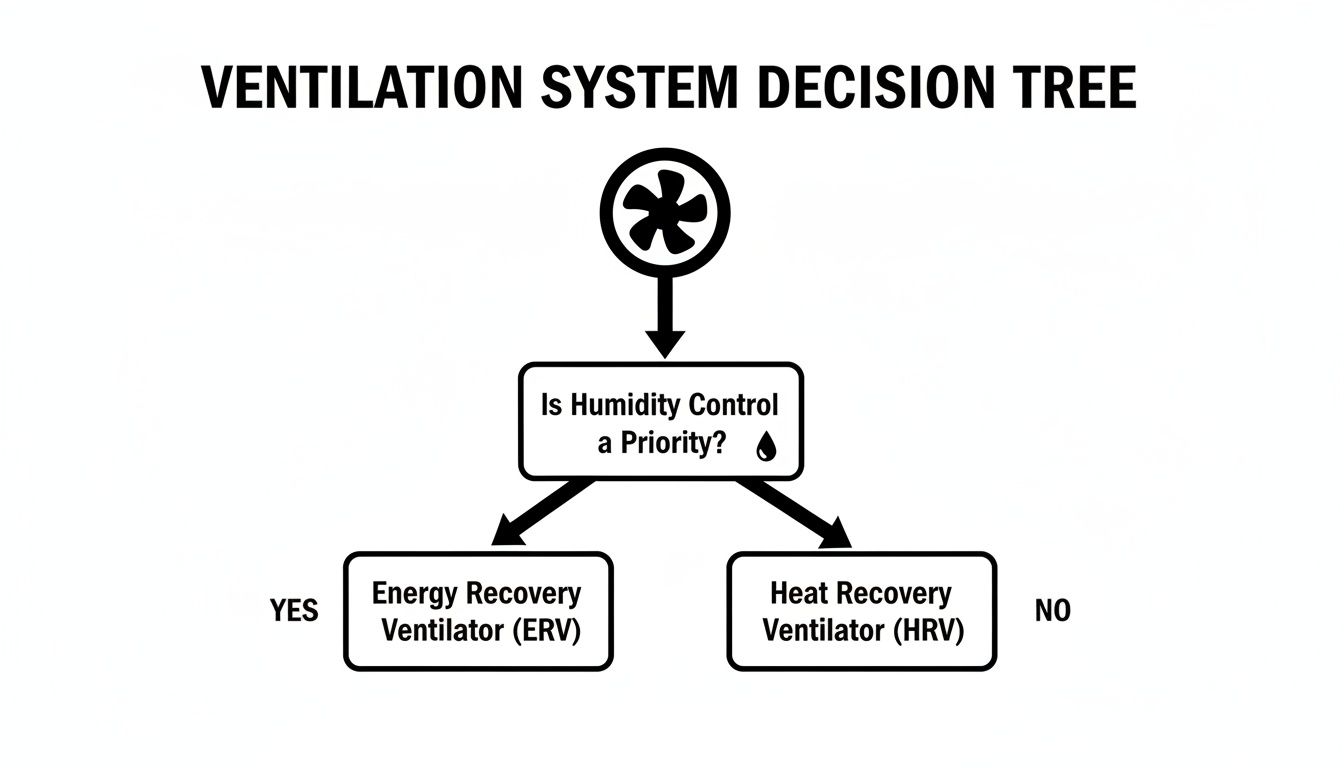
As you can see, if keeping indoor humidity at a comfortable, efficient level is your top priority—and in most of Canada, it should be—an ERV is almost always the right call.
For a clearer picture, here’s a direct comparison of the key features that matter most to Canadian homeowners.
HRV vs ERV Feature Comparison for Canadian Homes
| Feature | Heat Recovery Ventilator (HRV) | Energy Recovery Ventilator (ERV) |
|---|---|---|
| Primary Function | Heat recovery and fresh air ventilation. | Heat recovery, moisture recovery, and fresh air ventilation. |
| Summer Humidity Control | Poor. Introduces outdoor humidity, making the AC work harder. | Excellent. Removes excess humidity from incoming air. |
| Winter Humidity Control | Poor. Expels indoor humidity, making the home feel drier. | Excellent. Retains indoor humidity for better comfort. |
| Best For | Older, less airtight homes that have excess humidity year-round. | Newer, well-sealed homes that need balanced humidity. |
| Energy Efficiency | Good, but can increase AC load in summer and heating load in winter. | Superior, by reducing the dehumidification load on the AC and retaining humidity. |
This table makes it pretty clear: the ERV's ability to manage moisture gives it a big advantage across our distinct seasons.
Which System Is More Effective
It's not just theory; the proof is in the data. Research right here in Canada backs up the real-world benefits of an ERV's moisture control. One study tracked an ERV and an HRV in similar homes over a Canadian winter and found the ERV was far better at maintaining comfort. The ERV system kept the indoor relative humidity at a pleasant 42.4%, while the home with the HRV dropped to a dry 37.2%. That's a noticeable difference you can feel.
For most well-sealed homes across Canada, from British Columbia to Nova Scotia, an Energy Recovery Ventilator (ERV) offers a more complete solution. Its ability to manage humidity provides year-round comfort and energy savings that an HRV simply cannot match in our climate.
Of course, whole-home ventilation is just one piece of the puzzle. If you're struggling with a particularly damp basement, you might need a more targeted solution. Check out our guide on the best dehumidifiers for basements to tackle those problem spots head-on.
Practical Scenarios for Choosing Your System
Theory is great, but let’s get real. Seeing how an ERV or HRV actually fits into a Canadian home makes the decision a lot clearer. The best erv hrv ventilation system isn't just about the specs on a box; it’s about matching the right tech to your house, your family, and your lifestyle.
A home’s age, how it was built, and even your family’s health needs are massive factors. To bring this to life, we’ll walk through a few common situations you'd find right here in Canada.
The Modern Downtown Toronto Condo
Picture a new high-rise condo downtown. These places are built like a fortress—super airtight to meet modern energy standards. That's fantastic for keeping your heating bills down, but it also means every bit of moisture from cooking, showering, and even breathing is trapped inside.
- The Challenge: High humidity all year long. In the summer, that tight seal keeps humid air locked in. In the winter, all your daily activities can lead to annoying, and potentially damaging, condensation on the windows.
- The Solution: An ERV is the clear winner here, no question. Its secret weapon is transferring moisture out during our sticky summer months. Then, in the winter, it smartly holds onto just enough humidity to keep the air from getting painfully dry. It’s all about finding that perfect balance for a modern, sealed space.
The Older, Draftier East Coast Home
Now let's head over to a classic home in the Maritimes. These homes have character, but they're often not as airtight as newer builds. You’ve probably got small drafts around older windows and doors, which means some natural air is already moving through. Basements in these homes can also be prone to dampness.
- The Challenge: The main goal is getting rid of excess indoor moisture, especially during the winter when condensation loves to form on cold surfaces.
- The Solution: An HRV is often a great, cost-effective choice in this situation. Since the house is already breathing a little on its own, your priority is to kick out stale, humid air efficiently. An HRV is a workhorse for this, venting out moisture while recovering precious heat to keep your energy costs from skyrocketing.
If your home constantly feels damp, proper ventilation is your first line of defence. Unchecked moisture can spiral into bigger problems, so it's critical to know the signs of mold in your house and take action. An HRV can be a huge part of the solution.
The Suburban Home with Respiratory Sensitivities
Finally, think about a family in a suburban home where a child struggles with asthma or allergies. For them, good air quality isn't just about comfort—it's about health. The bone-dry air of a Canadian winter can irritate their airways, while the high humidity of summer can be a breeding ground for dust mites and mould.
- The Challenge: Keeping indoor humidity levels and air quality rock-steady to avoid triggering respiratory issues.
- The Solution: An ERV is the superior option when health is the top priority. By working to keep humidity in that ideal 40-50% sweet spot, it stops the air from getting too dry in the winter or too muggy in the summer. This stable environment is much less friendly to common allergens and is far gentler on sensitive lungs.
Understanding Installation Costs and Maintenance
Okay, you've picked the right system for your home—what's next? Getting a handle on the total cost of ownership is a crucial step for any homeowner. The initial price tag on an ERV or HRV is more than just the unit itself; you've got to factor in the installation, potential ductwork changes, and the controls. Budgeting for both the upfront investment and the simple ongoing care is how you make sure your erv hrv ventilation system runs at its best for years.
The cost for a professional install can swing quite a bit, mostly depending on how complex the job is. The biggest question is whether the new unit can tie into your home’s existing HVAC ductwork or if it needs a brand-new, dedicated set of ducts.
Typical Installation Cost Ranges in Canada
For homeowners across Canada, the costs for retrofitting are fairly consistent. If you need a full ERV or HRV installation with all-new, dedicated ducting, you can expect to pay anywhere from $3,800 to $7,500.
However, if you're already renovating or have easy access, integrating the system into your existing ducted HVAC setup can bring the cost down to between $2,500 and $5,500. You'll also want to budget for extras like controls (an extra $250 to $800) and the final commissioning visit ($350-$900), which is essential to meet provincial building codes and ensure the system is balanced correctly. If you want a deeper dive, this 2025 guide from JG Contracting breaks down Toronto HRV/ERV retrofit costs in detail.
The state of your current ductwork is the real wild card here. The Can Do Duct Cleaning team can give it a thorough inspection to see if your ducts are good to go or if they need some modifications. To get a feel for what that work entails, check out our professional installation of ductwork services.
Ongoing Maintenance for Long-Term Performance
Here's the good news: once your system is up and running, keeping it in top shape is surprisingly easy and affordable. A little bit of consistent upkeep goes a long way in protecting your investment, keeping it efficient, and maintaining great indoor air quality.
Here’s a quick rundown of what regular maintenance looks like:
- Filter Cleaning/Replacement: Think of the filters as the system's lungs, catching all the dust and airborne gunk. They need to be cleaned every one to three months and swapped out once or twice a year, depending on what the manufacturer suggests.
- Core Inspection and Cleaning: The core is the heart of the unit, and it needs an annual check-up. A pro can slide it out and clean off any buildup, which is vital for keeping its energy-transfer magic working.
- Exterior Vent and Condensate Drain Checks: Make sure the vents on the outside of your house are clear of leaves, snow, or critter nests. It's also a good idea to ensure the condensate drain line isn't clogged and is flowing freely.
"I was worried about maintaining an ERV, but it’s actually really easy. I change the filter every 6 months and that’s it!" – Nancy W., Homeowner
Honestly, these simple tasks are all it takes to keep your system humming along quietly and efficiently. If you let it slide, you’ll notice reduced airflow, less energy savings, and a drop in the quality of the fresh air your family is breathing.
Making the Right Choice for Your Home
So, how do you actually decide between an ERV and an HRV? It really boils down to your home's unique personality. The final call depends on a few critical factors: its age, how airtight it is, and the typical humidity levels you deal with day-to-day here in Canada.
For most modern, well-sealed houses in our country, an Energy Recovery Ventilator (ERV) is almost always the smarter investment. Think about our climate—bone-dry winters where your skin feels tight, and sticky, humid summers. The ERV’s magic is in managing that moisture. It hangs onto precious humidity during the winter and kicks excess moisture out in the summer, making your home comfortable all year round and easing the load on your furnace and AC.
But that doesn't mean the Heat Recovery Ventilator (HRV) is obsolete. Far from it. An HRV is a fantastic, no-nonsense workhorse for certain situations. If you're in an older, leakier home that battles window condensation and a general feeling of dampness, the HRV's powerful dehumidifying action is exactly what the doctor ordered. It excels at getting rid of that stale, moist air while saving the heat you've already paid for.
The Decisive Next Step
At the end of the day, picking the right system isn't a decision you should make from a blog post alone. The single most important thing you can do is get a professional to look at your home’s specific ventilation needs and the state of your ductwork. A cookie-cutter recommendation just won't cut it when you're comparing a new build in Vancouver to a century home in Montreal.
A proper consultation with a ventilation expert is the only way to know you’re investing in a system that will actually deliver better air and lasting comfort. They can spot the little things that make a big difference and point you to the right solution for your family.
If you’re building a new home or in the middle of a major reno, this is a crucial conversation to have with your contractor. For some great pointers on what to cover, you might find these important questions to ask your home builder really helpful.
Frequently Asked Questions About Home Ventilation
Diving into the world of erv hrv ventilation can feel a bit overwhelming, and it’s natural to have questions. We get it. To help clear things up, we’ve put together answers to some of the most common queries we hear from homeowners across Canada.
Do I Need an ERV or HRV If I Have a Furnace and AC?
Yes, you absolutely do. This is probably the biggest point of confusion for homeowners. Your furnace and air conditioner are fantastic at controlling temperature, but they just aren't designed to bring in fresh air. They mostly just reheat or cool the same stale air that's already in your house.
An ERV or HRV has a completely different job. Its sole purpose is to push out old, pollutant-filled indoor air and pull in fresh, filtered air from outside. In today's tightly sealed Canadian homes, this is non-negotiable for getting rid of built-up contaminants.
How Much Noise Do These Ventilation Systems Make?
When properly installed, you should barely know it's there. Modern ERV and HRV units are designed to run whisper-quiet in the background. Think of the low hum of a new, high-efficiency refrigerator—that's about the noise level you can expect.
If you’re hearing anything louder—like rattling or a noticeable motor sound—it’s often a red flag. That usually points to a poor installation job or a sign that the system is overdue for maintenance.
A well-installed ventilation system shouldn't disrupt your peace and quiet. Its presence should be felt in the fresh air you breathe, not heard in the background of your daily life.
Can an ERV or HRV System Help with Allergies?
Definitely. For allergy sufferers, these systems can be a game-changer. By constantly swapping out stale indoor air for fresh, filtered outdoor air, both an ERV and an HRV significantly reduce the concentration of airborne irritants like dust, pet dander, and pollen floating around your home.
The ERV takes it a step further. Because it helps stabilize indoor humidity, it creates an environment where mould and dust mites—two notorious allergy triggers—really struggle to survive. This adds another layer of relief, particularly during those damp seasons across Canada.
Ready to improve your home's air quality with the right ventilation system? The experts at Can Do Duct Cleaning can inspect your ductwork and help you choose the perfect solution for your home. Contact us today for a professional consultation.


