
Purchasing a home is one of life's most significant milestones, blending excitement with a complex array of decisions. The Greater Toronto Area (GTA) market, in particular, presents its own unique set of challenges and opportunities that demand a discerning eye. Knowing precisely what to look for when buying a house is the key to transforming this daunting process into a successful, long-term investment in your future. This guide moves beyond generic advice, offering a comprehensive checklist designed to empower prospective homeowners, real estate agents, and property managers across the GTA, from Ajax to Scarborough.
This listicle serves as your detailed roadmap, equipping you with the knowledge to assess every critical aspect of a potential property. We will cover everything from the curb appeal and foundational integrity to the hidden systems that truly define a home's health. You'll gain practical insights into evaluating crucial components like the electrical and plumbing systems, the HVAC's condition, and signs that indicate a need for professional duct or dryer vent cleaning, a vital but often overlooked factor.
We’ll delve into the specifics that professional inspectors prioritize, unpack the nuances of neighbourhood analysis for the diverse communities in the GTA, and reveal the hidden costs that can significantly impact your budget and long-term affordability. By exploring property taxes, potential resale value, and the importance of professional inspections and contingencies, this guide provides a clear framework for action. Consider this your essential compass for making a confident, informed, and rewarding home purchase in the competitive 2025 market.
1. Beyond the Address: Decoding Neighbourhood & Location DNA
The golden rule of real estate, ‘location, location, location’, is more nuanced than ever. When considering what to look for when buying a house, especially in the competitive Greater Toronto Area (GTA), you must look beyond the postal code. A great location is not just about prestige; it's about the intricate alignment of the neighbourhood's character, or its "DNA", with your daily life and long-term financial security.
A property in a neighbourhood that fits your lifestyle can significantly enhance your quality of life. Conversely, a mismatch can lead to daily friction, whether it's a stressful commute, a lack of nearby amenities, or a community vibe that doesn't feel like home. Analysing a location's DNA means you are investing in both a financial asset and a foundation for your future happiness.
Putting Neighbourhood DNA to the Test
To truly understand a potential neighbourhood, you need to immerse yourself in it. Go beyond a single weekend viewing and perform some practical due diligence.
- The Commute Simulation: Don't just estimate your commute; live it. Drive, walk, or take the GO Train or TTC from the potential home to your workplace during peak morning and evening rush hours. This real-world test reveals the true time and stress involved.
- Weekend vs. Weekday Vibe: A neighbourhood can have a completely different personality at different times. Visit on a weekday evening to gauge the after-work atmosphere and then again on a weekend afternoon to see how the community relaxes and interacts.
- Future-Proof Your View: Check the local municipal or city planning websites for any pending zoning applications or development proposals. That beautiful, unobstructed view of the park could be the future site of a high-rise condominium, impacting your enjoyment and property value.
- Talk to the Locals: Your potential future neighbours are an invaluable source of information. Casually ask them about their experience with local schools, garbage collection, community safety, and neighbourhood events.
By decoding a neighbourhood's DNA, you make a more informed decision, ensuring the location supports your lifestyle for years to come.
2. Property Condition and Inspection
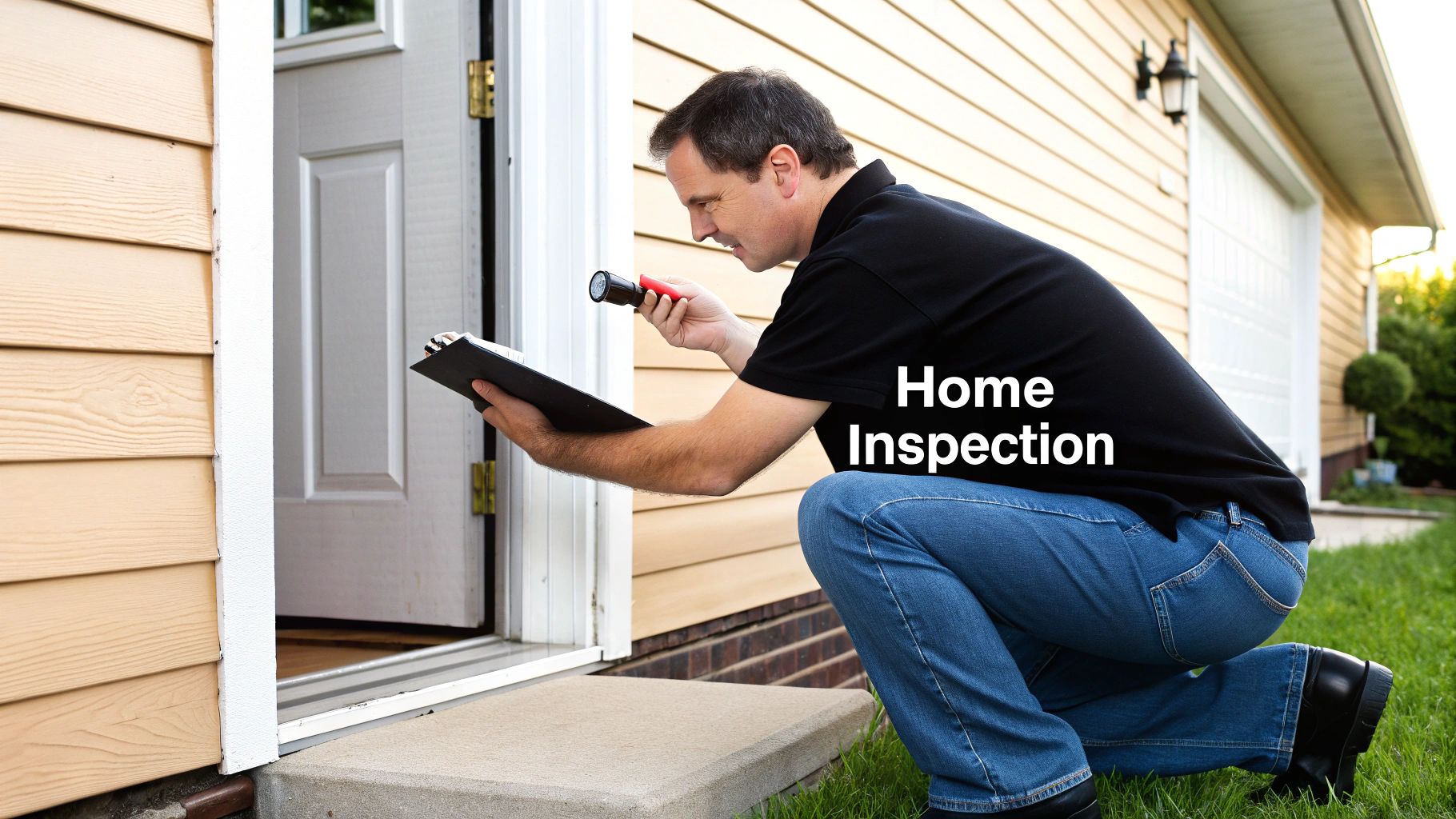
Falling in love with a home’s aesthetic is easy, but the true value and safety of your investment lie beneath the surface. A professional home inspection is a non-negotiable step when considering what to look for when buying a house. This critical evaluation provides an unbiased, in-depth look at the property's structural integrity and the functionality of its essential systems, from the foundation to the roof.
An inspection uncovers hidden issues that could translate into thousands of dollars in unexpected repairs. A home in Chicago, for example, was found to need $45,000 in foundation work, a cost the buyer successfully negotiated off the price after the inspection. This process empowers you with crucial information to either proceed confidently, negotiate repairs, or walk away from a potentially costly mistake, protecting your financial future.
Putting Property Condition to the Test
To get a comprehensive understanding of a home’s health, you must partner with a qualified professional and be an active participant in the inspection process.
- Hire a Certified Professional: Don't just hire any inspector; choose one who is certified by a reputable organization like the Canadian Association of Home & Property Inspectors (CAHPI). Their training ensures they follow a rigorous standard of practice.
- Attend and Engage: Be present for the inspection. Walking through the property with the inspector allows you to see issues firsthand and ask questions. This transforms a simple report into a practical education about your potential new home.
- Look for Hidden Dangers: The inspection can reveal serious health hazards. For instance, inspectors in humid climates frequently uncover mould issues hidden behind walls or in attics, which can be costly to remediate. Find out more about identifying the signs of mould in a house.
- Get Detailed Estimates: If the inspection uncovers major problems, such as an outdated electrical system or a failing roof, get written estimates from qualified contractors. This provides concrete evidence for negotiating the purchase price or requesting repairs from the seller.
By thoroughly vetting a property’s condition, you aren't just buying a house; you are making a secure investment in a safe and sound home.
3. Price and Market Value: Beyond the Asking Figure
The sticker price on a listing is just a starting point, not the final word. When determining what to look for when buying a house, especially in a dynamic market like the GTA, understanding the property's true market value is critical. This value is a reflection of recent comparable sales, current market conditions, and the home's unique attributes, not just the seller's asking price.
Grasping the fair market value protects you from the financial pitfall of overpaying, which can lead to immediate negative equity. It also arms you with the data needed for effective negotiation. A price that aligns with the market ensures your investment is sound from day one, preventing buyer's remorse and setting a strong foundation for future appreciation.
Putting Market Value to the Test
To move beyond the list price and uncover a home's actual worth, you need to analyze the data like a professional. This involves a clear-eyed assessment of what similar homes are genuinely selling for.
- Run the Comparables (Comps): Use online portals to find recently sold properties, but focus your analysis. Look for homes in the same neighbourhood that have sold within the last 90 days. Compare properties of a similar size, age, and condition to get the most accurate picture.
- Request a Professional CMA: Ask your real estate agent for a formal Comparative Market Analysis (CMA). This report provides a detailed, professional assessment of the property's value based on comprehensive sales data that isn't always publicly available.
- Decode Market Conditions: Understand whether you're in a buyer's or seller's market. In a seller's market, homes may sell over asking. In a buyer's market, like the one seen across parts of the GTA after the 2022 interest rate shifts, there is more room for negotiation and prices may fall below the initial listing.
- Focus on Sold, Not Listed: The most important number is the final sale price, not the asking price. A home listed for $999,000 that sells for $950,000 tells a very different story about market value than the listing suggests.
By rigorously evaluating market value, you ensure the price you pay is a true reflection of the property's worth, not just the seller's expectations.
4. Financing and Affordability: Beyond the Asking Price
Your dream home remains a dream until the financing is secured, and more importantly, sustainable. When determining what to look for when buying a house, a critical, non-negotiable step is to look beyond the listing price and scrutinize your long-term affordability. A property that stretches your finances too thin can quickly turn from an asset into a significant source of stress, impacting your financial health for years to come.
Understanding the full scope of homeownership costs is essential. This includes not just the monthly mortgage payment but also property taxes, home insurance, potential condo or HOA fees, and ongoing maintenance. Miscalculating these expenses is a common pitfall that can lead to financial strain, making a thoughtful analysis of your budget a cornerstone of the home-buying process.
Putting Your Budget to the Test
A proactive approach to financing will give you a powerful advantage in a competitive market like the GTA. Before you even start viewing properties, it is crucial to understand precisely what you can afford.
- Secure a Pre-Approval First: A mortgage pre-approval from a lender is your golden ticket. It shows sellers you're a serious, qualified buyer and clearly defines your maximum budget, preventing you from falling in love with a home you can't afford.
- Apply the 28/36 Rule: Financial advisors often recommend the 28/36 rule as a healthy guideline. Your total monthly housing costs (mortgage principal, interest, taxes, insurance) should not exceed 28% of your gross monthly income, and your total debt payments should not exceed 36%.
- Calculate the True Monthly Cost: Don't just focus on the mortgage. Add up estimated property taxes (check municipal websites for tax calculators), homeowner's insurance quotes, and any applicable condo fees to get a realistic picture of your monthly outlay.
- Budget for Ongoing Maintenance: A wise homeowner budgets 1-2% of the home's purchase price annually for maintenance and repairs. For a $900,000 home, that’s $9,000-$18,000 per year set aside for everything from a new water heater to routine upkeep. These ongoing costs, such as understanding how much duct cleaning is, are a crucial part of your financial planning.
By rigorously assessing your financing and long-term affordability, you ensure your new house is a foundation for financial growth, not a burden.
5. Right-Sizing Your Life: Assessing Home Size and Layout
Beyond the total square footage, the home’s layout and floor plan are crucial factors in determining its suitability for your lifestyle. When considering what to look for when buying a house, a well-designed layout can make a smaller space feel expansive, while a poorly configured one can make a large home feel cramped and dysfunctional. The right fit affects everything from daily comfort to long-term resale value.
A home's layout is its functional blueprint. It dictates the flow between rooms, the separation of public and private spaces, and the overall usability of your home. A floor plan that complements your daily routines enhances your quality of life, whereas one that clashes can create constant, low-level frustration. This makes evaluating the spatial design just as important as the physical structure itself.
Putting Size and Layout to the Test
To properly evaluate a home's floor plan, you need to go beyond a quick walkthrough. Imagine your life unfolding within its walls and scrutinize the details.
- Visualize Your Life: Don't just look at empty rooms; mentally place your furniture in them. Will your king-sized bed fit comfortably in the primary bedroom? Is there a logical spot for your home office desk? This practical visualization reveals potential spatial shortcomings.
- Trace Your Daily Path: Walk through the home as if you were living there. Consider the path from the garage to the kitchen with groceries, from the bedrooms to the laundry room, and how guests will move through the space. An awkward or inefficient path will be a daily annoyance.
- Assess Natural Light Flow: Visit the property at different times of the day. Observe how sunlight moves through the house. A home with ample natural light feels larger and more inviting, while a poorly lit layout can feel gloomy and oppressive.
- Consider Future Scenarios: Think five or ten years ahead. Will this layout accommodate a growing family, an aging parent, or a permanent remote work setup? Check if doorways are wide enough for future mobility needs and if spaces are flexible enough to adapt. A layout that supports your future self is a wise investment.
By carefully scrutinizing the size and layout, you ensure the home can not only meet your current needs but also adapt to your life's future chapters.
6. Age and Construction Quality
The year a house was built provides a crucial snapshot of its potential strengths and weaknesses. When deciding what to look for when buying a house, its age and the quality of its original construction are powerful indicators of future maintenance needs, potential repair costs, and overall durability. A newer home in the GTA might offer modern systems, but an older home often boasts a prime location and unique character that can't be replicated.
Understanding this balance is key. A home's construction quality determines whether you'll face minor cosmetic fixes or significant structural issues. A well-built century home may be more sound than a poorly constructed new build. Evaluating both age and build quality helps you anticipate long-term costs and ensures your investment is solid from the ground up, protecting you from unforeseen financial strain.
Putting Age and Construction Quality to the Test
To properly assess a home's history and structural integrity, you need to look beyond the surface and ask the right questions. This diligence can save you from costly surprises down the road.
- Era-Specific Vulnerabilities: Research the common issues for homes built in a specific period. For example, GTA homes from the 1970s and 80s can be prone to aluminum wiring, while pre-1920s Victorian homes often have stone foundations and outdated plumbing that may require significant upgrades.
- Builder Reputation Check: For newer homes or subdivisions, investigate the original builder's reputation. Search for online reviews, community forums, or news articles related to their past projects. A history of quality builds is a good sign, while a pattern of complaints is a major red flag.
- Documentation is Key: Ask the sellers for any documentation related to major upgrades, renovations, or system replacements. This includes permits, warranties for windows or roofing, and service records for the HVAC system. These papers provide a tangible history of the home’s upkeep. You can learn more about maintaining your air duct systems here.
- Specialized Inspections: For homes over 50 years old, consider hiring an inspector with specific expertise in older properties. They can better identify issues like knob-and-tube wiring, structural shifts, or asbestos-containing materials that a general inspector might miss.
By thoroughly investigating a home's age and the quality of its construction, you are not just buying a property; you are investing in a home with a transparent past and a more predictable future.
7. Beyond the Mortgage: Calculating True Ownership Costs
Your mortgage pre-approval sets a ceiling on your purchasing power, but it doesn't represent the full monthly cost of homeownership. When figuring out what to look for when buying a house, it's crucial to analyse the recurring expenses of property taxes and homeowners' insurance. These two figures are significant, non-negotiable costs that directly impact your budget and the long-term affordability of the property.
Ignoring these carrying costs can lead to financial strain, turning your dream home into a source of stress. In the Greater Toronto Area (GTA), property tax rates can vary significantly between municipalities like Toronto, Mississauga, and Ajax. Similarly, insurance premiums depend on factors like the home's age, construction, and specific location risks. A thorough analysis ensures you're buying a home you can comfortably afford for years to come, not just one you can qualify for today.
Putting Ongoing Costs to the Test
To get a precise picture of your future expenses, you need to look beyond the listing price and do some financial reconnaissance.
- Tax Bill Verification: Don't rely on estimates. Ask the listing agent for the most recent property tax bill or use the local municipal website's tax calculator. This provides the exact annual cost based on the home's current assessed value, helping you avoid any surprises.
- Insurance Quote Comparison: Contact multiple insurance providers for quotes before you make an offer. A home with older wiring, a wood stove, or located in a flood-prone area could have drastically higher premiums. Getting real numbers clarifies the true monthly outlay.
- Factor in Future Value: A home is an investment, and part of that is understanding how its value can grow. Knowing How to Increase Property Value with Smart Upgrades can help you assess a property not just for its current state, but for its future potential and how that might impact its assessed value and taxes over time.
- Check for Exemptions: Ask your real estate agent or municipality about potential property tax rebates or exemptions you might qualify for, such as those for seniors or first-time homebuyers, which could lower your annual obligation.
By accurately calculating these ongoing costs, you can confidently determine a home's true affordability and make a financially sound investment.
8. Resale Value and Market Demand
Buying a home is both an emotional and a significant financial decision. When evaluating what to look for when buying a house, thinking like an investor is crucial. A home is not just a place to live; it's a major asset. Understanding its potential resale value and the underlying market demand ensures your investment is secure and has the potential for appreciation, providing you with financial flexibility in the future.
A property with strong resale potential is less risky and easier to sell when your life circumstances change. Factors like evolving neighbourhood trends, local economic health, and even the home's architectural style can dramatically impact its future marketability. Assessing these elements protects your initial investment and positions you for a profitable sale down the road, making it a critical step in the home-buying process.
Putting Resale Potential to the Test
To gauge a property's long-term investment viability, you need to look beyond its current appeal and analyze its future prospects.
- Analyse Historical Trends: Don't just look at the last year of sales data. Research the 5- and 10-year appreciation history for the neighbourhood. This gives you a clearer picture of stable, long-term growth versus a temporary market bubble, a key consideration in volatile markets like the GTA.
- Evaluate Future Development: Visit the local municipality’s planning department website. Are there major infrastructure projects planned, like a new GO station, LRT line, or community centre? These future additions can significantly boost property values and demand in the area.
- Assess Broad Appeal: A home with a layout that appeals to the widest possible audience will always be in higher demand. A standard three-bedroom, two-bathroom home is often more marketable than a highly customized or oversized five-bedroom mansion, which caters to a much smaller buyer pool.
- Choose Timeless Over Trendy: While trendy finishes might look great today, they can quickly date a property. Opt for classic architectural styles and neutral interior designs that have enduring appeal. This prevents your home from looking tired in a few years and saves you from costly updates before you sell.
9. Natural Disasters and Environmental Risks
A home's resilience against nature and its environmental health are crucial factors that directly impact your safety, insurance costs, and long-term financial stability. When looking at what to look for when buying a house, it's vital to assess risks like flooding, ice storms, and environmental contaminants. Overlooking these potential hazards can lead to devastating emotional and financial consequences, transforming your dream home into a recurring liability.
A property in an area prone to natural disasters or environmental issues not only poses a direct threat to your family's well-being but can also drastically inflate insurance premiums and diminish resale value. Understanding these risks is not about avoiding a purchase; it's about making a calculated, informed decision, ensuring you are prepared for and protected against potential threats specific to the Greater Toronto Area and beyond.

Putting Environmental Risks to the Test
To properly evaluate a property’s environmental and disaster-related vulnerabilities, you need to look beyond the surface and consult official data and professional assessments. This proactive investigation can save you from significant future hardship.
- Map Out the Dangers: Start by checking official resources. Review your local Conservation Authority’s flood plain mapping to see if the property is in a high-risk flood zone. While Ontario has low seismic risk, it's still wise to be aware of regional environmental data.
- Investigate Contaminant History: Certain invisible threats can pose significant health risks. High radon levels are a concern in various parts of Canada. It is highly recommended to conduct a radon test, as this naturally occurring gas is a leading cause of lung cancer. For a deeper analysis of your home's air, you might consider professional indoor air quality testing.
- Factor in Insurance Realities: Contact insurance providers with the property address and inquire about the cost of coverage. Homes in designated flood plains or areas with a history of claims can face substantially higher premiums or may even be difficult to insure.
- Ask About Mitigation Measures: Inquire if the current owners have installed any protective systems, such as a sump pump, backwater valve, or upgraded window wells to prevent water damage. These features can provide peace of mind and potentially lower insurance costs.
By scrutinizing these environmental and disaster-related factors, you protect your investment and, more importantly, your family’s health and safety.
10. Understanding HOA Rules & Community Amenities
When you’re looking at what to look for when buying a house, especially in a condominium or planned community within the GTA, the Homeowners' Association (HOA) or Condo Corporation is a critical, often overlooked, factor. These entities govern the community, and their rules, fees, and financial health directly impact your ownership experience and monthly costs. A well-managed association protects property values, while a poorly run one can become a source of financial stress and constant frustration.
Joining an HOA is not optional; it's a legal agreement that comes with the property. This agreement dictates everything from whether you can paint your front door a different colour to what amenities your monthly fees cover. Overlooking this aspect of your purchase is like signing a contract without reading the fine print, potentially leading to surprise assessments for major repairs or restrictions that clash with your lifestyle.
Putting the Association to the Test
Due diligence on an HOA or Condo Corporation is non-negotiable. It requires a detailed review of its governance and financial stability to protect your investment.
- Request the Status Certificate: This is the most crucial step. Your real estate lawyer will request this package, which includes the corporation's financial statements, budget, reserve fund study, bylaws, and rules. Scrutinize the reserve fund; experts suggest it should be adequately funded to cover future repairs without levying large special assessments.
- Investigate Fees and Assessments: Ask for a history of fee increases and any special assessments levied in the past five years. A history of sudden, steep increases or frequent special assessments can be a red flag for poor financial management or underfunded reserves.
- Clarify Rules and Restrictions: Read the bylaws and rules carefully. Are you allowed to have pets? Can you rent out your unit in the future? Are there restrictions on renovations, parking, or even the type of window coverings you can use? Understanding these rules upfront prevents future conflicts.
- Talk to Residents: Just like checking a neighbourhood's vibe, talk to people who already live there. Ask about their experience with the property management company, the responsiveness of the board, and the overall state of the building and its amenities. This firsthand insight is invaluable.
10 Key Home-Buying Factors
| Factor | Evaluation Complexity | Assessment Effort / Cost | Expected Outcome / Impact | Ideal Use Cases | Key Advantages |
|---|---|---|---|---|---|
| Location and Neighborhood | Medium — requires site visits and research | Low–Medium — travel and data lookup | High — major driver of appreciation and daily convenience | Long-term investment, families, commute-sensitive buyers | Strong appreciation, amenities, school quality |
| Property Condition and Inspection | Low (hire professional) but detailed findings | Medium — inspection fees, possible specialized tests | High — identifies repairs, enables negotiation | All buyers, older homes, fixer-uppers | Reveals hidden issues; protects buyer and loan approval |
| Price and Market Value | Medium — comparables analysis and market study | Low–Medium — MLS/CMA tools or agent services | High — ensures fair price and negotiation leverage | Competitive markets, investors, timing-sensitive buys | Data-driven pricing; avoids overpaying |
| Financing and Affordability | Medium–High — multiple loan products and calculations | Medium — pre-approval costs, application fees | High — determines monthly costs and purchase power | First-time buyers, budgeting, refinancing | Secures financing, prevents overextension |
| Home Size and Layout | Low — measurements and walkthrough evaluation | Low — time and simple measuring tools | Medium — affects livability and resale appeal | Growing families, remote workers, downsizers | Functional living, flexibility, resale attractiveness |
| Age and Construction Quality | Medium — records review and specialty inspections | Medium — potential for specialized inspections/estimates | Medium — predicts maintenance and replacement needs | Older homes, historic properties, cautious buyers | Informs maintenance budgets; warranty considerations |
| Property Taxes and Insurance Costs | Low–Medium — public records and insurer quotes | Low–Medium — quote requests, assessor research | High — large effect on ongoing affordability | Budget-conscious buyers, buyers in high-tax/ hazard areas | Predictable ongoing costs; possible exemptions |
| Resale Value and Market Demand | Medium — trend analysis and demographic research | Low–Medium — agent reports and market data tools | High — affects liquidity and long-term equity | Investors, buyers planning future resale | Protects investment; ensures marketability |
| Natural Disasters and Environmental Risks | Medium–High — maps, tests, historical research | Medium–High — mitigation, insurance, testing costs | High — impacts safety, insurance and resale value | Properties in flood/quake/fire-prone regions | Risk awareness; enables mitigation planning |
| HOA Rules and Community Amenities | Low–Medium — document and meeting review | Low — request governing docs, review fee history | Medium — affects lifestyle, fees, and restrictions | Condo/townhome buyers, amenity-focused buyers | Maintains common areas; shared amenities and services |
From Checklist to Keys in Hand: Your Next Steps
Navigating the Greater Toronto Area's real estate market can feel like an overwhelming task, but you are now equipped with a comprehensive framework for success. Moving beyond the glossy photos of online listings, you understand the critical importance of a deep-dive analysis. You know that what to look for when buying a house extends far beyond curb appeal and into the very bones of the property: its foundation, its systems, and its place within the community.
You've learned to scrutinize the roof for signs of wear, to assess the foundation for structural integrity, and to listen for the hum of a well-maintained HVAC system. More importantly, you recognize the subtle but crucial indicators of a home's overall health, such as the condition of its ductwork and dryer vents. Clean, properly sealed ducts are not just a sign of meticulous upkeep; they are a direct indicator of better indoor air quality and lower energy bills, a tangible benefit you can enjoy from day one.
Synthesizing Your Knowledge into Action
The journey from aspiring buyer to confident homeowner is about transforming this knowledge into a strategic plan. Each property viewing is now an opportunity to apply your checklist, moving systematically from the big picture of neighbourhood and location down to the minute details of electrical outlets and water pressure.
Remember the key takeaways from our guide:
- Look Beyond the Surface: A fresh coat of paint can hide a multitude of sins. Always investigate the age and condition of core systems like plumbing, electrical, and HVAC. A home's true value lies in its structural and mechanical soundness.
- The Neighbourhood is Part of the Package: Your home doesn't exist in a vacuum. Evaluate proximity to amenities, school districts, traffic patterns, and future development plans. This due diligence ensures your home fits your lifestyle today and protects its resale value tomorrow.
- Efficiency Equals Savings: Don't underestimate the long-term financial impact of good insulation, energy-efficient windows, and a well-maintained heating and cooling system. These elements translate directly into lower monthly utility costs and a more comfortable living environment.
- Trust, But Verify: A professional home inspection is non-negotiable. It provides an unbiased, expert opinion that can uncover issues you might miss, giving you powerful leverage in negotiations or the confidence to walk away from a potential money pit.
Your Path Forward in the GTA
Your next steps are clear and actionable. Begin by assembling your team: a trusted real estate agent who understands the specific GTA market you're targeting, a mortgage broker to secure your pre-approval, and a real estate lawyer to handle the legalities. With your professional team in place, you can refine your personal criteria with newfound clarity.
As you begin your search in earnest, carry this knowledge with you. Don't be swayed by staging alone. Open cabinets, check under sinks, and ask pointed questions about maintenance history. To assist you in keeping track of all the details throughout your journey, consider consulting your ultimate home buying checklist. This will help ensure no stone is left unturned.
Ultimately, buying a house is one of the most significant investments you'll ever make. By approaching the process with diligence, armed with the right questions and a clear understanding of what truly matters, you are setting yourself up for success. You are not just buying a property; you are choosing a home, a community, and a foundation for your future. Go forward with confidence, knowing you have the tools to make an informed, intelligent, and rewarding decision.
As you inspect potential homes, pay close attention to the HVAC system and visible ductwork. If you find your perfect property but suspect the ducts haven't been cleaned in years, trust the experts at Can Do Duct Cleaning to ensure you and your family breathe fresh, clean air from the moment you move in. A professional cleaning can improve energy efficiency and air quality, making your new house feel even more like home.

