
Think of a central vacuum system as a built-in cleaning workhorse for your home. Unlike the portable vacuum you lug around, this system has a powerful motor permanently installed in an out-of-the-way spot like your garage, basement, or utility room. This central unit is connected to wall inlets throughout your house by a network of hidden pipes. When you need to clean, you just grab a lightweight hose, plug it into the nearest inlet, and all the dirt, dust, and allergens are whisked away to a central canister, never to be seen in your living space again.
Understanding the Central Vacuum System
Imagine if your home’s cleaning power was integrated right into its structure, just like your plumbing or electrical wiring. That’s the core idea behind a central vacuum. It means no more dragging a heavy machine up and down stairs, hunting for a free outlet, or smelling that stale "vacuum" odour as fine dust gets blown back into the air.
Instead, you just plug a light, easy-to-handle hose into a wall-mounted inlet. The powerful motor, humming away quietly in the basement or garage, kicks into action, creating immense suction. This force pulls everything—from stubborn pet hair to everyday dirt—through the hidden network of pipes and deposits it all into a large, central collection bin.
A Healthier Approach to Cleaning
This system doesn't just clean your floors; it genuinely improves the air you breathe. It's a game-changer compared to traditional vacuums.
Here’s why it’s so much better for your home’s air quality:
- Total Debris Removal: Portable vacuums have an exhaust, and even the best ones can recirculate microscopic dust and allergens back into the room. A central vac, on the other hand, sends all collected particles—even the tiniest ones—to the central unit and vents them completely outside your living area.
- Superior Allergen Control: By physically removing allergens like dust mites, pollen, and pet dander from your home instead of just stirring them up, it creates a much healthier environment. This is a huge plus for anyone with allergies or asthma.
- Quieter Operation: The main motor is located far away from your living spaces. The only sound you'll hear is the gentle whoosh of air through the hose, making cleaning a far more peaceful chore.
A key advantage for Canadian homeowners is the system's ability to thoroughly remove winter grit and salt tracked indoors without recirculating fine dust, leading to cleaner air during the long months spent inside.
Ultimately, this setup provides a powerful, quiet, and fundamentally healthier way to keep your home pristine.
How the Core Components Work Together
To really wrap your head around a central vacuum system, you have to stop thinking of it as a single appliance. Instead, picture it as a well-oiled team of four key players working together to give your home a clean that portable vacuums just can't touch.
It all starts the moment you plug the lightweight hose into a wall inlet. That simple click is like flipping a switch—it sends a low-voltage signal through the network, instantly waking up the system's powerhouse.
The Power Unit and Filtration System
The Power Unit is the heart and muscle of the entire operation. Tucked away in a garage, basement, or utility closet, this stationary motor is built for one purpose: generating incredible suction. Because it doesn't need to be dragged around, its motor can be up to five times more powerful than what you'd find in even the priciest portable vacuums.
Right alongside it is the Filtration System. As air loaded with dirt, pet dander, and dust bunnies gets pulled into the main unit, this system traps it all in a large collection canister. This is a huge deal for your home’s indoor air quality, as it means only clean, filtered air is exhausted outside.
The real genius of the system is how it separates the raw power from the person doing the cleaning. You get all the strength of an industrial-grade motor without having to lug it around or listen to it roaring in your living room.
This diagram breaks down how debris travels from your floor, through the walls, and into the central unit.
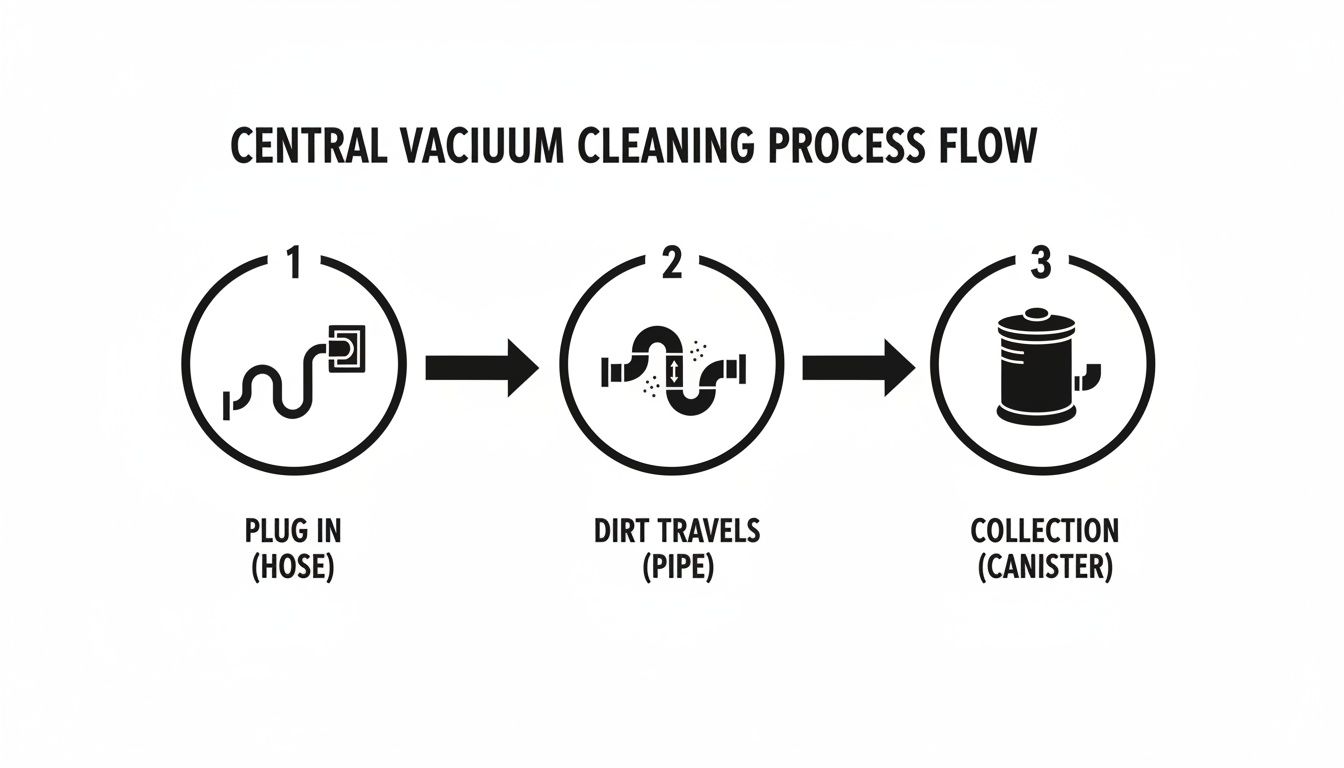
As you can see, it's a direct route that permanently removes dirt and allergens from your living space, rather than just recirculating them.
The Tubing Network and Your Cleaning Tools
Next up is the In-Wall Tubing Network. Think of this as a hidden superhighway made of durable PVC pipes that snake behind drywall, through floor joists, and across attics. This network connects every inlet valve in your home directly back to the power unit, creating a clear, uninterrupted path for all that debris.
Finally, we have the parts you actually handle: the Hose and Attachments. The hose itself is surprisingly light and crush-proof, so it's a breeze to carry from room to room. And with the right attachments, you can tackle any cleaning job with total confidence.
- Powerheads: These are motorized brush heads that dig deep into carpets and area rugs to pull out embedded dirt.
- Floor Brushes: Perfect for giving hardwood, tile, and laminate floors a scratch-free clean.
- Crevice Tools: Your best friend for getting into tight corners, along baseboards, and between couch cushions.
- Upholstery Tools: Designed with softer bristles to safely clean curtains, sofas, and fabric chairs.
Matching the right tool to the task makes all the difference. You can browse a whole range of central vacuum accessories to find the perfect setup for your home's unique needs. Once you see how the power unit, filtration, tubing, and tools all work in sync, the system's incredible efficiency becomes crystal clear.
The Impact on Your Home's Air Quality
The quiet operation and easy handling of a central vacuum are fantastic perks, but its biggest advantage—and the one that really matters—is the dramatic improvement to your home's air quality. For Canadian families focused on creating a healthier living space, this is where the system truly shines.
Let's think about your typical portable vacuum for a second. It sucks up dirt, traps most of it in a filter or bag, and then spits the air right back out into the room you're cleaning. Even the best models with HEPA filters can't catch every microscopic particle. They end up blowing fine dust, allergens, and pet dander back into the air you're breathing.
Getting Rid of Recirculated Allergens
A central vacuum flips this whole process on its head. Since the main power unit is tucked away in the garage or basement and vents everything outside, 100% of the collected particles are permanently removed from your living areas. No exhaust, no recirculation, no problem.
This is a complete game-changer, especially for anyone with breathing sensitivities.
- Allergy and Asthma Relief: By physically removing microscopic triggers like dust mites, mould spores, and pet dander from your home, a central vac system creates a far healthier environment. For many, the relief is significant.
- No More "Vacuum Smell": It also gets rid of that musty, stale odour that portable vacuums often leave behind, making your home feel and smell genuinely clean.
It’s a simple but powerful idea: instead of just stirring dust around, a central vacuum system takes it out of your home for good. The result is measurably cleaner, healthier air for your entire family.
For homeowners in Canada, this isn't just a cleaning tool; it's a long-term investment in your home and health. Allergists often point out that these systems can slash the number of indoor allergens by up to 90% compared to portable vacuums, which can also give your home's resale value a nice little boost.
A Foundation for a Healthier Home
A central vacuum is a cornerstone for improving overall indoor air quality, but it's one piece of a bigger picture.
By preventing allergens from being kicked back into the air every time you clean, the system helps you maintain a consistently cleaner home. This lowers the overall "allergen load" in your house, which means less irritation for sensitive family members and better air for everyone.
Want to learn more? Check out our detailed guide on how to improve air quality at home. A central vac gives you a powerful head start.
Installation and Maintenance Insights for Canadian Homes
So, how does one of these systems actually get into your house? That's one of the first questions Canadian homeowners ask, and it's a great one. Understanding the installation and maintenance is key to seeing the long-term value, and you’ll be happy to know the process is more straightforward than you might think.
Whether you’re building from the ground up or upgrading the home you already love, a central vacuum is a totally feasible and practical addition.
New Construction vs. Retrofitting
If you're building a new home anywhere in Canada, putting in a central vacuum is a piece of cake. The network of PVC tubing goes in right after the plumbing and electrical work, but before the drywall goes up. This makes it a simple and really cost-effective add-on during the construction phase.
But what if your home is already built? No problem. Retrofitting a system into an existing home is surprisingly manageable for a skilled technician. They can strategically run the tubing through out-of-the-way spaces with very little disruption.
Installers have a few clever tricks up their sleeves. Common pathways include:
- Basements and Attics: These unfinished areas are perfect for running the main pipe lines without tearing into your walls.
- Closets: Pros often run pipes vertically through closets that are stacked on top of each other, keeping them completely hidden.
- Crawlspaces: Just like a basement, a crawlspace provides a clear path to connect inlets all across the main floor.
A professional installation is the secret to a high-performing system. It’s a job where expertise really matters. And for general advice on any home project, finding a reputable remodeling contractor is always the first step.
The Beauty of Low Maintenance
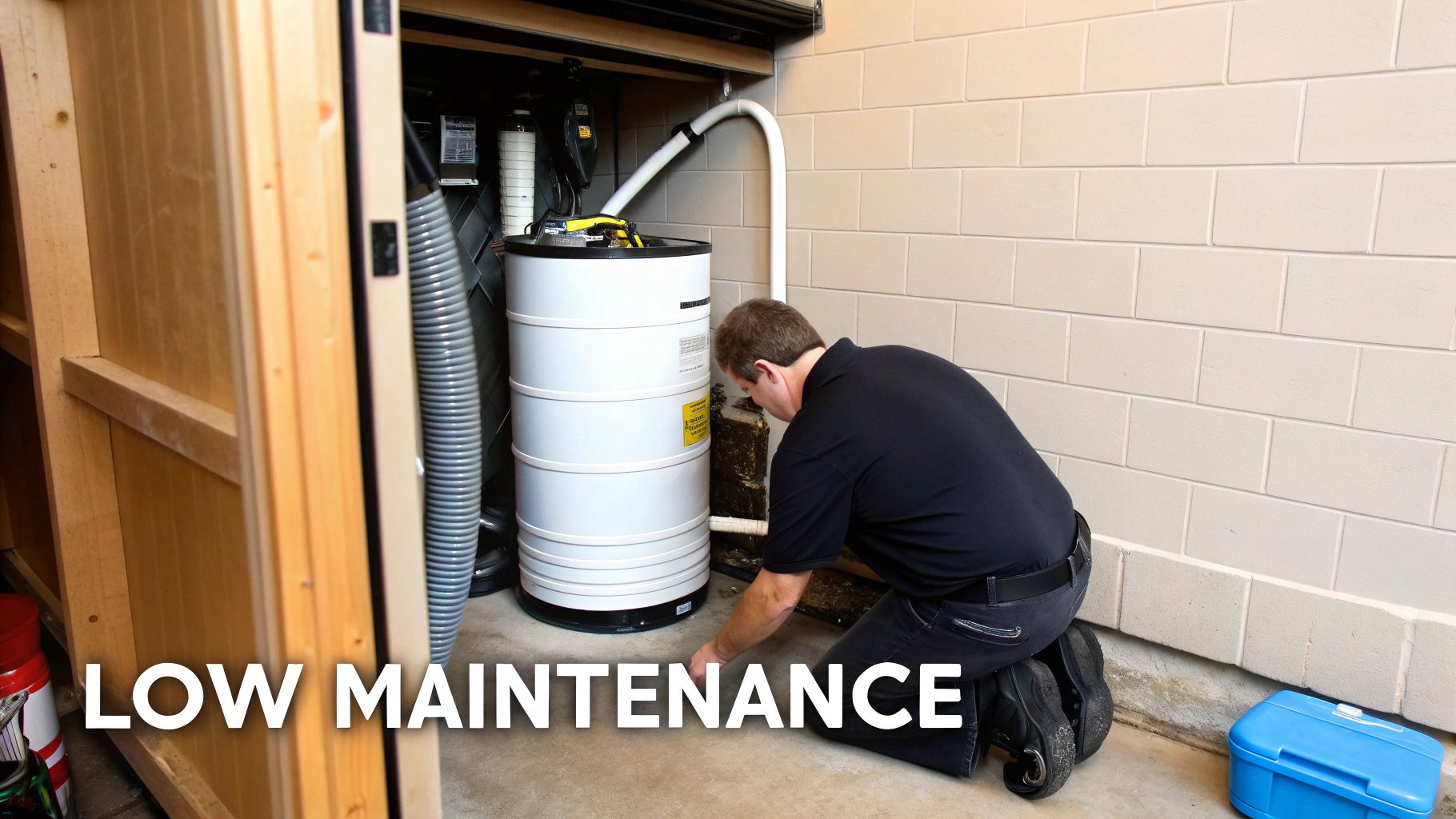
Once it's installed, one of the best parts about a central vacuum is how little you have to think about it. Say goodbye to the endless cycle of buying bags or washing out messy filters every few weeks. These systems are built to last, often for 20 years or more, with just a bit of basic care.
The main job? Emptying the large collection canister. For an average-sized home, you’ll only need to do this two to four times a year. Think about that—it completely frees you from the constant chores and costs that come with portable vacuums.
Beyond that, the system pretty much takes care of itself. If you want to keep it running in peak condition for decades, getting it professionally serviced once in a while is a great idea. You can learn more about what’s involved in our guide to central vacuum system maintenance.
At the end of the day, a central vacuum gives you powerful, reliable cleaning without demanding constant upkeep, making it a genuinely smart upgrade for any Canadian home.
Calculating the Cost and Long-Term Value
Let's talk about the price tag. It's often the first thing homeowners look at, and yes, the upfront cost for a central vacuum system is more than grabbing a portable one from the store. But it's better to think of it as a long-term investment in your home's health and value, not just another cleaning appliance.
The final bill for a full installation in a Canadian home will depend on a few things: the size of your house, how many inlets you need for easy access, and which power unit you choose. For a typical home in Canada, this investment really does pay for itself over the years.
The True Cost of Convenience and Durability
Think about it this way: how many portable vacuums have you gone through? A good one might last a few years if you're lucky. A central vacuum system, on the other hand, is built to last. We're talking a typical lifespan of 20 years or more.
That durability is a huge part of its long-term value. One central vac installation can easily outlast three, four, or even five portable models. You're not just saving money; you're saving yourself the hassle of constantly researching and buying replacements. It's no wonder the market for these systems is growing so steadily.
A central vacuum isn't a disposable appliance; it's a permanent upgrade to your home's infrastructure. It adds real, tangible value that you benefit from every day and that potential buyers will notice down the road.
Speaking of the market, it's booming, and Canada is a major player in manufacturing. The industry was valued at USD 497.84 million globally and is projected to skyrocket to USD 1202.04 million by 2033. According to Straits Research, that’s a growth rate of 10.29%—driven by our strong economy and all the new construction happening.
Boosting Your Home's Resale Value
Beyond just saving money on replacements, a central vacuum is a feature that makes your property stand out. In a hot real estate market like many across Canada, it’s a detail that can set your home apart. It tells potential buyers that the house is modern, well-maintained, and has premium features built right in.
Here’s exactly how it adds value:
- Modern Amenity: Buyers see it as a high-end, built-in convenience, just like a dishwasher or a smart thermostat.
- Health and Wellness: For families with allergies or pets, the promise of better indoor air quality is a massive selling point.
- Quiet and Powerful: During a house viewing, the quiet operation and impressive cleaning power are practical benefits that buyers can immediately appreciate.
This isn't just a cleaning tool; it's a smart home upgrade that delivers a return through durability, convenience, and a higher property value. If you're trying to figure out the right fit for your space, our guide to the best central vacuum systems in Canada is a great place to start looking at top-rated models.
Why a Central Vacuum Is a Smart Home Upgrade
When you add up all the perks, it’s easy to see that a central vacuum system is more than just another appliance. Think of it as a foundational upgrade—one that makes your home healthier, quieter, and frankly, a much nicer place to live. This isn't just about making cleaning easier; it’s an investment in your home's overall environment.
First off, the cleaning power is in a different league. With a motor up to five times stronger than most portable vacuums, it pulls out the deep-down dirt, pet dander, and stubborn allergens that other machines leave behind. You can actually see and feel the difference after the first use.
A Healthier, Quieter Home
The biggest win, though, is something you can't always see: the air you breathe. A central vac doesn't just trap dust—it completely removes it. By piping all the collected particles directly outside, it gets 100% of dust and allergens out of your living space for good. For anyone in the family with allergies or asthma, that's a total game-changer.
This upgrade also brings a bit of peace and quiet to your cleaning routine.
- Noise Reduction: The main power unit is tucked away in the garage or basement. That means the only sound you hear is the gentle whoosh of air through the hose, not the deafening roar of a motor right next to you.
- Effortless Cleaning: Forget about lugging a heavy machine up and down the stairs or bumping it into furniture. All you handle is a lightweight hose. It makes cleaning less of a workout.
A central vacuum works behind the scenes to make daily life better. It’s a long-term investment that offers a superior clean and real value, making it one of the most practical and impactful additions you can make to your Canadian property.
Frequently Asked Questions
Thinking about making the switch? Here are some straightforward answers to the questions we hear most often from Canadian homeowners about central vacuum systems.
Can a Central Vacuum Be Installed in an Older Home?
You bet. While it's certainly a simpler job during a new build, a professional can almost always retrofit a system into an existing home.
They're experts at finding clever, out-of-the-way paths for the pipe network—think attics, basements, crawlspaces, or tucked inside closet walls. The goal is always a clean, discreet installation with minimal fuss.
How Often Does the Collection Canister Need Emptying?
This is where the real convenience kicks in. For a typical family home, that big collection canister only needs to be emptied 2 to 4 times per year. That's it. You can say goodbye to the constant cycle of buying and changing out dusty little bags.
The real win here is the "set it and forget it" nature of the system. You get months of top-tier performance without the weekly or bi-weekly chore that comes with a portable vacuum.
Are Central Vacuums Really More Powerful Than High-End Portables?
Yes, and the difference is huge. A central vacuum's power unit is built with a much larger, stationary motor. This design allows it to generate 3 to 5 times more raw suction power (measured in air watts) than even the most expensive portable vacuums on the market. The result is a much deeper, more thorough clean every single time.
If you ever notice a drop in suction, don't panic. Most issues are simple to sort out. Our central vacuum troubleshooting guide can walk you through the common culprits and help you get your system back to peak performance.
A central vacuum system is a smart, long-term investment in your home’s cleanliness and the quality of the air you breathe. If you're in Canada and want to explore professional installation or maintenance, get in touch with Can Do Duct Cleaning today at https://www.candoductcleaning.com.

