
Moving into a new house is a monumental milestone, but it's also a complex project with countless moving parts. For homeowners across the Greater Toronto Area, from Scarborough to Ajax, a well-organised plan is the key to transforming potential chaos into a smooth, successful transition. A detailed moving into new house checklist is more than just a list of things to do; it's your strategic roadmap for a stress-free experience. It ensures that critical tasks, from transferring utilities and updating your driver's license to essential deep cleaning and safety checks, are handled precisely at the right time.
This guide is designed to be your ultimate blueprint, breaking down the entire process into actionable, timeline-based steps. We'll cover everything from the crucial weeks leading up to your move, to the logistics of moving day itself, and all the important details of settling in during your first 24 hours, first week, and first month. To ensure you cover all your bases, consider complementing this guide with a comprehensive moving checklist that can help you track every small detail.
Our focus is on providing specific, practical advice to help you manage logistics, avoid common pitfalls, and turn your new property into a comfortable, safe, and welcoming home from the moment you get the keys. We'll even delve into often-overlooked tasks like scheduling professional air duct and dryer vent cleaning, a vital step for ensuring your new home's air quality and safety. Let's get started on making your move as seamless and efficient as possible.
1. Declutter and Downsize Belongings
The single most impactful step you can take before packing a single box is to declutter. This isn't just about tidying up; it's a strategic process of sorting through every possession to decide what truly deserves a place in your new home. By shedding items you no longer need, use, or love, you streamline the entire moving process, making it faster, cheaper, and far less stressful. This essential first action sets the foundation for a more organised and intentional life in your new space.
Moving less stuff means paying for a smaller truck, fewer boxes, and less time for movers. It also means you'll unpack more quickly and start with a clean, organised environment. Think of it as a fresh start for your belongings, not just for you.
How to Get Started
Begin this process at least 6-8 weeks before your moving day to avoid feeling rushed. Tackle one room or even one small area at a time, like a single closet or drawer, to prevent overwhelm.
- Categorise Your Items: Create distinct piles or use clearly labelled boxes for items you will Keep, Donate, Sell, or Discard. This prevents you from moving items from one pile to another.
- Use the One-Year Rule: If you haven't used an item in the past year and it holds no significant sentimental value, it's a prime candidate for letting go. Be honest with yourself about its future utility.
- Digitise Paperwork: Scan important documents, photos, and sentimental papers to reduce physical clutter. Store them securely in the cloud.
Expert Insight: Remember, the goal of decluttering isn't just to get rid of things, but to make conscious decisions about what adds value to your life. This mindset, popularised by figures like Marie Kondo, transforms the move from a logistical nightmare into a purposeful transition.
By decluttering, you not only ease your move but also improve the quality of your new home environment. Having fewer items collecting dust makes cleaning easier and can contribute to better indoor air quality from day one. You can read more about how a clutter-free space contributes to reducing household dust and improving air quality.
2. Create a Moving Inventory and Label System
Once you've decluttered, the next crucial step is creating a detailed inventory and a robust labelling system. This is a systematic process of cataloguing everything you plan to move and marking each box and furniture item for easy identification. This methodical approach ensures nothing gets lost in transit, simplifies the unpacking process by directing boxes to their correct rooms, and provides essential documentation for insurance claims if any items are damaged. It transforms the potential chaos of moving day into a managed, organised operation.
A clear system eliminates guesswork and stress. You'll know exactly what's in each box without having to open it, allowing you to prioritise unpacking. For homeowners, especially those in the GTA undertaking a significant move, this level of organisation is a non-negotiable part of any comprehensive "moving into new house checklist."

How to Get Started
Begin creating your inventory as you pack, not after. This ensures accuracy and integrates the task seamlessly into your workflow. Use a digital spreadsheet, a dedicated app, or a simple notebook to track everything.
- Use Colour-Coded Labels: Assign a specific colour to each room in your new house (e.g., blue for the primary bedroom, yellow for the kitchen). Apply the corresponding coloured tape or label to every box destined for that room for quick visual sorting.
- Number Every Box: Sequentially number each box within a room (e.g., Kitchen-1, Kitchen-2, Living Room-1). This helps you quickly identify if a box is missing.
- Create a Master Inventory List: Your list should include the box number, its assigned room, and a brief summary of its main contents. For high-value items, take photos and note their condition before packing.
- Label an "Essentials Box": Mark one or two boxes clearly as "Open First" or "Essentials." These should contain items you'll need immediately upon arrival, such as toiletries, medications, a change of clothes, basic tools, and cleaning supplies.
Expert Insight: Professional moving companies have long used inventory systems to ensure accountability and efficiency. You can adopt their methods by using apps like Sortly or MovingWaldo, which allow you to create digital inventories, add photos, and track your belongings from your phone, keeping your master list accessible at all times.
A detailed inventory is not just for organisation; it's your primary evidence if you need to file an insurance claim. By documenting your possessions before they are loaded onto the truck, you protect your investment and ensure a smoother claims process, providing peace of mind during a hectic time.
3. Notify Important Parties and Update Address Information
One of the most critical administrative tasks in any move is systematically updating your address. This goes beyond simply forwarding your mail; it's about ensuring a seamless transition for all your essential services, from banking and insurance to government correspondence. Failing to inform key organisations can lead to missed bills, lapsed insurance coverage, or even identity theft risks. This step is a cornerstone of a well-organised move, preventing major headaches down the road.
Properly managing this process ensures you continue to receive important documents without interruption. It safeguards your financial and legal standing by making sure critical communications from banks, creditors, and government bodies like the Canada Revenue Agency reach you at your new home. Think of it as protecting your administrative life during a period of physical transition.
How to Get Started
Start this process 3-4 weeks before your move date. Create a master checklist or spreadsheet to track who you've notified and when, ensuring no one is missed. Tackle this in batches, starting with the most critical entities first.
- Set Up Mail Forwarding: Your first step should be to arrange mail forwarding with Canada Post. This can be done online and should be set up at least a week before your move to catch any mail you might have missed. Keep it active for at least six to twelve months.
- Prioritise Critical Services: Immediately notify financial institutions (banks, credit cards, investments), insurance providers (home, auto, life), and your employer's HR department. These often have the most significant impact if a communication is missed.
- Update Government IDs and Services: Update your address on your driver’s licence, health card (OHIP), and vehicle registration with ServiceOntario. You must also update your address with the Canada Revenue Agency (CRA) and Elections Canada to ensure you receive tax documents and can vote.
Expert Insight: Real estate agents consistently advise clients to create a digital "change of address" checklist. This living document can be shared between partners and updated in real-time. It transforms a scattered, stressful task into a manageable and systematic process, ensuring no subscription, bill, or important notice slips through the cracks during the chaos of moving.
Updating your information promptly also protects your home and belongings. Your home insurance policy is tied to a specific address, and failing to update it could void your coverage in an emergency. Similarly, ensuring your alarm monitoring company has your new address is a critical safety measure for your new property.
4. Arrange Moving Transportation and Book Professional Movers
Securing your moving transportation is one of the most critical logistical tasks on your moving into new house checklist. This decision dictates your moving day's efficiency, cost, and overall stress level. Whether you opt for a full-service professional company, a do-it-yourself truck rental, or a hybrid container service, booking well in advance is key to a smooth transition into your new home. This step ensures you have the right resources on the right day, preventing last-minute chaos.
Choosing the right moving service impacts your budget and the physical labour required. Full-service movers like Allied Van Lines or Two Men and a Truck handle everything from packing to transport, while DIY options like U-Haul give you full control. Making this choice early allows you to budget accurately and plan the rest of your move around this central piece.
How to Get Started
Begin researching and booking your transportation 6-8 weeks before your move, especially if moving during the peak season from May to September. This lead time gives you better availability and pricing.
- Gather Multiple Quotes: Contact at least three to five different companies to compare services and pricing models. Ask whether they charge a flat rate, by the hour, or based on weight.
- Verify Credentials and Insurance: Ensure any professional moving company is properly insured. Read recent reviews on Google, Yelp, and the Better Business Bureau to gauge reliability and customer service. Ask for proof of WSIB coverage for movers in Ontario.
- Clarify All Details: Before signing a contract, confirm what is included. Ask about packing materials, equipment like dollies and ramps, the number of movers, and potential extra fees for stairs, long carries, or heavy items.
Expert Insight: Don't just focus on the base price. A slightly more expensive but highly-rated and fully insured mover can save you significant money and stress by preventing damaged belongings or unexpected fees. Ask detailed questions about their claims process and liability coverage before making your final decision.
Booking your movers is a cornerstone of your moving plan. Once this is set, you can confidently schedule other pre-move tasks like packing and utility transfers. This single action transforms the abstract idea of moving into a concrete plan with a fixed date, providing structure and momentum for the entire process.
5. Arrange Utilities Setup and Disconnection
One of the most critical logistical tasks in any move is coordinating the transfer of your utility services. This involves scheduling the disconnection at your old residence and the activation at your new home to ensure a seamless transition. Properly managing this process prevents being charged for services you're no longer using, avoids the inconvenience of arriving at a home without power or water, and ensures your new house is comfortable and functional from the moment you step inside.
A well-timed utility transfer is a non-negotiable part of a successful moving into new house checklist. It ensures you have essentials like electricity, heating, water, and internet ready for move-in day. Failing to plan this can lead to unnecessary stress and additional costs, turning an exciting first day into a frustrating scramble to get services turned on.
How to Get Started
Begin contacting your utility providers at least three to four weeks before your move. This provides ample time to schedule appointments, handle any required deposits, and troubleshoot potential issues without last-minute pressure.
- Create a Utility Checklist: List all your current providers: hydro, natural gas, water, internet, cable, and phone. Note their contact information and your account numbers for easy reference.
- Schedule Service Dates: Arrange for services at your old home to be disconnected the day after you move out. Schedule activation at your new home for the day before or the morning of your arrival. This overlap ensures you won't be left without power during final cleaning or unpacking.
- Confirm and Document: After scheduling, request confirmation numbers or emails for both the disconnection and new activation appointments. Take photos of the meter readings at both properties on the day you leave and the day you arrive to ensure accurate final and initial billing.
Expert Insight: Many people prioritise electricity and water but forget that internet setup can have the longest lead times. Contact your internet service provider as early as possible, as some installations require a technician and appointments can be booked weeks in advance. A functional internet connection is often crucial for work and communication from day one.
Upon arrival, it's also a good idea to inspect key systems like your furnace to ensure they are operating correctly with the newly activated utilities. A basic check can prevent surprises later, and you can familiarise yourself with the system by following a simple furnace maintenance checklist.
6. Pack Systematically by Room and Category
Once you've decluttered, the next crucial phase is strategic packing. This involves organising your packing process by room and by category, which transforms a chaotic task into a manageable project. Packing systematically ensures every box has a clear destination, fragile items are protected, and the unpacking process is dramatically streamlined. This method prevents the dreaded "mystery box" situation and makes settling into your new home significantly faster and less stressful.

This organised approach, favoured by professional movers, not only protects your belongings but also simplifies the physical move. Movers can place boxes directly into their designated rooms, saving you hours of sorting later. It’s an essential part of any complete moving into new house checklist that lays the groundwork for an efficient move-in day.
How to Get Started
Begin packing non-essential items 4-6 weeks before your moving date. Focus on completing one room entirely before moving to the next to maintain momentum and a sense of accomplishment.
- Label and Colour-Code: Assign a specific colour to each room in your new home. Use coloured tape or markers on your boxes, and place a corresponding coloured sticker on the door of each room upon arrival. Clearly label each box with its destination room and a summary of its contents.
- Pack Smartly: Place heavy items like books in small boxes and lighter items like linens in larger ones. Fill boxes completely, using packing paper, towels, or clothing to prevent contents from shifting and the box from collapsing. Keep the weight of any single box under 50 pounds (approx. 23 kg).
- Create an "Open First" Box: Pack a clearly labelled box with essentials for the first 24 hours: toiletries, medications, phone chargers, basic tools, a change of clothes, and coffee-making supplies.
Expert Insight: Professional organisers like Marie Kondo and teams from shows like The Home Edit champion categorisation. Packing kitchen items by type (all plates together, all glassware together) rather than by cupboard makes it much easier to visualise and set up your new kitchen logically.
A systematic pack-up also makes it easier to stage rooms for pre-move services. For example, clearing out items room-by-room simplifies the process of preparing your house for a duct cleaning service before you move out, ensuring the new owners inherit a clean and healthy environment.
7. Update Your Driver's License and Vehicle Registration
One of the most crucial administrative tasks after moving is legally updating your identification documents to reflect your new address. This is not just a suggestion; in Ontario, it's a legal requirement to update your driver's licence and vehicle registration within six days of moving. Failing to do so can result in fines and cause significant issues for banking, voting, insurance, and other legal matters. This simple step ensures your official records are accurate and you remain compliant with provincial law.
Keeping your address current with the Ministry of Transportation is a non-negotiable part of any comprehensive moving into a new house checklist. An outdated address can lead to missed renewal notices for your licence or licence plate sticker, potentially resulting in driving with expired documents unknowingly. It also guarantees that important mail from government bodies reaches you without delay.
How to Get Started
Start this process as soon as you have officially moved into your new home, given the tight six-day window in Ontario. The good news is that for most standard address changes, you can complete the entire process online, saving you a trip to a ServiceOntario centre.
- Gather Your Documents: You will need your current driver's licence number and the vehicle permit number (the green ownership document) for each vehicle you need to update.
- Use the Official Online Service: Visit the official ServiceOntario website to change the address on your driver's licence and vehicle registration simultaneously. This is the fastest and most efficient method.
- Confirm All Associated Products: The online portal will typically prompt you to update your address on your Health Card at the same time. It is highly recommended to complete this for a comprehensive update of your provincial records.
Expert Insight: Remember that updating your address with ServiceOntario is free of charge. Be wary of third-party websites that may ask for a fee to perform this service. Always use the official provincial government website to ensure your personal information is secure and the change is processed correctly.
Completing this update promptly ensures you maintain continuous, valid car insurance, as your insurer must have your correct address on file. It also simplifies future interactions with any government service or financial institution. You can change your address officially through the ServiceOntario website.
8. Inspect Both Properties and Document Condition
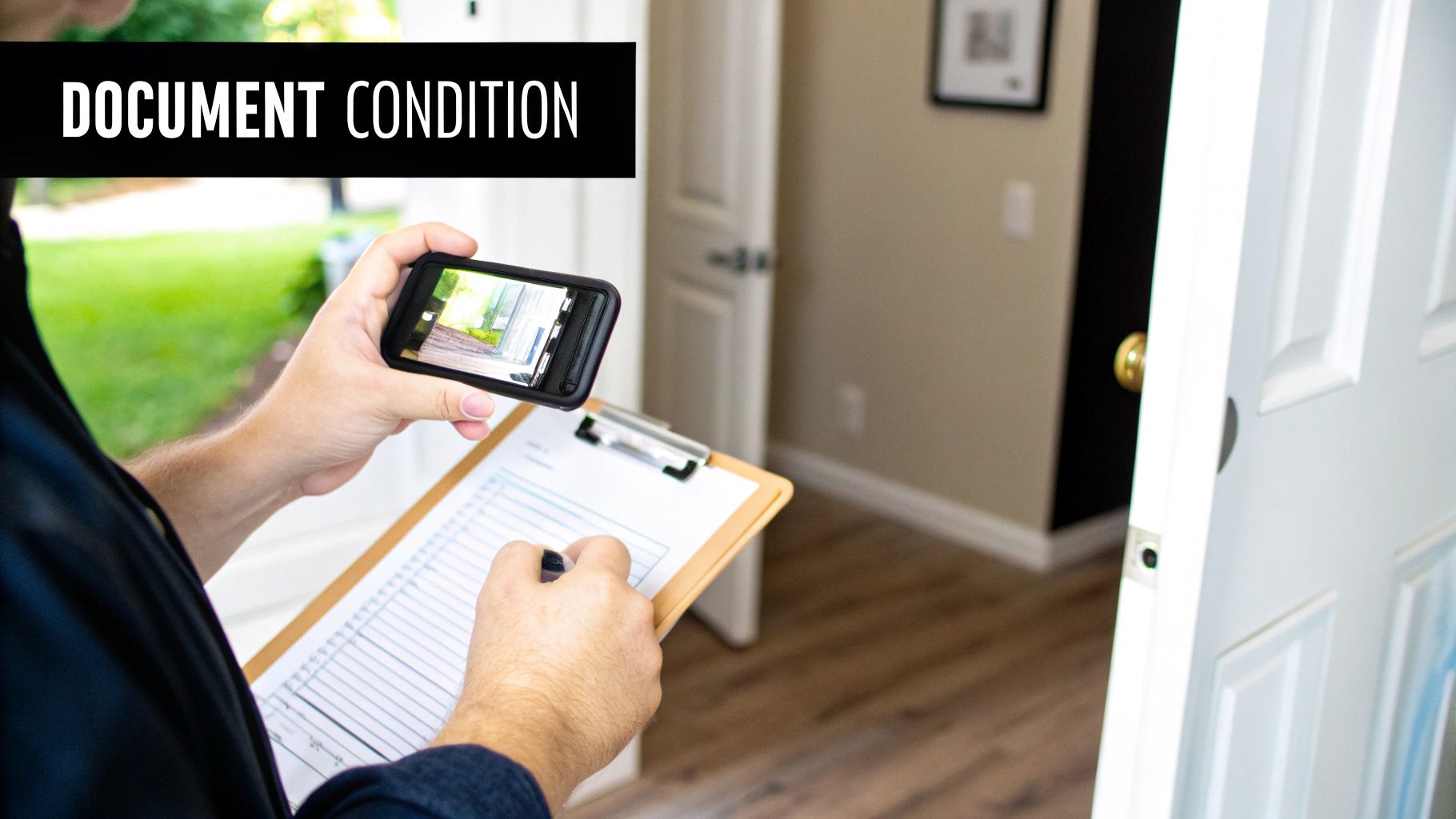
This crucial, non-negotiable task involves thoroughly documenting the state of your old residence before you leave and your new home the moment you arrive. This process serves as your official record, providing undeniable proof that is essential for securing your full security deposit, substantiating any potential insurance claims, and establishing a clear baseline condition for your new property. Overlooking this step can lead to costly disputes and unnecessary stress, making it a cornerstone of any organised moving into new house checklist.
Documenting the condition protects you financially and legally. For renters, it's your primary defence against unfair charges for pre-existing damage. For new homeowners, it’s vital for identifying issues that may have been missed during the home inspection and for future maintenance reference.
How to Get Started
Begin this process during your final walkthrough of your old home and immediately upon receiving the keys to your new one, before a single box is moved inside. This ensures your documentation captures the property's true state without any of your belongings obscuring views.
- Use Video and Photos: Take a comprehensive video walkthrough of each property, narrating what you see and timestamping the footage. Supplement this with high-resolution photos of every room, including inside closets, cabinets, and appliances.
- Focus on the Details: Capture close-up shots of any existing damage, such as scuffs on walls, stains on carpets, cracks in tiles, or scratches on floors. Don't forget to document the condition of fixtures, windows, and major systems.
- Document Meter Readings: Photograph the water, gas, and electricity meters at both locations to have a clear record for final and initial utility bills, preventing disputes over usage.
- Create Digital Backups: Organise all photos and videos into clearly labelled folders (e.g., "Old House Move-Out May 2024," "New House Move-In May 2024") and save them to a secure cloud storage service.
Expert Insight: Think like an insurance adjuster. Your goal is to create an objective, detailed record that leaves no room for ambiguity. This documentation is your most powerful tool in any discussion with landlords, moving companies, or insurance providers about the property's condition.
A thorough inspection upon arrival also allows you to identify immediate concerns, such as damp spots or musty odours. Being proactive can help you address potential issues early, and you can get more information on what to look for by reading about the common signs of mould in a house.
9. Plan and Execute Final Walkthrough and Cleanup
One of the final, yet most crucial, tasks at your old residence is conducting a thorough walkthrough and cleanup. This step is about more than just being tidy; it's a formal process to ensure you meet the terms of your lease or sale agreement. Properly executing this stage is essential for recovering your security deposit, maintaining a positive relationship with your landlord, and closing this chapter of your life without any lingering issues.
Leaving your former home in pristine condition honours your agreement and prevents potential disputes or financial penalties. For renters, this is the key to a full deposit return. For sellers, it's a professional courtesy that ensures a smooth handover to the new owners. This final act sets a respectful tone for your departure and prevents last-minute complications from derailing your move.
How to Get Started
Begin planning your final cleanup as soon as your belongings are moved out, scheduling it for the 1-2 days before you hand over the keys. This gives you a clear, empty space to work with, making the process more efficient.
- Create a Checklist: Review your lease agreement for any specific move-out cleaning requirements provided by your landlord or property management company. Use this to build your own detailed, room-by-room checklist.
- Deep Clean Everything: This is not a surface-level tidy. You must clean inside appliances, cabinets, and closets. Address walls, baseboards, light fixtures, and windows. If your lease requires it, arrange for professional carpet shampooing.
- Document the Condition: Once the entire home is clean and empty, take time-stamped photos or a detailed video of every room. This documentation serves as undeniable proof of the property's condition should any disputes arise later.
Expert Insight: Many property management companies now require professional-grade cleaning. It’s often wise to hire a service that specialises in move-out cleans, like Molly Maid or other local GTA providers. They understand landlord expectations and can provide a receipt, which adds another layer of proof that you fulfilled your obligations.
A meticulously planned final walkthrough and cleanup is a non-negotiable part of any comprehensive moving into a new house checklist. It protects you financially and ensures your transition is clean in every sense of the word, allowing you to focus completely on settling into your new home without looking back.
10. Set Up Essential Services and Accounts in New Location
Beyond utilities, a smooth transition into your new home involves proactively establishing all essential personal and professional services in your new neighbourhood. This step is about ensuring continuity in your daily life, from healthcare and banking to community engagement. Addressing these accounts early prevents stressful gaps in service, helps you integrate into your new community faster, and makes your house truly feel like a home from the moment you arrive.
Taking care of these logistical details is a critical part of any comprehensive moving into a new house checklist. Having your primary care physician, pharmacy, and bank accounts sorted out beforehand provides peace of mind. It allows you to focus on unpacking and settling in, rather than scrambling to find a doctor or transfer a prescription during your first week.
How to Get Started
Begin researching and contacting new service providers 4-6 weeks before your move. Many transfers and registrations can be initiated online or over the phone, but some, like meeting a new doctor, may require an in-person appointment that needs to be scheduled in advance.
- Organise Your Healthcare: Don't wait until you're unwell. Research doctors, dentists, and specialists who are accepting new patients in your area. Contact your old providers to have your medical records transferred and find a new pharmacy to move your prescriptions.
- Update Financial and Insurance Details: Notify your bank of your new address. More importantly, contact your insurance providers (auto, home/renter's, life) as your rates and coverage needs may change based on your new location. This is a good time to shop for new quotes.
- Connect with Your Community: Join local online groups like Nextdoor or neighbourhood Facebook pages to get authentic recommendations for everything from a reliable mechanic to the best local parks. Register for a library card and look into local community centres and recreational programs.
Expert Insight: Relocating is more than just a change of address; it's an opportunity to build a new support network. By establishing these essential services early, you are laying the groundwork for a comfortable and connected life in your new community, turning a new postal code into a new hometown.
As you settle in, you might also consider professional services that contribute to your family's health and well-being. Ensuring the environment inside your new home is clean and safe is paramount. You can learn more about how to assess the health of your indoor environment with professional indoor air quality testing.
10-Item New Home Move Checklist Comparison
| Task | Implementation complexity | Resource requirements | Expected outcomes | Ideal use cases | Key advantages |
|---|---|---|---|---|---|
| Declutter and Downsize Belongings | Medium — time-consuming, emotional decisions | Time, storage, donation/selling channels, possible temporary storage | Fewer items, lower moving cost, streamlined unpacking | Long-distance moves, cost reduction, desire for fresh start | Reduces costs, less unpacking, environmental benefits |
| Create a Moving Inventory and Label System | Medium–High — detailed tracking and upkeep | Time, labels/tape, spreadsheets or apps, smartphone/device | Minimizes lost items, speeds unpacking, supports claims | High-value moves, complex households, long-distance moves | Accurate tracking, faster unpacking, insurance documentation |
| Notify Important Parties and Update Address Information | Medium — many contacts to notify | Time, contact list, USPS forwarding, online forms | Mail/service continuity, fewer missed bills, legal notices received | Any move where mail/service continuity is critical | Prevents missed bills, reduces identity/fraud risk |
| Arrange Moving Transportation and Book Professional Movers | High — logistics, scheduling, negotiating quotes | Budget, time for quotes, insurance verification, vendor coordination | Efficient transport, reduced physical strain, insured move | Large households, long-distance, limited time to move | Professional handling, time saved, insurance protection |
| Arrange Utilities Setup and Disconnection | Medium — multiple providers and scheduling | Account info, deposits/fees, scheduling, meter readings | Service continuity, accurate final bills, systems active on move-in | All moves; essential for move-in readiness | Avoids service gaps, prevents duplicate billing |
| Pack Systematically by Room and Category | Medium — systematic planning and labor | Boxes, packing materials, labels, time | Reduced damage, organized unpacking, balanced box weights | DIY moves, families, those valuing efficient unpacking | Damage reduction, easier unpacking, safer box weights |
| Update Your Driver's License and Vehicle Registration | Low–Medium — bureaucratic steps and possible in-person visit | Required ID/docs, DMV appointment, fees | Legal compliance, correct records, voting eligibility | Interstate moves or where state law requires updates | Avoids fines, maintains valid official documents |
| Inspect Both Properties and Document Condition | Medium — thorough walkthrough and documentation | Camera/phone, checklist, time, cloud backup | Evidence for deposits/claims, identifies repairs needed | Rentals, security deposit protection, insurance claims | Protects deposit recovery, supports dispute resolution |
| Plan and Execute Final Walkthrough and Cleanup | Medium–High — physical labor or paid service | Cleaning supplies or professional service, time, repair budget | Maximized deposit return, smooth handover to landlord | Rental move-outs, lease end requirements | Improves deposit recovery, maintains landlord relations |
| Set Up Essential Services and Accounts in New Location | Medium — research and account transfers | Time, documentation, provider contacts, medical records | Healthcare continuity, proper insurance, local services in place | Long-term relocations, families, those needing uninterrupted care | Maintains essential services, aids community integration |
From Checklist to Comfort: Making Your New House a Home
Congratulations! Navigating the intricate dance of moving is a monumental achievement. By following a comprehensive moving into new house checklist, you have transformed a potentially chaotic process into a structured, manageable project. From the initial decluttering and meticulous labelling of boxes to coordinating with movers and transferring utilities, you have laid the groundwork for a smooth transition. You’ve successfully managed the logistics, the paperwork, and the heavy lifting. Now, the boxes are in, the truck has departed, and you’re standing in the quiet space of your new beginning. The next, and arguably most rewarding, chapter is about to unfold: turning this structure of walls, floors, and ceilings into a sanctuary that truly feels like your own.
This journey from a house to a home is less about logistics and more about personalization and well-being. It’s about creating an environment where you can relax, thrive, and feel secure. While the temptation might be to immediately start decorating and arranging furniture, the most impactful first steps often happen behind the scenes. They are the foundational tasks that ensure your home is not just beautiful, but also safe, healthy, and efficient from day one. This is where your focus should now shift, from the macro-level tasks of the move itself to the micro-level details of settling in.
Prioritising Health and Safety in Your New Space
Among the most crucial yet frequently overlooked tasks for new homeowners is addressing the indoor air quality. The previous occupants may have left behind more than just the property itself; years of dust, pet dander, allergens, mould spores, and construction debris can linger deep within the HVAC system's ductwork. This hidden accumulation can directly impact your family's health, potentially triggering allergies or respiratory issues, and circulating unpleasant, stale odours throughout your new home.
Key Insight: A clean home starts with clean air. Addressing the unseen elements within your ductwork and vents is a foundational step towards creating a truly healthy living environment for your family. This isn't just a cleaning task; it's a wellness investment.
Beyond air quality, remember the other safety checks outlined in this guide. Systematically test all smoke and carbon monoxide detectors, replacing batteries or entire units as needed. Familiarize every family member with the location of the main water shut-off valve and the electrical breaker panel. These small actions provide immense peace of mind, ensuring you are prepared for any unexpected situation. To truly make your new house a home, ensuring it's spotless upon arrival is key. Consider consulting an ultimate move-in cleaning checklist to get your new space sparkling and ready for comfort.
Your Next Steps on the Path to Home
Your moving into new house checklist doesn't end when the last box is unpacked. It evolves. The focus now shifts to long-term comfort, maintenance, and community integration. This is the time to establish routines, from regular maintenance checks on your appliances to exploring your new neighbourhood and discovering local parks, shops, and services. You’ve done the hard work of getting here. Now, embrace the joy of making this space uniquely yours, confident that you have built your new life on a foundation of careful planning, safety, and health. Welcome home.
Ready to ensure the air in your new GTA home is as fresh as your start? Contact Can Do Duct Cleaning for a professional and thorough air duct and dryer vent cleaning service. Start your life in your new home with the peace of mind that comes from breathing clean, healthy air by visiting Can Do Duct Cleaning to book your appointment today.

