
When it comes to choosing the best smart thermostat for a Canadian home, two names usually top the list: the Ecobee Smart Thermostat Premium, with its proud Canadian roots and clever sensors, and the Google Nest Learning Thermostat, known for its brilliant learning algorithm. Both promise big energy savings and better comfort, which is exactly what you need to handle Canada's wild climate swings.
Why Smart Thermostats Are Essential for Canadian Homes
Putting a smart thermostat in your Canadian home isn't just about getting the latest gadget. It’s a smart financial move that pays off in comfort and lower energy bills. Your old thermostat just turns the heat on and off, but a smart one learns your routine and anticipates your needs, which is a game-changer during our harsh winters and humid summers.
Because these thermostats connect to your Wi-Fi, you can control your home's temperature from anywhere using an app. Just imagine pre-heating your house on the drive home from a ski trip in Banff or cranking the AC during an unexpected heatwave in the Okanagan—all before you even walk in the door. No more coming home to a freezing or stuffy house.
Top Contenders for Canadian Homeowners
While the market is full of options, two brands consistently deliver the goods for Canadians. Each has its own philosophy for keeping your home comfortable, and knowing the difference is key to picking the right one. It's also important to understand how your thermostat works with your furnace; you can learn more in our guide to the best furnace brands in Canada.
| Brand | Key Differentiator | Best Suited For |
|---|---|---|
| Ecobee | Advanced remote sensors and built-in smart speaker. | Homes with hot/cold spots or multiple levels, and for those who want a central smart home hub. |
| Google Nest | A powerful learning algorithm that builds a schedule for you. | Homeowners who want a "set it and forget it" device that requires minimal tinkering. |
Think of a smart thermostat as the brain of your HVAC system. But even the smartest brain needs a healthy body to work properly. If your ductwork—the "arteries" of your home—is clogged or leaky, even the best thermostat can't deliver on its promise of efficiency and comfort. This guide will dive into the top models and show you how pairing one with a clean, well-maintained HVAC system unlocks its full potential.
Key Features for Canadian HVAC Systems
Picking the right smart thermostat in Canada is about more than just a slick interface. Our climate is no joke—we swing from deep-freeze winters in the Prairies to humid summer heatwaves in Southern Ontario, and your thermostat needs to keep up. The real test is making sure your shiny new gadget can actually talk to your home’s heating and cooling system.
The first potential snag for many Canadians is the C-wire, or "common wire." It’s what gives a smart thermostat the continuous power it needs for Wi-Fi and that bright, helpful screen. Most newer homes are good to go, but older houses with old-school furnaces often don't have one.
Some brands, like Toronto-based Ecobee, smartly include a Power Extender Kit (PEK) to get around this, saving you a call to an electrician. For other models, you might need a pro to run a new wire. Always check your wiring before you head to Canadian Tire.
Compatibility With Canadian Furnaces and Boilers
Beyond the C-wire, you have to be certain the thermostat is compatible with your specific HVAC system. The high-efficiency gas furnaces common in most Canadian suburbs will play nice with almost any smart thermostat on the market. But if you're in an older neighbourhood in Toronto or Montreal, your setup might be a bit different.
Watch out for these systems:
- Hydronic Systems (Boilers): These heat your home with hot water through radiators or in-floor pipes. They have entirely different wiring requirements than the forced-air furnaces most people are used to.
- Heat Pumps with Auxiliary Heat: This is a popular combination in milder climates like British Columbia. The heat pump handles most days, but a backup furnace (electric or gas) kicks in when it gets truly cold. You need a smart thermostat that can manage this dual-fuel system without wasting energy.
- Electric Baseboard Heaters: These are high-voltage systems and require a special thermostat. Models like the Mysa Smart Thermostat are built for this job. Trying to hook up a standard low-voltage thermostat is not just a mistake—it's a serious safety risk.
Before you buy anything, use the manufacturer’s compatibility checker on their website. It’s a non-negotiable first step that will save you a world of frustration.
The Importance of Reliable Wi-Fi and Remote Sensors
Let’s be honest: a smart thermostat is only "smart" if it's connected to Wi-Fi. That connection is what lets you crank the heat from your phone when an unexpected cold front hits while you’re out. It’s also how the device gets critical weather data and software updates.
For anyone living in a multi-level Canadian home, remote sensors are an absolute game-changer. Your thermostat can only read the temperature of the wall it’s on, which rarely reflects what's happening in the upstairs bedrooms or the basement.
Placing sensors in key rooms allows the thermostat to average the temperature across the house or prioritize a specific room (like a nursery at night), eliminating hot and cold spots and ensuring consistent comfort everywhere.
This feature is a lifesaver for balancing the temperature between a sun-blasted top floor and a chilly, north-facing living room. Of course, temperature is only one part of home comfort; you might also be interested in how your home's ventilation system plays a role. You can learn more about ERVs and HRVs in our detailed guide.
The demand for this kind of intelligent home control is exploding. The smart thermostat market in Canada is projected to hit USD 2,237.1 million by 2033, a huge leap from USD 525.45 million in 2024. This surge is fuelled by homeowners wanting to get a grip on their energy bills, with 25% of Canadians now using smart devices for that very reason—a trend especially strong among high-income households tired of rising utility costs. You can dive deeper into Canada's smart thermostat market trends.
In the end, the real magic is a thermostat that learns your family's rhythm. Features like geofencing can automatically set your system to "Away" mode the moment you leave, while smart schedules adapt to your routine so you’re never paying to heat an empty house.
Comparing the Top Smart Thermostats for Canadian Homes
Picking the best smart thermostat for your home in Canada isn't just about grabbing the one with the flashiest features. It's about finding the right fit for your specific home and lifestyle. After all, a thermostat that’s perfect for a sprawling two-storey in the suburbs is probably overkill for a downtown condo. Let's move beyond the generic lists and really dig into what makes the top contenders tick for Canadian homeowners.
This decision tree gives you a great starting point, helping you ask the right questions about your HVAC system and what you need from a smart device right from the get-go.
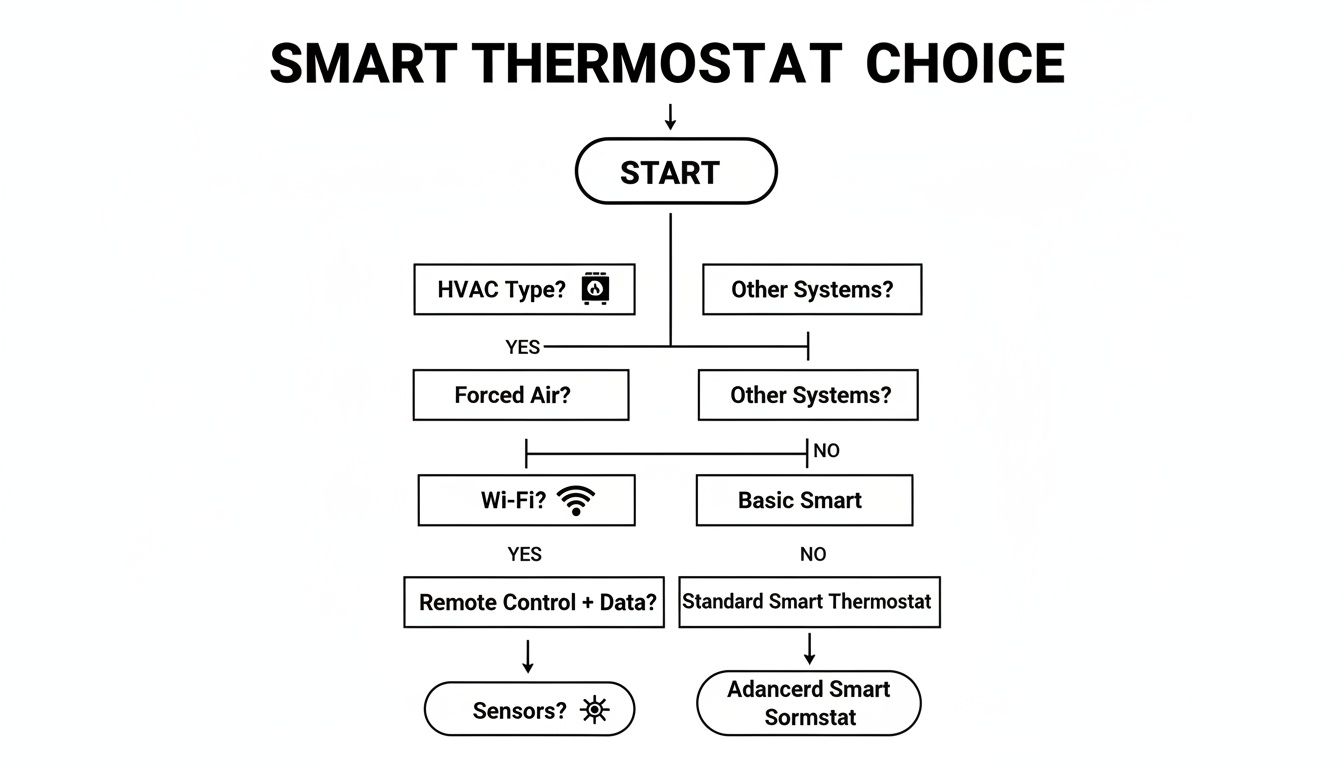
As the flowchart shows, the first and most important step is figuring out what kind of heating and cooling system you have. That simple fact will immediately narrow your options.
Best for Multi-Storey Homes with Temperature Imbalances
If you've ever lived in a multi-level house, you know the classic struggle: the basement is freezing, but the upstairs bedrooms feel like a sauna. This is exactly where the Ecobee Smart Thermostat Premium really shines. Its secret weapon is a set of sophisticated remote sensors that do more than just read the temperature.
Ecobee's SmartSensors track both temperature and whether someone is actually in the room. This lets the thermostat make much smarter choices, like ignoring an empty living room and prioritizing the nursery to keep it perfectly comfortable for nap time. You can even tell it to average the temperature across several rooms or focus on a single sensor at specific times.
For larger Canadian homes, this level of detailed control is a game-changer. It delivers consistent comfort everywhere and stops your furnace from working overtime just to heat one stubborn, chilly corner of the house.
Best for Hands-Off Automation and Simplicity
For those who love the "set it and forget it" philosophy, the Google Nest Learning Thermostat is easily one of the best choices out there. Its standout feature is a powerful learning algorithm that automates your home's efficiency without you having to micromanage it.
For the first week or so, you just adjust the temperature like you normally would. The Nest quietly observes your habits, learns your routine, and builds a custom schedule around it. It figures out when you wake up, when you leave for work, and when you head to bed, automatically tweaking the temperature to save energy without you lifting a finger.
The Nest's Farsight feature is another one of those subtle but brilliant details. When it senses you from across the room, it lights up to show the time, weather, or target temperature in big, clear numbers, making it a genuinely useful part of your home's decor.
It's the perfect thermostat for busy families or anyone who doesn't want to fiddle with complex schedules but still wants to see real savings on their energy bills. It simply learns the rhythm of your life and takes care of the rest.
Best for Older Homes with Electric Heating
Many older homes across Canada, especially in provinces like Quebec and parts of Atlantic Canada, still use high-voltage electric baseboard heaters or in-floor heating. Standard smart thermostats from brands like Nest and Ecobee just aren't compatible with these systems—in fact, trying to connect them can be dangerous. This is the crucial gap that Mysa Smart Thermostats, a company from St. John's, Newfoundland, were designed to fill.
Mysa builds thermostats specifically for high-voltage electric heat. They sport a sleek, minimalist design but pack all the smart features you’d want:
- App Control: Change the temperature from anywhere using your phone.
- Scheduling: Create a unique heating schedule for every single room.
- Geofencing: Senses when you leave home and automatically turns down the heat.
- Energy Reports: Get detailed reports on your electricity use to see where you can save.
By installing a Mysa in each room, you effectively create a zoned heating system, giving you the power to heat only the spaces you're actually using. For homes that previously had little to no temperature control, this is a massive upgrade in both comfort and efficiency. While this is a smart investment, it's helpful to see how it fits into your home's overall budget; you can learn more by checking out our guide on how much a new furnace costs.
Head-to-Head Smart Thermostat Comparison for Canada
To make the decision a bit easier, here’s a straightforward, side-by-side look at how these top contenders stack up on the features that matter most to Canadian homeowners.
| Feature | Ecobee Smart Thermostat Premium | Google Nest Learning Thermostat | Mysa Smart Thermostat |
|---|---|---|---|
| Ideal Use Case | Multi-level homes with hot/cold spots | Busy households wanting hands-off automation | Homes with high-voltage electric heat |
| Key Differentiator | Advanced remote sensors (occupancy & temp) | Self-learning algorithm that builds a schedule | High-voltage system compatibility |
| HVAC Compatibility | Low-voltage systems (furnace, AC, heat pump) | Low-voltage systems (furnace, AC, heat pump) | High-voltage systems (baseboard, fan-forced) |
| C-Wire Required | No (Power Extender Kit included) | No (uses power-stealing, but C-wire recommended) | No (powered by the heating system) |
| Smart Home Hub | Yes (Built-in Alexa and Siri support) | No (Integrates with Google Assistant) | No (Integrates with all major platforms) |
| Air Quality Monitor | Yes (monitors VOCs and CO2) | No | No |
Ultimately, the best choice boils down to your home's unique setup and your personal preferences. Do you crave granular control over every room's temperature, or would you rather have an intelligent system that learns your routine and runs on autopilot? Answering that one question will point you straight to the perfect smart thermostat for your home.
How to Maximize Savings With Canadian Rebate Programs
Putting in one of the best smart thermostats in Canada is more than just a home upgrade—it's your ticket to some pretty serious cash back from government and utility programs. These incentives are designed to get more of us using energy-efficient tech, and they can slash the upfront cost of your new device. It makes a smart thermostat an even smarter financial move.
When you stack a rebate with long-term energy savings, the thermostat often pays for itself way faster than you'd think. The trick is knowing where to find these deals and how to take advantage of them.
Finding Rebates Across the Provinces
Different provinces and even individual cities have their own programs. While some programs change from year to year, here are some of the key players to look for:
- BC Hydro: Often provides rebates for qualifying smart thermostats and other energy-saving home upgrades.
- Énergie NB Power: Runs programs in New Brunswick aimed at improving home energy efficiency.
- Efficiency Manitoba: Offers incentives for a variety of energy-saving products, including smart thermostats.
- Ontario: Many local hydro companies (like Toronto Hydro or Alectra Utilities) offer peak demand response programs. These often give you an upfront credit for enrolling your smart thermostat.
The best approach is to check the website of your provincial energy provider and your local utility company. They’ll have the most up-to-date information on what rebates you can get.
Calculating Your Return on Investment
So, how quickly does a smart thermostat actually start paying you back? Let's run the numbers for a typical home in the Greater Toronto Area, factoring in both a common rebate and the energy savings.
Let's say you buy a new smart thermostat for $250.
- Right away, you sign up for your local utility's demand response program and snag a $75 bill credit. Your net cost is now down to $175.
- Manufacturers and independent studies have found that a smart thermostat can cut your heating and cooling costs by up to 23%. For an average Canadian home, that can easily mean saving $200 or more every year.
With numbers like these, your thermostat could pay for itself in less than a year. After that, all the annual savings are just money back in your pocket. That's a solid return on investment.
These provincial programs are part of a larger push toward energy efficiency. This has kicked off a huge trend across Canada, where it's predicted that direct-to-consumer sales will make up 51.12% of smart home revenue in 2025, according to insights on the Canadian smart home market. Rebates are a big part of that, making a simple upgrade a clear financial win. Just remember, your thermostat’s performance is linked to your whole HVAC system. You can learn more in our guide to the cost of replacing a furnace and air conditioner.
Why Clean Ductwork Is Key to Smart Thermostat Performance
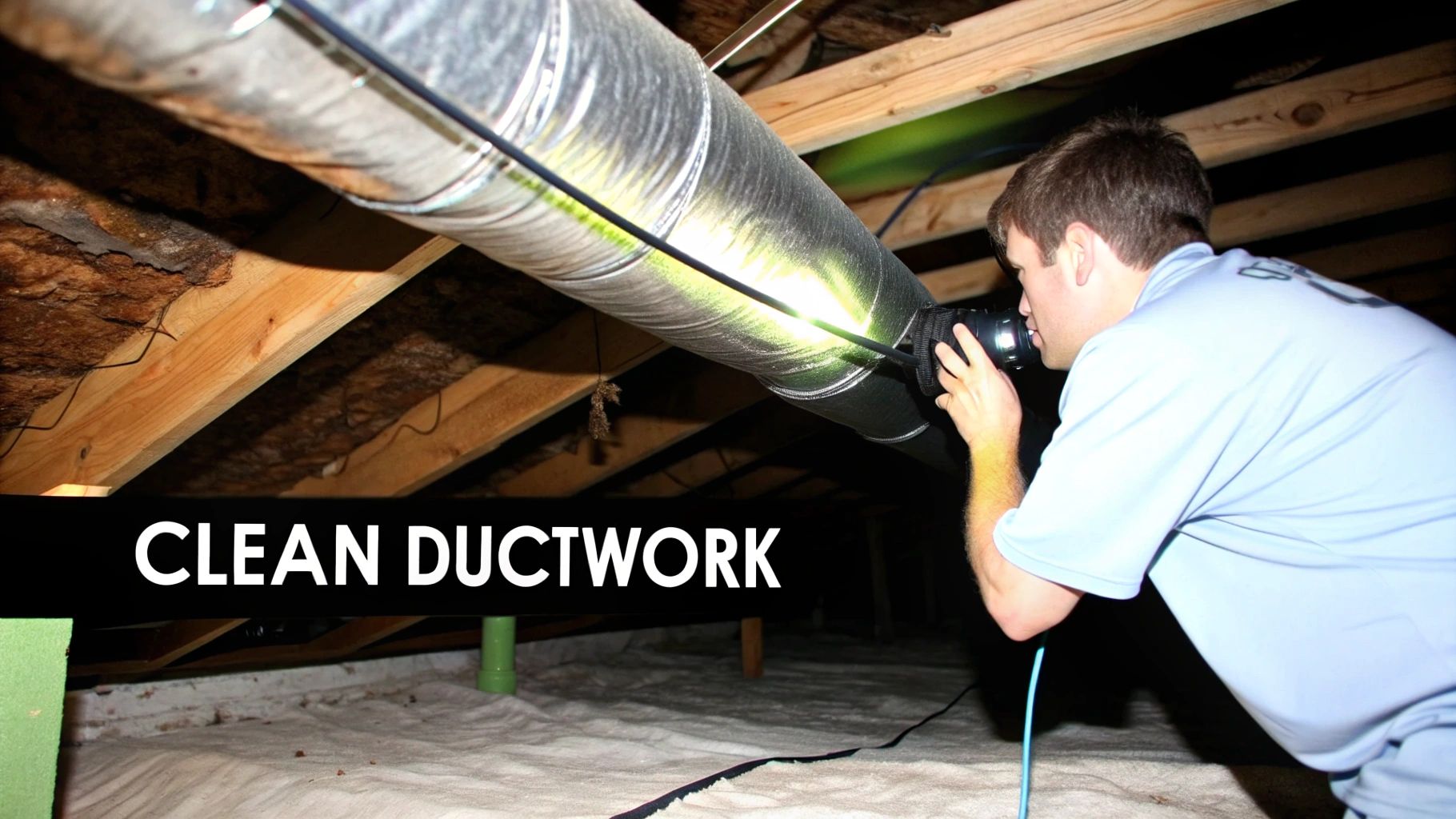
Picking one of the best smart thermostats in Canada is a brilliant move for a more comfortable and efficient home. But here’s something most people overlook: that shiny new thermostat is only as good as the system it’s connected to. Think of it as the new brain for your home's heating and cooling. If the arteries—your ductwork—are clogged, even the smartest brain can’t do its job right.
Your ducts are the lungs of your home, circulating warm and cool air everywhere it needs to go. Over time, these pathways get choked with dust, pet dander, and other debris, creating serious resistance. This blockage makes your furnace and AC work way harder than they should, burning through energy and driving up your utility bills. It completely defeats the purpose of the smart thermostat you just invested in.
The Connection Between Airflow and Efficiency
A smart thermostat is designed to make intelligent, split-second decisions. It learns your schedule and reads the room temperature to run your furnace for the exact amount of time needed. But when dirty ducts restrict airflow, that whole calculation gets thrown off. The system has to run longer and harder just to get the house to the right temperature.
That inefficiency isn't a small thing. For homeowners across the country, dust-clogged vents can slash an HVAC system's efficiency by up to 20%. Your equipment is forced into overdrive, completely negating the precise commands from your new smart device. With the Canadian smart thermostat market hitting USD 497.2 million in 2024 and Wi-Fi models making up a huge 75.08% of sales, it’s clear Canadians are embracing this technology. Making sure it actually pays off starts with your ducts.
A smart thermostat paired with dirty ducts is like driving a high-performance car with the emergency brake on. You're simply not getting the power or efficiency you paid for because the system is fighting against itself.
Getting your ducts cleaned before you install a new thermostat allows your HVAC system to breathe properly and operate at peak performance. This teamwork between a clean system and a smart controller is what truly unlocks major energy savings and next-level comfort.
Installation Considerations: DIY vs Professional
Once your ductwork is clear, it's time to install the thermostat. While many smart thermostats are marketed as easy DIY projects, home wiring—especially in older Canadian houses—can be full of surprises.
The most common snag is the C-wire (or "common wire"), which provides continuous power to the thermostat's screen and Wi-Fi. Many older homes don't have one. While some models like Ecobee cleverly include a Power Extender Kit, for other thermostats or more complex systems, calling in a pro is the safest play. Frying a brand-new thermostat or your furnace control board is a costly mistake.
When to call a professional:
- You pop the old thermostat off and have no idea what you're looking at.
- Your system is a multi-stage heat pump or a dual-fuel setup.
- You don't have a C-wire and aren't comfortable trying to install an adapter.
A professional will get it done right, fast, and make sure your new thermostat is properly calibrated to your specific furnace and AC.
Maximizing Your Investment with System Maintenance
To get the absolute most out of your smart thermostat, you need to think beyond the device on the wall. The entire HVAC system needs to be in good shape, and that means having an effective HVAC maintenance plan. Simple things like regular filter changes and annual professional tune-ups work hand-in-hand with your smart thermostat's efficiency goals.
Before you even mount that new thermostat, scheduling a professional duct inspection is one of the smartest things you can do. A technician can give you an honest assessment of your ductwork's condition and let you know if a cleaning is needed. This pre-installation check-up ensures your new "brain" is connected to a healthy, efficient "body," setting you up for success from day one. It's a small step that protects your investment, lowers your energy bills, and dramatically improves your home's indoor air quality.
Find out how our team can get your system ready by exploring our ductwork cleaning services.
Your Smart Thermostat Questions Answered
Making the switch to a smart thermostat is a great move, but it's natural to have a few questions before you dive in. Homeowners often wonder about compatibility with older systems or what the real savings look like. We get it.
Here are the most common questions we hear from our clients across Canada, along with some straightforward, practical answers to help you feel confident about your upgrade.
Do Smart Thermostats Work With Older Canadian Furnaces?
This is easily the number one question we get asked. The short answer is almost always yes, but there's a small detail to be aware of. Most smart thermostats are built to work with the low-voltage HVAC systems common in Canadian homes, even the older ones.
The main hurdle you might run into is the lack of a C-wire, or "common wire." This wire provides constant power to the thermostat, which is needed for features like the Wi-Fi connection and digital display. Without it, some models can get a bit flaky.
Fortunately, the top brands have already thought of this:
- Ecobee thermostats usually include a Power Extender Kit (PEK). This clever device lets you create a C-wire connection right at your furnace, so you don't have to fish new wires through the walls.
- Google Nest thermostats are known for their ability to "power steal" from other wires, but for rock-solid reliability, having a dedicated C-wire is always the best way to go.
The best first step? Pop your old thermostat off the wall and take a peek at the wiring. If you're not sure what you're looking at, a quick call to an HVAC pro can clear things up and save you a potential headache.
How Much Can I Realistically Save on My Hydro Bill?
The savings can be pretty substantial, but it's not a one-size-fits-all number. It really depends on things like your home's insulation, your family's daily schedule, and how efficient your furnace is to begin with. Most manufacturers claim you can save up to 23% on heating and cooling.
For a typical Canadian household, that often works out to $200 or more per year. The savings come from the thermostat's smarts—it learns your routine, uses your phone's location to know when you're away, and fine-tunes your furnace's runtime to avoid waste.
Just remember, a smart thermostat can't fix an inefficient system. It's the brain of the operation, but it can’t overcome the energy loss from clogged ducts or a furnace that’s struggling.
When you pair those intelligent savings with provincial or local utility rebates, it’s not uncommon for the thermostat to pay for itself in less than a year.
Is Professional Installation Always Necessary?
Not always, but it’s often the best call. If you're comfortable with basic wiring, have a straightforward furnace and AC setup, and you've confirmed you have a C-wire, you can probably handle the installation yourself. The thermostat's app will walk you through it.
That said, you should definitely call a professional if:
- You have a more complex system, like a dual-fuel setup with a heat pump.
- You need a C-wire adapter installed and aren't comfortable working on your furnace.
- The wires behind your old thermostat look like spaghetti and don't match the instructions.
A pro makes sure the job is done safely, preventing any costly damage to your new thermostat or your furnace's control board. They’ll also make sure it's calibrated perfectly to your specific system, so you get peak performance right from the start.
A smart thermostat is the command centre for your home's comfort, but it needs a clear pathway to do its job. It relies on clean, healthy ductwork to deliver that promised efficiency and comfort. Before you upgrade, make sure your system is ready to work at its best. The team at Can Do Duct Cleaning offers expert inspections and cleaning services to get your home prepped for its smart new addition. Visit us at https://www.candoductcleaning.com to schedule your appointment.

