
When you type "air duct cleaning near me" into a search bar, you're looking for more than just a service. You're really asking how to make your home a healthier place to live. Getting your air ducts professionally cleaned is one of those essential home maintenance tasks that clears out years of hidden dust, allergens, and gunk, letting your family breathe easier.
Your Guide to Healthier Home Air
It helps to think of your home's HVAC system as its lungs. The network of air ducts acts like airways, circulating warm and cool air to every room to keep you comfortable. And just like our own airways, they need to stay clear to work correctly.
Over the years, these hidden passages can get surprisingly filthy. Dust, pet dander, pollen, mould spores, and other debris settle inside, creating a grimy layer of buildup. Every time your furnace or air conditioner turns on, it forces air through these dirty ducts, scattering those irritants all over your home.
Why Duct Cleaning Is More Than Just Dusting
A lot of homeowners ask if this service is genuinely necessary. It's a fair question. You change your furnace filter regularly, so isn't that enough? Well, not quite. Your filter is the first line of defence, but it can’t catch everything, and a professional cleaning gets to the root of the problem right inside the ductwork.
This guide will walk you through exactly what’s involved, showing you why air duct maintenance is a crucial part of taking care of your home. The perks go way beyond just having less dust to wipe off your shelves.
A clean HVAC system doesn't have to fight through layers of debris to circulate air, which means it runs more efficiently. In fact, the U.S. Department of Energy estimates that homeowners can boost their system's efficiency by up to 40% with regular maintenance, including clean ductwork.
The Core Benefits of a Clean System
Bringing in a professional duct cleaning crew is an investment in your home’s health and your family’s comfort. Once you understand what a proper cleaning entails, you'll see why it's worth it. Here are the main advantages:
- Improved Indoor Air Quality: When you remove allergens and pollutants at the source, the air you breathe every day is just cleaner. Simple as that. You can learn more about practical steps for indoor air quality improvement and how it affects your family's health.
- Enhanced HVAC Efficiency: Your system can finally "breathe" again. With clear pathways, there's less strain on critical components like the blower motor, helping it run the way it was designed to.
- Potential Energy Savings: An HVAC system that runs smoothly uses less energy to heat and cool your home. That efficiency can show up as lower monthly utility bills.
- Reduced Odours: Funky smells from pets, cooking, or just a general mustiness can get trapped in the dust lining your ducts. A deep clean gets rid of those trapped particles, leaving your home smelling fresh.
Is It Time to Clean Your Air Ducts?
Your house has its own way of telling you when things aren't right. A leaky pipe screams for attention, but the signals from your HVAC system are often much more subtle. Learning to spot these quiet clues is the first step in deciding whether it's time to find a pro for an air duct cleaning.
These aren't always big, dramatic signs. Often, it's the little things you barely notice at first—like your hydro bill creeping up, or a persistent cough that seems to vanish the moment you leave the house. Think of it as your home's early warning system telling you its lungs are getting clogged.
The In-Your-Face Clues You Can See and Smell
Sometimes, the evidence is so obvious you can't miss it. These are the most straightforward signs that your ductwork is overloaded and needs a serious clean-out.
- Visible Dust Puffing from Vents: If you see little clouds of dust shoot out of the registers when your furnace or AC kicks on, that’s a big red flag. It means your ducts are so packed with debris they're literally spitting it back into your living space.
- A Funky, Musty Odour: Can you smell a persistent stale or musty scent coming from the vents? This often points to mould or mildew hiding in the dark, damp environment of your ductwork. No amount of air freshener is going to fix that.
- Unwanted Houseguests: Finding rodent droppings, insect fragments, or bits of nesting material near your vents is a clear sign that critters have moved in. This is a serious sanitation issue, as their waste is now circulating through the air you breathe.
These are just a few of the more obvious hints your system might be giving you. To go a bit deeper, check out this detailed guide on the signs that you need to get your air ducts cleaned to see if your home is ticking other boxes.
The Sneakier Signs Hitting Your Wallet and Your Health
Not all problems are easy to spot. Some of the most telling clues show up in your family's health and your monthly bills, and because they build up slowly, it can be tough to connect them back to your ducts.
One classic symptom? A sudden, unexplained jump in your heating or cooling costs. When your ducts are clogged, your HVAC system has to work overtime just to push air through. All that extra effort burns more energy, which translates directly to higher bills. You end up paying more for air that isn't even circulating properly.
According to the U.S. Department of Energy, a home can lose 20% to 30% of its conditioned air through leaky or poorly connected ducts. Clog those same ducts with dirt and dust, and the efficiency loss gets even worse.
Another sneaky sign is when your family starts having allergy-like symptoms—sneezing, itchy eyes, a nagging cough—that only flare up at home. Your ductwork can become a massive reservoir for allergens like pollen, pet dander, and dust mites, continuously blowing these irritants into every room.
Quick Checklist for Duct Cleaning Needs
Not sure if your home's symptoms add up to a problem? This quick table can help you connect the dots between what you're noticing and what it might mean for your ducts.
| Symptom | What It Looks Like | Potential Impact |
|---|---|---|
| Excessive Dust | Surfaces get dusty again almost immediately after cleaning. | Your HVAC system is circulating old dust instead of fresh air. |
| Higher Energy Bills | Your heating and cooling costs are climbing without explanation. | Clogged ducts are forcing your system to work harder, using more energy. |
| Allergies at Home | Sneezing, coughing, or watery eyes that improve when you leave. | Ducts are likely harbouring and spreading allergens like dander and pollen. |
| Visible Mould | Black or green spots around vents or inside accessible ductwork. | A serious health concern that requires immediate professional remediation. |
| Unpleasant Odours | A persistent musty, stale, or mouldy smell from the vents. | Indicates potential mould or mildew growth deep inside the system. |
If you find yourself nodding along to one or more of these points, it's a strong indicator that your air ducts are overdue for a professional cleaning.
When to Suspect a Bigger Issue
Beyond the usual buildup of dust and dander, some signs can point to a more serious problem hiding in your ductwork.
- You Can See Actual Mould Growth: If you spot black or greenish splotches on or around your vent registers, don't ignore it. This isn't just dirt; it's a potential health hazard that needs to be handled by trained professionals.
- You've Recently Renovated: Home renovations create a storm of fine dust and debris. A lot of that gets sucked right into your HVAC system, quickly clogging your filter and coating the entire network of ducts.
- The Dust Never Ends: Do you feel like you're fighting a losing battle with your duster? If a new layer of dust settles almost as soon as you've cleaned, your ductwork is probably the culprit, acting like a giant dust-spewing machine.
Good home maintenance is all about prevention. Keeping your entire HVAC system in good shape, including routine winter heating system maintenance, helps you know what's normal and what's a cry for help. If you're noticing any of these signs, it’s a pretty safe bet your home is ready for a thorough duct cleaning.
What Happens During a Professional Duct Cleaning
When you hire a pro for an air duct cleaning near you, you're getting a lot more than just a quick vacuum job. The whole thing is a systematic, multi-step process designed to get every last bit of gunk out of your home's "lungs." It's less like dusting and more like a full detox for your HVAC system.
Any reputable company uses a method called "source removal," which is the gold standard in our industry. The goal is simple: physically knock all the debris loose and then suck it completely out of your home. It’s a powerful one-two punch of agitation and suction that gets your ductwork incredibly clean.
Step 1: Inspection and Home Preparation
The first thing a good crew does is protect your home. Before a single tool is turned on, they'll lay down drop cloths and protective coverings on floors and furniture near your vents. The goal is to leave your home cleaner than they found it, period.
Next, they’ll do a thorough visual inspection. They often use special cameras to peek deep inside the ducts, checking how bad the buildup is and looking for any red flags like mould or damage. This initial look helps them create a game plan tailored to your system.
To get ready for the actual cleaning, the technicians seal off every supply and return vent in your house. This is a crucial step. It creates a closed, pressurized system, which means that once their powerful vacuum is hooked up, all that dislodged dust is going straight into their truck—not back into your rooms.
Step 2: Creating Negative Pressure
With your house prepped and the vents sealed, the real action begins. The crew hooks up a massive, industrial-strength vacuum system to your main duct lines, usually down by the furnace. This isn't your average shop vac; this machine creates immense suction, known as negative pressure, throughout the entire network of ducts.
This negative pressure essentially creates a one-way highway for all the contaminants. Any dust, dander, or debris that gets knocked loose has nowhere else to go but straight into the vacuum's collection unit. It's this containment that stops all that nasty stuff from getting stirred up and settling all over your house.
A key part of this setup is the HEPA (High-Efficiency Particulate Air) filter on the vacuum. This ensures that even microscopic particles—down to 0.3 microns—are trapped and not just blown back into your home's air.
Step 3: Agitating and Loosening Debris
While the negative pressure system is running, the technicians work their way through your home, unsealing one vent at a time. They feed specialized tools into the ductwork to physically scrub and break loose years of caked-on grime from the inside surfaces.
The tools they use are seriously effective and are chosen based on the type of ducts you have:
- Rotating Brushes: These powerful brushes spin at high speeds, scrubbing the inner walls of the ducts to break free all the stubborn gunk that has built up over time.
- Air Whips: These tools blast highly compressed air in a 360-degree pattern, knocking dust and debris out of every last nook and cranny.
- Skipper Balls: Often used in the main trunk lines, these shoot jets of compressed air forwards and backwards, pushing debris down the line toward the vacuum.
As each section is scrubbed, the negative pressure instantly pulls the loosened contaminants away, making sure nothing gets left behind. They repeat this process for every single supply and return duct in your home to guarantee a complete clean. We believe in being transparent about this process; you can read more about what a full air duct cleaning involves and why every step is so important.
This infographic highlights some of the key signs—like excessive dust, high energy bills, and strange odours—that tell you it might be time for a cleaning.
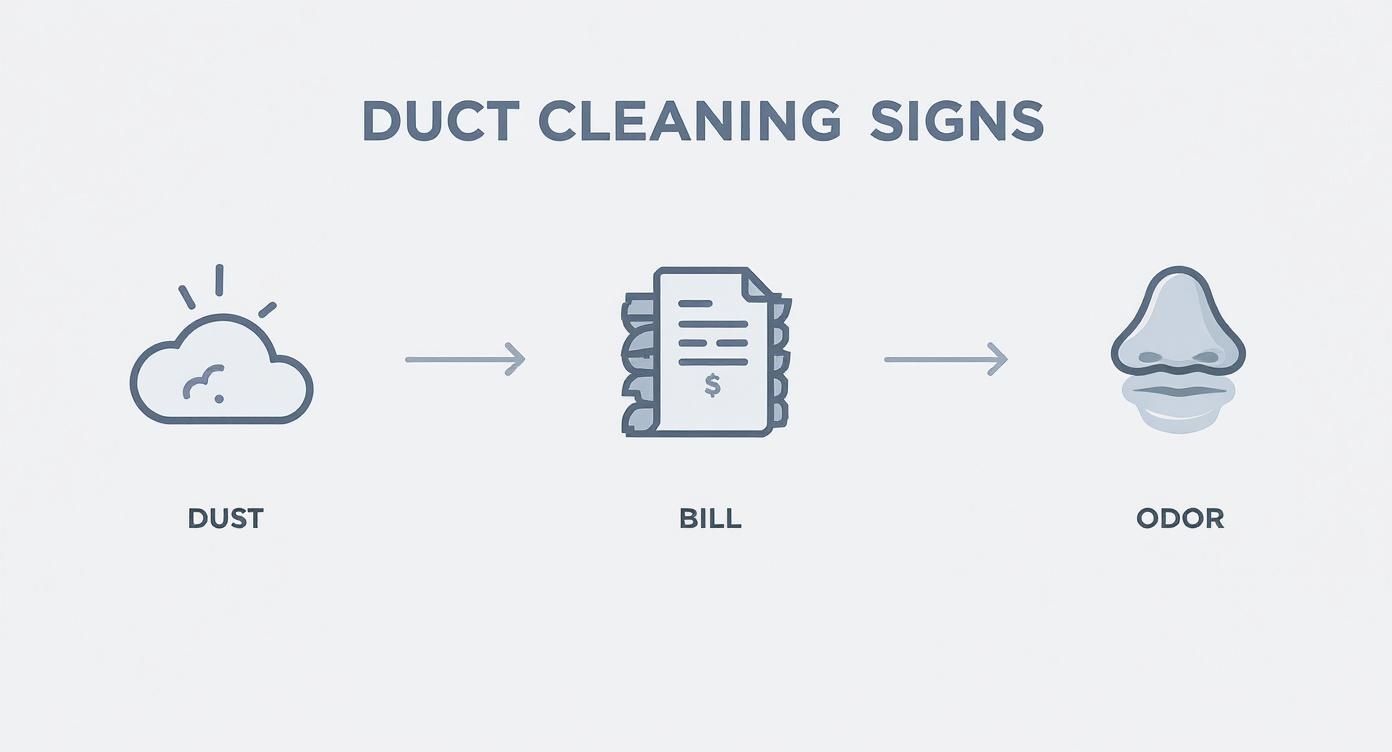
These are often the first clues that the hidden network inside your walls needs professional attention to get your air quality and HVAC efficiency back on track.
Step 4: Final System Cleanup and Inspection
The job isn't done just because the ducts are clean. A true professional service cleans the entire system. That means tackling other critical parts of your HVAC unit that air moves through, like the blower motor, fan, and the evaporator coil, if it's accessible.
They’ll also remove all the register covers—the grilles on your walls and floors—and wash and sanitize them before putting them back. Any access points the crew made to connect their equipment are sealed up with professional-grade materials, making sure your ductwork is airtight and efficient again.
Finally, the crew does a post-cleaning inspection, sometimes using the same camera to show you the amazing before-and-after results. They’ll run your HVAC system to make sure everything is working perfectly before they pack up, leaving your home with cleaner, healthier air than when they arrived.
Breaking Down Air Duct Cleaning Costs
When you start searching for “air duct cleaning near me,” the first question that pops into your head is probably, "How much is this going to cost me?" It's a fair question. Knowing what goes into the price helps you budget properly, sniff out those too-good-to-be-true deals, and really see the value in a professional job done right.
Think of it like getting your house painted. The cost to paint a small studio apartment is going to be wildly different from a sprawling multi-storey home. Air duct cleaning works the same way—the final quote is shaped by a few key variables that a pro needs to assess to figure out the real scope of the job.
Key Factors That Shape Your Quote
A reputable company won't just throw out a flat price over the phone without asking some important questions first. The final cost is always a tailored estimate based on the unique details of your home and its ductwork.
Here’s a look at the main things that influence the price you'll pay:
- Your Home's Size: The total square footage is the biggest piece of the puzzle. Bigger homes naturally have more ductwork, which means more time and labour to get it all clean.
- The Number of Vents: The technicians have to clean every single supply and return vent. The more vents you have, the longer the job takes, and that’s reflected in the cost.
- Accessibility of the Ductwork: Is your furnace in a wide-open basement or crammed into a tight crawl space? Tricky, hard-to-reach spots can add to the labour time and nudge the price up.
- Level of Contamination: If your ducts haven't been touched in a decade or you just finished a dusty renovation, they'll need a much deeper clean than a system with just a light layer of dust.
Real-World Pricing: What to Expect
Let's talk numbers. In Canada, air duct cleaning costs can vary a lot by region. Taking a major city like Toronto as an example, the average cost lands around $335 per home, with most homeowners paying somewhere in the range of $221 to $449.
Some companies price by the square foot, usually between $0.13 and $0.26. So, for a 1,750-square-foot house, you might be looking at a bill between $260 and $530. It's always a good idea to research your local market rates.
Red Flag Alert: Be extremely skeptical of ads screaming "$99 whole-house cleaning." These are almost always bait-and-switch scams. Once they're in your home, they'll "find" all sorts of urgent problems that inflate your bill to several hundred dollars.
Understanding Add-On Services and Their Costs
A standard cleaning package focuses on the ductwork itself. But a lot of companies offer extra services that you can bundle for a better deal and a more complete cleaning of your entire HVAC system.
- Dryer Vent Cleaning: This isn't just a cleaning service; it's a critical fire safety measure. Tacking it onto your duct cleaning service is often cheaper than booking it separately later on.
- Mould Remediation: If the technician finds mould during the inspection, that's a whole different ball game. It requires specialized, intensive cleaning and sanitization, which comes with its own cost.
- Furnace or A/C Coil Cleaning: Getting the internal parts of your HVAC unit—like the blower fan and coils—cleaned ensures the whole system is spotless. It’s a highly recommended add-on for peak performance.
Each of these services solves a specific problem, and a trustworthy pro will walk you through why they might recommend them for your home. For a more detailed look at what to expect, check out our full guide to the average cost of air duct cleaning. Investing in a thorough service from a reputable company gives you cleaner air, peace of mind, and true value for your money.
How to Find a Trusted Local Company

Googling "air duct cleaning near me" can leave you staring at a wall of search results, and it's tough to know where to start. Choosing the right company is easily the most critical part of the process—it’s the difference between a thorough, safe cleaning and a complete waste of money.
The gap between a real pro and a scammer is huge, but you can spot the good ones if you know what to look for. Your mission is to find a company that’s not just technically skilled but also transparent and honest. A little homework now will save you a massive headache later.
Look for Industry Certifications
The first thing you should check for is professional certification. In our world, the National Air Duct Cleaners Association (NADCA) is the gold standard. A NADCA-certified company is one that plays by the rules, follows a strict code of ethics, and employs technicians who have passed some serious exams on proper cleaning methods.
Think of NADCA certification like a Red Seal for a tradesperson. It's an immediate signal that the company has invested in proper training and is serious about doing the job right.
When a company carries the NADCA seal, you know they're using the correct "source removal" techniques and have the professional-grade equipment needed to clean your system without making a mess or causing damage. Always ask to see their certification.
Verify Insurance and Check Local References
This part is simple: no one should work in your home without proper insurance. Before letting a crew on your property, confirm they carry liability insurance. This protects you from any what-ifs, like accidental damage to your floors or your HVAC system.
Don't just take their word for it—ask to see a certificate of insurance. Any company worth its salt will also have a list of happy local customers. Ask for a few recent references and spend a few minutes scrolling through reviews on Google or the Better Business Bureau (BBB).
Beware of Bait-And-Switch Scams
If a price seems too good to be true, it absolutely is. Be extremely wary of any ad promising a "$99 whole-house special." These deals are almost always a classic "bait-and-switch" designed to get a technician through your front door.
Once they're inside, they'll magically "discover" major issues like mould that require expensive, surprise add-ons. A legitimate quote for a standard home will be in the several hundred dollar range. For example, some sources show average prices around $347 in certain cities, with a typical range of $0.13 to $0.27 per square foot. Doing a little research on what local pricing looks like will give you a realistic idea of what to expect.
Critical Questions to Ask Potential Companies
To separate the pros from the phonies, you need to ask the right questions. A good contractor will be happy to give you straight answers.
Here’s a quick checklist to run through with any company you're considering:
- Are you NADCA certified? Start here. If the answer is no, move on.
- Can you provide proof of insurance? Don't even think about proceeding without a yes.
- What cleaning methods and equipment do you use? You want to hear them mention things like HEPA-filtered vacuums, brushes, and air whips.
- Will you clean the entire HVAC system? A complete job includes the blower motor, coils, and drain pan.
- Do you provide a written quote before starting? Get every detail in writing to avoid any nasty surprises on the final bill.
Ultimately, finding a great contractor—whether it's for your ducts or your wiring—boils down to the same principles. The steps you take to vet a service provider are pretty universal. You'd use a similar approach if you had to find the best electrician near you in Brisbane. Being an informed customer is your best defence.
For a deeper dive into finding a professional in your area, check out our guide to duct cleaning services near you.
Common Questions About Air Duct Cleaning
Even after you've wrapped your head around the process and benefits, it's totally normal to have a few more questions. After all, it's not a service you get every day, and being curious is a smart way to be a homeowner. Getting clear, straight-up answers helps you make the right call for your home.
Let’s dig into some of the most frequent questions we get from folks searching for "air duct cleaning near me" and put those last few uncertainties to rest.
How Long Does an Air Duct Cleaning Take?
One of the first things on everyone's mind is the time commitment. The real answer? It really depends on the size and layout of your house.
For a standard home, say somewhere between 1,500 to 2,500 square feet, you can expect a thorough, professional job to take about three to five hours. If you're in a larger home with a more complex network of ducts or you have more than one furnace, it could easily take up a good chunk of the day.
Here's a pro tip: if a company quotes you a ridiculously short time, like an hour or two, see that as a major red flag. A proper cleaning is methodical and can't be rushed. It involves carefully sealing every vent, hooking up heavy-duty equipment, and systematically cleaning every single inch of ductwork. That just takes time to do right.
Will Duct Cleaning Make a Mess in My House?
This is a big one, and we get it. Nobody wants a fine layer of dust coating their furniture after a cleaning service leaves. But with a reputable company, the answer is a solid no.
A professional crew uses a completely sealed and contained system. They'll start by laying down drop cloths to protect your floors and furniture. Then, they create powerful negative air pressure inside your ductwork with a massive, truck-mounted vacuum. This suction is the key—it ensures that every bit of dust, debris, and gunk they loosen is pulled directly out of your vents and into their collection unit outside.
The whole point of hiring a pro is to remove contaminants from your home, not just move them around. If a team leaves a mess behind, they’re either cutting corners or don't have the right gear for the job.
How Often Should I Get My Air Ducts Cleaned?
There isn't a single magic number that works for every home, but the general rule of thumb from industry experts is to schedule a professional cleaning every three to five years.
That said, life happens, and certain situations might mean you need it done more often. You should think about a shorter cleaning cycle if you've got:
- Pets: All that fur and dander has to go somewhere, and a lot of it ends up in your ducts.
- Allergies or Asthma: For family members sensitive to airborne irritants, more frequent cleanings can make a world of difference.
- Recent Renovations: Drywall dust is incredibly fine and heavy, and it can clog up a system in no time.
- Smokers in the Home: Smoke particles can settle inside your ductwork, leading to stale, lingering odours.
Instead of just marking a date on the calendar, pay attention to what your house is telling you. If you notice more dust than usual or a persistent musty smell, it might be time for a cleanout.
Can I Clean My Air Ducts Myself?
I love a good DIY project as much as the next person, but this is one area where it's best to call in the professionals. The tools you'll find at a hardware store, like those brush attachments for your drill, are no match for the industrial-strength equipment the pros use.
A DIY attempt usually just stirs up the dust, pushing it deeper into the system or, even worse, blowing it right back out into your living space. Professionals use a powerful combination of agitation tools to knock everything loose and massive HEPA-filtered vacuums to suck it all out safely. Without that specialized setup, you could accidentally make your indoor air quality worse.
Is Air Duct Cleaning Worth the Investment?
Absolutely. The best way to think about it is like a deep-clean for your home's lungs. The value isn't just in one thing—it’s a combination of better indoor air quality, a more efficient HVAC system (which can lead to lower energy bills), and getting rid of allergens and funky smells. It's a solid investment in your family’s health and the lifespan of your furnace and AC.
When you hire a pro, you're paying for their experience, training, and some very expensive equipment. In California, the duct cleaning industry employs thousands, but it's a field with its own economic nuances. The average hourly wage for a duct cleaning professional is $16.56, with a typical range falling between $13.27 and $17.07. Interestingly, these figures place California at the bottom of state rankings for duct cleaning salaries, suggesting a highly competitive market. You can learn more about salary trends for duct cleaning professionals and see how these factors shape the industry. Hiring a certified pro ensures you're getting true value and a job done right.
Ready to breathe cleaner, fresher air in your home? The team at Can Do Duct Cleaning has over 30 years of experience providing meticulous, professional air duct cleaning services across the Greater Toronto Area. We use eco-friendly products and advanced techniques to ensure your home's air is as healthy as possible. Schedule your on-site inspection today!

