
When your furnace gives up mid-winter or your air conditioner just can't handle a summer heatwave, the first question on your mind is probably, "How much is this going to cost me?" It's a big question, and the answer isn't always straightforward.
Let's cut to the chase. In Canada, you're generally looking at a range of $6,000 to $12,000 for a new furnace and $7,500 to $15,000 for a new air conditioner. If you decide to tackle both at once, a full furnace and air conditioner replacement typically falls between $14,000 and $25,000.
Breaking Down Your HVAC Replacement Costs in Canada
Thinking about replacing your home's heating and cooling system is a big deal. It’s more than just buying a new appliance; it’s a major investment in your home's comfort and infrastructure. The final price tag is a mix of the equipment itself, the expert labour needed to install it safely, and a few other key factors unique to your home and our local market.
To give you a clearer picture, here's a quick visual breakdown of what you can expect to invest in a major Canadian city.
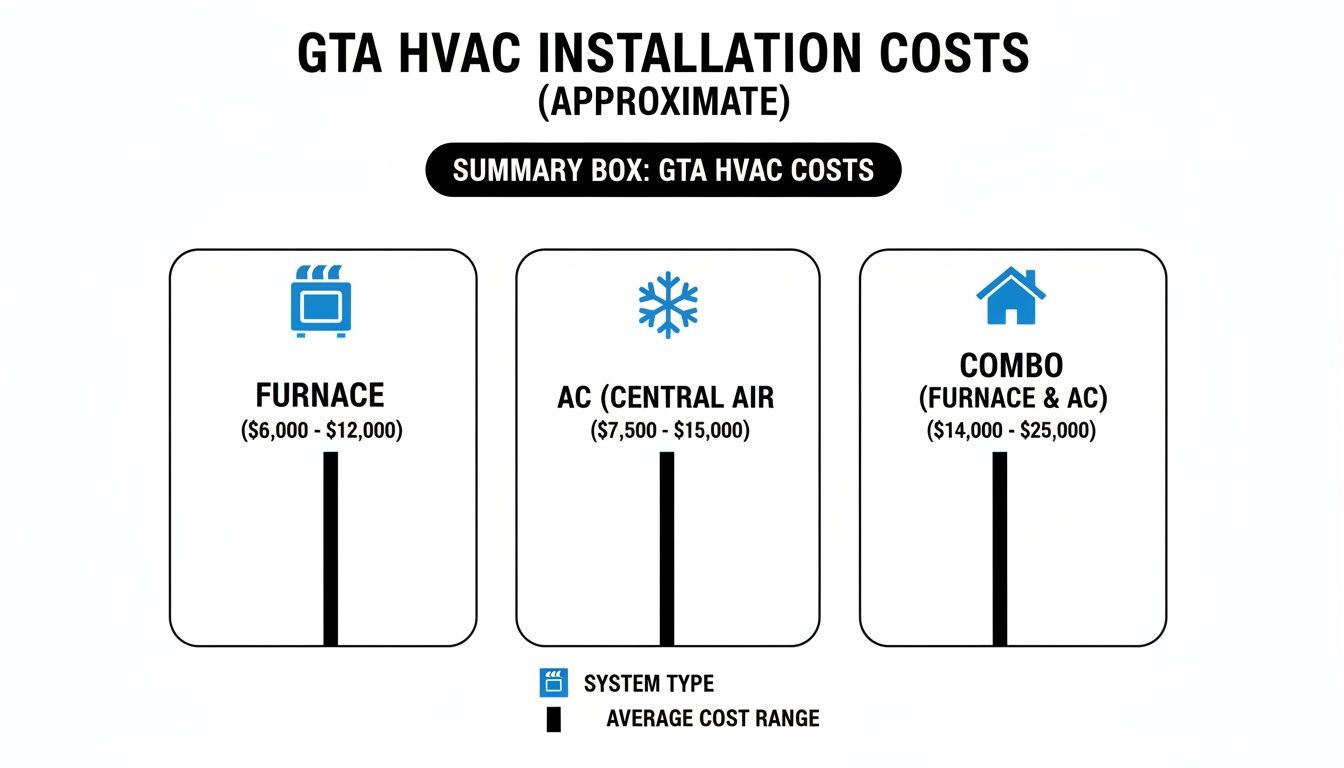
As you can see, while replacing just one unit is a significant cost, bundling them together—though a bigger upfront hit—often makes the most financial sense in the long run.
For a quick reference, here's a summary of what you can expect to pay for a new HVAC system in a major Canadian market.
Estimated HVAC Replacement Costs in Canada
This table provides a high-level overview of the typical cost ranges for replacing your furnace, air conditioner, or both systems at the same time in Canada.
| Replacement Type | Average Cost Range (CAD) | Ideal For |
|---|---|---|
| New Furnace | $6,000 – $12,000 | Homes with a functional AC unit but an old, inefficient, or broken furnace. |
| New Air Conditioner | $7,500 – $15,000 | Homes with a reliable furnace but an aging or malfunctioning AC unit. |
| Furnace & AC Combo | $14,000 – $25,000 | Homes where both systems are over 15 years old, require frequent repairs, or you want to maximize long-term efficiency and savings. |
These figures are a starting point, but the final quote you receive will be shaped by several factors specific to our region.
Understanding the Numbers
Unlike picking up a new TV, an HVAC replacement is a complex job with local realities that influence the final price. Every homeowner in Canada should know what's behind the numbers on their quote.
- Skilled Labour Market: The demand for certified and experienced HVAC technicians in major Canadian cities is high. This creates a recognized skilled labour premium, meaning a good chunk of your cost covers the expertise needed for a safe, correct installation.
- Strict Safety Codes: Provincial bodies like Ontario's TSSA (Technical Standards and Safety Authority) don't mess around. Their installation codes are some of the most rigorous in the country, often requiring specific parts, permits, and detailed procedures that add to the cost but are non-negotiable for your family's safety.
- Our Wild Climate: From bone-chilling winters to sweltering, humid summers, the Canadian climate demands equipment that can handle extremes. The systems recommended for our area are built tough, which is reflected in their price.
A full furnace and air conditioner combo replacement in a major Canadian city averages $14,000–$25,000 CAD. For a typical 2,500 sq ft home in a region like Durham, that often lands around $18,750. This number reflects recent supply chain issues and a local 22% skilled labour premium.
This all-in price usually includes the gas furnace, the AC unit, all labour, and any essential duct modifications. This last part is crucial—audits have shown that around 35% of older Canadian homes have ductwork that just isn't compatible with modern, high-efficiency systems, making adjustments a common part of the job.
You can get a deeper dive into the specifics by reading more about the complexities of furnace replacement costs and how these factors come together in your final quote.
Decoding Your Furnace Replacement Quote
Getting a furnace replacement quote can feel a bit like reading a foreign language. You’re staring at a page of line items, weird acronyms, and a final number that can make your eyes water. So, what exactly are you paying for? Let's break it down.
Those numbers aren't just pulled out of thin air. They represent a blend of top-tier equipment, the cost of skilled labour, and a bunch of small but essential safety details. For us here in Canada, local factors really dial up the price.
In 2026, homeowners across Canada are looking at a furnace replacement cost somewhere between $6,000 and $12,000 CAD. The sweet spot for a standard gas model in a typical 2,000-square-foot home in a place like Ajax or Calgary is usually around $8,500. A big reason for this is Canada's high labour rates, which are about 25% above the North American average, thanks to a shortage of certified technicians and the strict codes from provincial safety authorities.
The Heart of the Cost: The Furnace Unit
The biggest chunk of your bill will always be the furnace itself. The price tag here swings wildly depending on the brand, its features, and most importantly, its efficiency. It’s a lot like buying a car—a basic, no-frills sedan gets the job done, but it won't have the performance or perks of a high-end model.
- Standard-Efficiency Furnaces: These are your entry-level units, usually with an 80% AFUE (Annual Fuel Utilization Efficiency) rating. In simple terms, for every dollar you spend on natural gas, 80 cents heats your home and 20 cents goes right up the chimney.
- High-Efficiency Furnaces: These powerhouses boast an AFUE of 95% or more. They cost more upfront, no doubt. But they shave a significant amount off your monthly gas bills, often paying back that initial investment over the furnace's lifespan.
Your decision here really shapes the long-term cost of replacement furnace and air conditioner ownership. A cheaper furnace might feel like a win today, but a high-efficiency model puts money back in your pocket every single month. For a deeper dive into unit pricing, check out our complete guide to furnace installation costs in Ontario.
Labour: The Price of Expertise
The second heavyweight on your quote is labour. And this isn't just about hauling the old beast out of your basement. You’re paying for the certified, licensed expertise needed to hook up a complex gas appliance without putting your family at risk.
In Canada, labour costs are driven by the high demand for provincially certified technicians. Their training is what guarantees your furnace is installed to code, protecting your home from catastrophic risks like gas leaks or carbon monoxide poisoning.
This cost covers a technician’s extensive training, insurance, and the specialized tools they need to do the job safely and correctly. A botched installation can void your warranty, slash your furnace's efficiency, and create serious safety hazards. Professional labour isn’t just a line item; it’s peace of mind.
Beyond the Box: The "Hidden" Costs
A proper, professional quote will also include smaller items that are absolutely critical for a safe, high-performing system. These aren't sneaky "add-ons"—they're non-negotiable parts of the job.
- Permits: By law, any gas appliance installation in Canada requires a permit. This ensures the work is done to code and gets a passing grade from an inspector.
- Venting Upgrades: High-efficiency furnaces work differently and need different venting—usually those white PVC pipes you see running out of newer homes. Your quote will include the materials and labour to install this new, safer venting.
- Ductwork Integration: Your new furnace has to connect perfectly to your existing ductwork. This often means fabricating custom sheet metal transitions to create a perfect, airtight seal that prevents heated air from leaking into your basement.
Finally, think about what that new furnace will be breathing. It makes zero sense to push perfectly clean, warm air through ducts clogged with years of dust, pet dander, and construction debris. A professional duct cleaning before the new system is fired up ensures it runs at peak efficiency from day one, giving you better air quality and preventing wasted energy.
Understanding Air Conditioner Installation Costs
Getting ready for a humid Canadian summer usually starts with one question: is my air conditioner going to make it? When it's time for a replacement, getting a handle on the costs involved helps you budget properly and make smart calls for your home’s comfort—and your hydro bill. The price tag on a new AC isn't just for the box itself; it’s a mix of the equipment, the highly skilled labour, and getting it all to work together perfectly.
Think of it like buying a car. You're not just paying for the engine; you're paying for the whole vehicle, properly assembled and ready to drive. With an AC, the two biggest "engine" components that drive the price are its size and efficiency.
Sizing and Efficiency: The Core of Your AC Cost
The size of an air conditioner is measured in tonnage. This has nothing to do with its weight, but everything to do with its cooling power. Picking the right size is crucial. A unit that's too small will run non-stop, burning electricity without ever hitting a comfortable temperature. On the flip side, an oversized unit will blast your home with cold air too quickly, leading to short, jarring cycles that fail to properly dehumidify the space. A pro will do a proper load calculation to find the perfect fit.
Efficiency is all about the SEER2 (Seasonal Energy Efficiency Ratio 2) rating. The higher the SEER2 number, the less electricity the unit sips to deliver the same amount of cooling. While high-SEER2 models cost more upfront, they can carve a serious chunk out of your hydro bills over their lifespan, paying for themselves in the long run.
In Canada, a full air conditioner replacement typically runs from $7,500 to $15,000 CAD. For a typical home in a humid area like Southern Ontario, a 3-ton central unit averages around $10,200. That breaks down to roughly $4,800 for a modern SEER 16 unit, $4,000 for labour (reflecting the high demand for skilled techs in major cities), and $1,400 for any necessary system upgrades.
These costs are also shifting due to our changing climate and new government rules. As cooling demand grows and older refrigerants are phased out, investing in a modern, efficient system isn't just a good idea—it's becoming essential. You can learn more about how these factors influence overall HVAC costs from other industry experts.
Labour: What You’re Really Paying For
The labour line item on your quote covers a lot more than just carrying a heavy box. It pays for specialized skills and certifications that ensure your new system runs safely, efficiently, and legally. This is a huge piece of the final cost of replacement furnace and air conditioner systems.
Here’s a glimpse into what that covers:
- Physical Installation: Carefully placing the heavy outdoor condenser and connecting it to the indoor evaporator coil without damaging your property or the new unit.
- Electrical Work: A licensed electrician is often needed to run new wiring and make sure the circuit can handle the load, all while following the strict Electrical Safety Code in your province. This is not a DIY job.
- Refrigerant Handling: Technicians need to be certified to handle refrigerants like R-410A. The job involves safely removing the old coolant and charging the new system with absolute precision. Getting this wrong is bad for the environment, illegal, and will wreck your new AC's performance. Our guide on proper AC pipe installation dives deeper into why this is so critical.
The Overlooked Hero: Your Ductwork
Think of your ductwork as the highway system for your home's air. You could install a Ferrari of an air conditioner, but if the roads are full of potholes and dead ends, you’re not getting anywhere fast. If your ducts are leaky, clogged, or too small, you're just paying to cool your attic and the space between your walls.
It’s a bigger deal than you might think. Leaky ducts can waste up to 30% of your conditioned air before it even reaches your rooms. That forces your shiny new AC to work overtime, completely wiping out those high-efficiency savings and inflating your hydro bill.
Before installing anything, a good contractor will always inspect your ducts. A thorough duct cleaning is almost always a smart move to make sure your big investment pays off from day one, delivering clean, cool air to every corner of your home.
Key Factors That Influence Your Final Price
It can be baffling to get a few quotes for a new HVAC system and see the numbers swing wildly. Why is one contractor’s price for the cost of a replacement furnace and air conditioner thousands of dollars higher than another’s? The truth is, that final price isn't just a number pulled out of thin air. It’s a direct reflection of your home's unique needs and the specific equipment you choose.
Think of it like getting a custom suit made versus buying one off the rack. A good tailor takes dozens of measurements for a perfect fit. In the same way, an HVAC pro has to account for a whole host of factors to design a system that actually works for your home. These variables are exactly why a detailed, on-site inspection is an absolute must before you ever see a final quote.
Your Home’s Unique Footprint
The biggest driver of your cost is the size and layout of your home. It’s pretty simple: a sprawling two-storey house in Edmonton needs a lot more heating and cooling power than a compact bungalow in Vancouver. That directly impacts the size—and price—of the furnace and AC you'll need.
To figure this out, contractors perform what's called a load calculation. They’re not just guessing; they're looking at things like:
- Total Square Footage: The overall size of the space you need to keep comfortable.
- Ceiling Height: Vaulted ceilings look great, but they mean there’s more air volume to heat and cool, requiring a more powerful system.
- Number of Windows and Doors: These are the biggest culprits for heat loss in the winter and heat gain in the summer.
- Insulation Levels: If your attic or walls are poorly insulated, your HVAC unit will have to work overtime just to keep up.
And it’s not just about the HVAC unit itself. The quality of your home’s "thermal envelope" is huge. Building an airtight comfort system can dramatically lower how much energy your home needs in the first place.
Equipment Efficiency and Brand Choice
Once you know the right size, your next big decision is the efficiency level of your new gear. This choice creates one of the biggest swings in your initial quote, but it also has the biggest impact on your savings down the road.
For furnaces, we measure efficiency with AFUE (Annual Fuel Utilization Efficiency). A standard 80% AFUE furnace turns 80 cents of every gas dollar into heat, while the other 20 cents go up the chimney. A high-efficiency unit with 96% AFUE wastes only 4 cents.
For air conditioners, the metric is SEER2 (Seasonal Energy Efficiency Ratio 2). The higher the SEER2 number, the more cooling you get for your hydro dollar.
Choosing a high-efficiency furnace and a high-SEER2 air conditioner can increase your upfront cost by 20-40%. However, this premium is often wiped out over time by huge savings on your monthly utility bills and eligibility for government rebates.
The brand you pick also matters, but maybe not as much as you think. While premium brands often come with a higher price tag, the skill of the person installing it is far more important. It’s worth exploring different options to find a good balance between reputation and value. If you want to dive deeper, you can learn about some of the best furnace brands available in Canada in our detailed guide.
Below is a quick-glance table showing how these different variables can pull your final quote up or down.
How Different Factors Impact Your HVAC Replacement Cost
| Cost Factor | Potential Impact on Price | Why It Matters |
|---|---|---|
| Home Size (sq. ft.) | High | Larger homes need bigger, more expensive equipment to maintain comfort. |
| System Efficiency (AFUE/SEER2) | High | High-efficiency models cost more initially but save you money on utilities long-term. |
| Brand Name | Medium | Premium brands often carry a higher price tag than budget-friendly options. |
| Ductwork Condition | Medium to High | Major repairs, modifications, or sealing add significant labour and material costs. |
| Installation Accessibility | Low to Medium | Tight crawlspaces or attics increase labour time compared to open basements. |
| Electrical/Gas Line Upgrades | Medium | Bringing older homes up to current safety codes is a necessary, added expense. |
| Permits and Inspections | Low | A required, fixed cost that ensures the installation is safe and compliant. |
As you can see, the final number is a sum of many parts, which brings us to the last piece of the puzzle.
Site Complexity and Code Compliance
Finally, the nitty-gritty details of your home’s layout and existing infrastructure can add to the final cost. These are often the "hidden" factors that a truly thorough contractor will spot during their on-site visit.
- Accessibility: Is your furnace tucked away in a tiny crawlspace or sitting in an open, easy-to-reach basement? A difficult installation takes more time and labour, which bumps up the cost.
- Ductwork Condition: Your existing ducts might need to be modified, repaired, or sealed to handle a modern, high-powered system. If you skip this, you could cripple your new unit’s performance from day one.
- Electrical and Gas Line Upgrades: Older homes might need a new electrical panel to support a modern AC or new gas lines to meet current provincial safety codes for a high-efficiency furnace. These aren't optional—they're required for safety and legal compliance.
Putting all these factors together is how a reputable contractor builds an accurate quote that covers all the bases. It prevents nasty surprises on the final bill and ensures you get a safe, efficient installation that will last for years.
How to Save on Your HVAC Replacement
That first quote for a new furnace and air conditioner can definitely cause some sticker shock. But don't let it fool you—that initial price tag is rarely the final number you'll pay. With a bit of smart planning, you can significantly cut down both the upfront cost and the long-term expenses, making this big purchase a savvy investment in your home.

Successfully managing the cost of replacement furnace and air conditioner systems is about more than just shopping for the lowest price. It’s about knowing how to tap into financial incentives, spread out the cost, and make smart choices that put money back in your pocket every month.
Maximize Rebates and Incentives
Here in Canada, both the government and local utility companies want you to upgrade to energy-efficient systems. To sweeten the deal, they offer some pretty generous financial rewards that can knock thousands of dollars off your final invoice.
Think of rebates as an instant return on your investment. Federal and provincial programs are designed to offset the higher cost of high-efficiency units, making the smarter long-term choice more affordable today.
For homeowners in Canada, here are the key programs to look into:
- Canada Greener Homes Grant: This federal program offers grants for a range of eligible home retrofits, and that includes installing high-efficiency heating equipment.
- Utility Rebates: Providers like Enbridge Gas or BC Hydro often have their own juicy rebates for upgrading to energy-efficient furnaces and adding smart thermostats.
- Provincial Programs: Always keep an eye out for province-specific programs that pop up to offer extra incentives for making your home more energy-efficient.
Before you buy anything, make sure to check the program websites for the latest details and eligibility rules. Any good HVAC contractor should also be able to guide you on which rebates your new equipment will qualify for.
Explore Financing Options
Even after rebates, the upfront cost can be a major hurdle. Most reputable HVAC companies in Canada get this, and they offer flexible financing plans to make the purchase much more manageable.
Financing lets you turn one massive payment into smaller, predictable monthly instalments. This way, you can get the high-quality, efficient system your home needs now without wiping out your savings or emergency fund.
Invest in Long-Term Efficiency
The single most powerful way to save money on your HVAC system is to shift your perspective. Stop thinking of a high-efficiency unit as an expense and start seeing it as an investment that pays you back, guaranteed.
A high-efficiency furnace and air conditioner will slash your monthly hydro and gas bills. Over the 15 to 20-year lifespan of the system, those savings can easily add up to more than the initial price difference from a basic model. That’s where the real payoff is.
To protect that investment and keep it running at its best, you can’t skip regular maintenance. For instance, dirty ductwork forces even the best new system to work harder, which wastes energy and inflates your bills. Understanding the average cost of furnace maintenance helps you budget for this critical service that keeps your system efficient and your air clean. You can also boost your savings by adding complementary upgrades like energy-efficient ceiling fans to improve air circulation and reduce cooling costs.
By combining rebates, smart financing, and a focus on long-term efficiency, your HVAC replacement becomes a financially savvy move for your home.
A Step-by-Step Guide to a Smooth Replacement
Facing a full HVAC replacement can feel like a huge, stressful project. But if you break it down into a simple roadmap, what seems overwhelming becomes a series of clear, manageable tasks. Let’s walk through the whole process, from that first inkling something’s wrong to kicking back and enjoying your new system. The goal here is to help you take control of the cost of replacement furnace and air conditioner with confidence.
It usually starts with a simple feeling—your house just isn't comfortable anymore. Knowing how to spot the early warning signs that your system is on its last legs is the key. It lets you plan the replacement on your own time, not in a panic during a January cold snap.
Step 1: Identifying the Warning Signs
Long before your system gives up completely, it starts sending out distress signals. If you can catch these clues early, you’ll be way ahead of the game, avoiding that dreaded mid-summer AC failure or a furnace breakdown when it's -20°C outside.
Keep an eye out for these tell-tale signs:
- Age: Is your furnace or air conditioner over 15 years old? It’s living on borrowed time. Newer models are in a different league when it comes to efficiency.
- Rising Bills: If your gas or hydro bills suddenly spike for no reason, it’s often because your old system is guzzling energy just to keep up. That’s a classic sign of dying efficiency.
- Strange Noises: Clanking, rattling, or high-pitched squealing are not the sounds of a happy HVAC system. Those are the sounds of expensive internal parts about to fail.
- Inconsistent Temperatures: Are you living with hot and cold spots? If some rooms are freezing while others feel stuffy, your system can no longer push air where it needs to go.
If you’re nodding along to a few of these, it’s time to get serious and start planning your replacement.
Step 2: Gathering Quotes and Vetting Contractors
Once you’ve made the call to replace your system, this is the most critical phase: finding the right crew for the job. Honestly, the quality of the installation matters even more than the brand name on the box.
An on-site inspection is an absolute must. Any contractor trying to give you a quote over the phone without ever stepping foot in your home is cutting corners. A proper look is the only way to spot issues with your ductwork, venting, or electrical panel that could turn into nasty, expensive surprises down the road.
Use this checklist to make sure you hire a real pro:
- Get Multiple Quotes: Don't just get one price. Aim for at least three detailed, written quotes from different reputable companies. It lets you compare the full picture—price, equipment, and the scope of work.
- Verify Credentials: Check that any contractor you're considering is fully licensed, insured, and holds the proper provincial certifications (like a TSSA certification in Ontario). Don’t be shy; ask for their numbers and look them up.
- Check Reviews and References: Look for established companies with a solid track record of positive online reviews. Asking for references from customers in your neighbourhood is also a smart move.
Step 3: Installation Day and Post-Installation Care
After picking your contractor and signing on the dotted line, it's time to prep for installation day. A typical furnace and AC combo replacement takes about a full day. The team will show up, haul out your old clunkers, install the new units, and run a bunch of tests to make sure everything is humming along perfectly.
But your job isn’t quite done when the truck pulls away. To protect this major investment, you need to stay on top of post-installation care. It’s what will ensure your new system actually delivers the efficiency and lifespan you paid for.
Here’s your final checklist for long-term success:
- Schedule Annual Maintenance: Get a pro to tune up your furnace every fall and your AC every spring. This is non-negotiable for keeping them running at peak performance.
- Regular Filter Changes: This one’s on you. Swap out your furnace filter every 1-3 months. It’s cheap, easy, and protects the system’s sensitive internal parts.
- Professional Duct Cleaning: To give your powerful new system the best possible start, a professional duct cleaning is a fantastic idea. It guarantees you’re pushing clean, conditioned air through a clear pathway right from day one. You can learn more by exploring professional furnace and installation services that often include this essential step.
Common Questions About HVAC Replacement Costs
When you’re staring down a big home upgrade like a new furnace and air conditioner, a lot of questions pop up. It's completely normal. To help you feel more confident about the process, we've tackled some of the most common questions we hear from homeowners across Canada.
Is It Cheaper to Replace My Furnace and Air Conditioner Together?
Absolutely. Tackling both at once is almost always the smarter financial move. Think about it: the technicians are already at your house with all their tools, which slashes the total labour time you're paying for. Plus, many contractors offer package deals when you buy the equipment as a set.
For most homeowners in Canada, bundling the job can save you anywhere from $1,000 to $2,500 compared to replacing them a few years apart. If both of your units are getting up there in age, this is hands-down the most cost-effective way to go.
How Long Does a Full HVAC Installation Take?
For a straightforward swap-out in a typical Canadian home, expect the job to take one full day—usually about 8 to 12 hours. This does mean your heat or AC will be off for that period, so try to book the installation for a day when the weather is mild.
Now, if your project is more complex—say, it needs major ductwork changes, electrical upgrades, or new venting to bring everything up to code—it might stretch into a second day. Your installer should give you a firm timeline after they’ve had a good look at your current setup.
Key Takeaway: The brand name on your new HVAC system is far less important than the person installing it. A mid-range unit installed by a top-notch professional will always run better and last longer than a premium brand that was poorly installed. Your real mission is to find a certified, well-reviewed contractor who knows how to size and install the system perfectly for your home.
Do I Need to Clean My Ducts with a New System?
We can't recommend this enough. Putting in a powerful new furnace and AC is a huge investment. You wouldn't put dirty, old oil in a brand-new car engine, right? The same logic applies here. All the dust, pet dander, and allergens that have built up in your ducts over the years will get blasted through your home the second that new system kicks on.
This not only makes your new unit work harder than it should from day one, but it also tanks your indoor air quality. A thorough duct cleaning gives your system a fresh start, ensuring it delivers clean air and runs at peak efficiency right out of the gate.
What Are the Best HVAC Brands for a Canadian Home?
It's easy to get caught up in brand names like Lennox, Carrier, or Trane, and while they all make solid equipment, here’s the honest truth: the quality of the installation is what truly counts. The biggest factors that determine how well your system performs and how long it lasts are rooted in the installer’s workmanship, not tiny differences between manufacturers.
Instead of focusing on the logo, vet your contractor. A great installer will do a proper "load calculation" to find the perfect size for your home, make sure every connection is sealed tight, and calibrate the system perfectly. That expertise is what really defines the long-term cost of replacement furnace and air conditioner ownership.
A clean start is the best start for your new HVAC system. The experts at Can Do Duct Cleaning ensure your ductwork is free of debris, allowing your new furnace and air conditioner to operate at peak efficiency from the moment they're installed. Learn more about our professional duct cleaning services today.


