
So, how do you actually test for carbon monoxide? The most straightforward and effective line of defence is installing audible CO detectors. You need one on every level of your home, especially right outside sleeping areas. These alarms are truly the only reliable way for a homeowner to get an early warning about this invisible, odourless gas.
The Unseen Risk in Canadian Homes
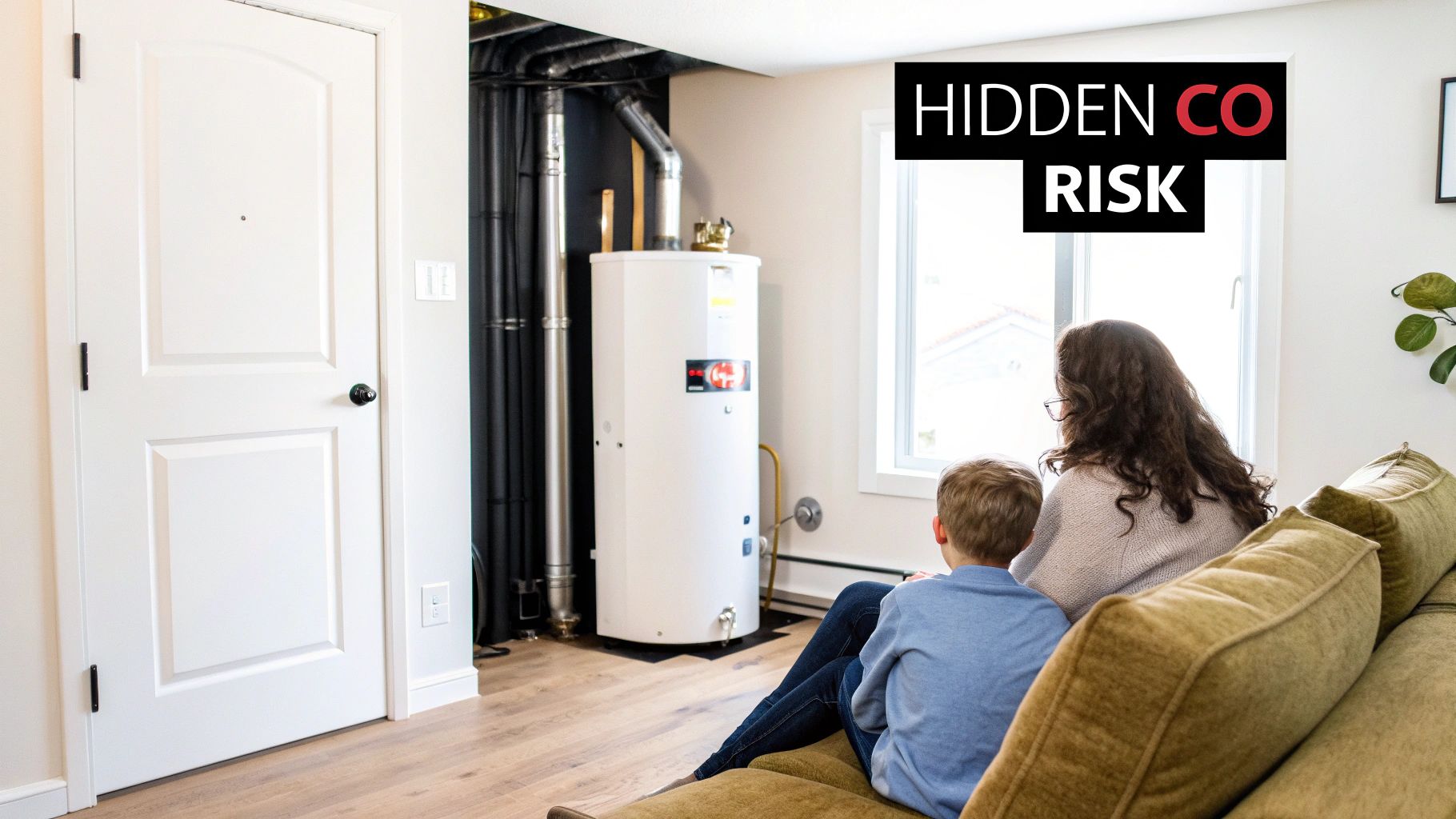
It’s easy to feel safe and sound while your furnace hums along, keeping a harsh Canadian winter at bay. But the very appliances that provide our comfort can also pose a silent threat. Carbon monoxide (CO) is a byproduct of incompletely burned fuels—think natural gas, propane, oil, wood, or even coal.
Everyday workhorses like your furnace, water heater, gas stove, and fireplace are all potential sources. This makes knowing how to test for carbon monoxide less of a recommendation and more of a non-negotiable skill for every homeowner in Canada.
A Story That Hits Close to Home
Think about a family in Ottawa who started feeling off during the winter—dull headaches, tired all the time. They brushed it off as just the seasonal blues, something many of us feel during those long, dark months. But they noticed something odd: they all felt much better after spending time outside. That nagging suspicion led them to call in a professional, who found their aging water heater had a faulty vent. It was slowly leaking low levels of CO into their house.
This kind of story is frighteningly common because the early signs of CO exposure feel just like the flu. It drives home a critical point: you absolutely cannot trust your own senses to detect it.
Carbon monoxide is called "the silent killer" for good reason. Without a working detector, a home can fill with deadly gas while the people inside simply fall asleep, never waking up. Prevention and detection are the only tools you have.
Let's Bust a Dangerous Myth
There's a persistent and dangerous myth that you can "smell gas" if you have a carbon monoxide problem. That’s just not true. The rotten egg smell is an additive put into natural gas specifically to alert you to a gas leak, not a CO issue. Carbon monoxide itself has no smell at all. Believing you can sniff it out creates a false sense of security that could be fatal.
Beyond detectors, it pays to know the warning signs from your appliances. An orange flame on your gas stove, for instance, isn't normal; it can signal incomplete combustion. Knowing how to fix an orange flame on a gas stove is a great proactive step. The same logic applies to other fuel-burning equipment, including specialty items like the different types of gas heaters for a garage.
Ironically, our modern, energy-efficient homes can sometimes make the problem worse. They're built to be tightly sealed to keep the cold out, but that also means less natural ventilation. If a CO leak starts, the gas can build up to dangerous levels much faster than in an older, draftier house.
Choosing the Right Carbon Monoxide Detector
Walking down the hardware store aisle, you're faced with a wall of carbon monoxide detectors. It's easy to feel overwhelmed, but picking the right one is your first line of defence. This isn't just about grabbing the first box you see; it’s about making an informed choice to protect your family.
Let's break down the main options you'll find. Each type has its place, and the best one for you really depends on your home and lifestyle.
Comparing Your Detector Options
To make sense of it all, let's compare the most common types of CO detectors you'll find on the shelf. Each has its strengths, and knowing the difference helps you pick the right one for your home's layout and your peace of mind.
| Comparing Carbon Monoxide Detector Types | ||||
|---|---|---|---|---|
| Detector Type | Power Source | Key Feature | Best For | ULC/CSA Certified? |
| Battery-Powered | Batteries (AA, 9V, etc.) | Ultimate placement flexibility; not tied to an outlet. | Homes with few outlets, renters, quick & easy setup. | Yes, always check for the mark. |
| Plug-In with Battery Backup | Wall Outlet + Battery | Continuous power with protection during outages. | Most standard homes, especially where power can be unreliable. | Yes, the backup feature is crucial. |
| Interconnected Smart System | Hardwired or Wireless | When one alarm sounds, they all sound. | Larger or multi-level homes for whole-house alerts. | Yes, ensures system-wide reliability. |
The takeaway here is simple: think about your home's specific needs. A small condo might be perfectly served by a battery-powered unit, while a large, three-story house in the GTA absolutely needs an interconnected system to be truly safe.
The Non-Negotiable: Look for the Mark of Safety
No matter which type you lean towards, there’s one detail that is absolutely non-negotiable.
Flip the box over and look for a CSA (Canadian Standards Association) or ULC (Underwriters Laboratories of Canada) certification mark. This little logo is your guarantee that the device has been independently and rigorously tested to meet strict Canadian safety standards.
An uncertified detector is a gamble you should never, ever take. That CSA or ULC mark is your assurance that the device will actually work when you need it most—when seconds count.
These certifications mean the sensor, the alarm, and the internal components are all built to perform reliably during an emergency. Don't settle for anything less.
Understanding the Tech Inside: Why Sensors Matter
The heart of any detector is its sensor. For home use, the gold standard is the electrochemical sensor.
These sensors are incredibly sensitive and precise, especially at detecting low levels of CO. This accuracy is key to avoiding the annoying false alarms that can happen with older or less sophisticated technologies. They work by sensing changes in electrical currents when carbon monoxide is present, providing a reliable and long-lasting detection method.
To test your home effectively, you should always use a ULC-listed detector with an electrochemical sensor. These are specifically calibrated to alert you based on concentration and time—for instance, triggering at 70 parts per million (ppm) over a few hours or much faster at 300 ppm. This tiered sensitivity is critical for early warning, aligning with established air quality standards. You can read more on CO detection and its impact in this detailed report on US A Facts.
The Power of a Digital Display
Here’s a feature that I always recommend to homeowners: a digital readout. While a basic alarm will shriek when CO hits a dangerous level, a detector with a digital display acts as an early warning system.
It shows you the real-time CO concentration in parts per million (ppm), even at very low levels that won't trigger the main alarm.
Why is this so valuable? Imagine seeing a steady reading of 15 ppm. That's not high enough to set off the alarm, but it's a huge red flag that a small, persistent CO leak is starting somewhere—maybe from a failing furnace or a poorly vented water heater. This insight allows you to be proactive and call a professional before it becomes a crisis. It turns your detector from a passive alarm into an active diagnostic tool.
For homeowners who want a complete picture of their home's health, pairing a great CO detector with a comprehensive air quality testing kit can give you an even deeper understanding of what you're breathing every day.
Choosing the right CO detector is your first and most important step. It's about picking a certified, reliable device with features that match your home's needs, giving you a powerful tool to protect everyone inside.
Strategic Detector Placement for Maximum Safety
Having a carbon monoxide detector is one thing, but knowing where to put it is what truly makes a difference. Proper placement is everything—it's the difference between an early warning and a device that's practically useless in an emergency.
Think of it less like a chore and more like creating a strategic safety net. Your goal is to place alarms along the pathways CO gas is most likely to travel and in areas where your family is most vulnerable, especially while sleeping.
Before you start mapping out locations, it helps to know what kind of detector you're working with.
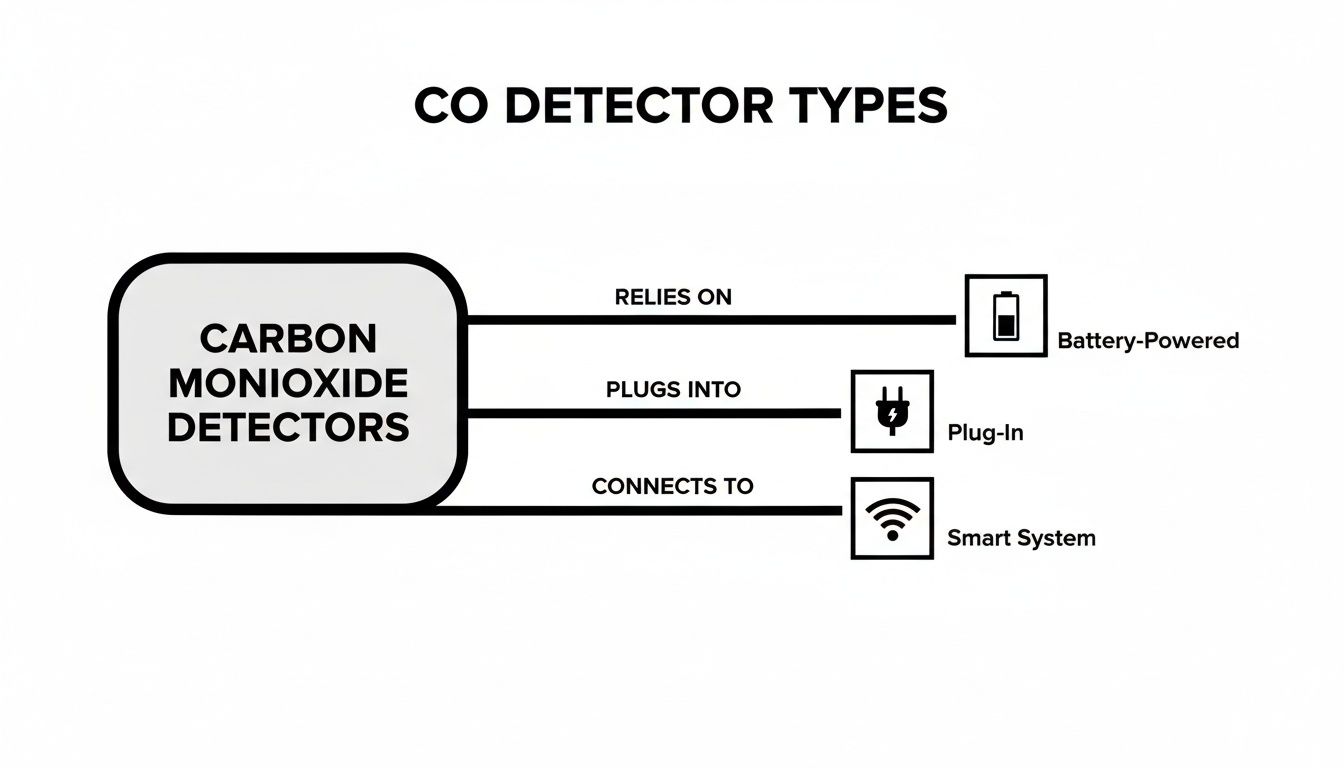
This quick visual breaks down the three common types: battery-powered, plug-in, and smart detectors. Each has different power needs that will influence where you can install them, so it's a good first step in your planning.
The Golden Rule of Placement
Here’s the absolute must-do: install a carbon monoxide detector in the hallway right outside the bedrooms. This is the most critical spot in the entire house.
Why? Because you're most defenceless when you're asleep. A detector placed near sleeping areas ensures the alarm is loud enough to wake everyone, giving you the crucial time needed to get out safely.
In Ontario, this isn't just a recommendation; it's the law. The Hawkins Gignac Act makes it mandatory to have CO alarms near all sleeping areas in homes. This legislation came from a place of tragedy, and it’s a powerful reminder of how vital correct placement really is.
Key Placement Locations in Canadian Homes
To create a complete safety net, a few other spots are essential, especially in typical Canadian homes with basements and attached garages.
- On Every Level: Basements and lived-in attics count, too. CO can easily travel through your home’s ductwork and up stairwells, so each floor needs its own alarm.
- Near the Furnace Room: Place a detector about 5-6 metres (15–20 feet) from your furnace or boiler. This is a sweet spot—close enough to catch a leak early but far enough away to avoid false alarms from the minor emissions that happen when an appliance kicks on.
- Near Attached Garages: If your garage is attached to the house, an alarm in the adjacent room or hallway is a must. A car left running by mistake can flood a garage with deadly CO in minutes, and that gas can quickly find its way inside.
The real strategy here is creating overlapping zones of protection. An alarm near the source (like the furnace) and an alarm near the people (outside the bedrooms) work together. You need both.
Testing for CO in these critical areas should be part of your regular home maintenance. This also ties into your home's overall indoor air quality. If you're wondering about more than just CO, it's a good idea to learn how to check the overall air quality in your home for a more complete picture.
The No-Go Zones: Where to Avoid Installing Detectors
Just as important as knowing where to put detectors is knowing where not to. The wrong spot can cause endless false alarms or—much worse—a delayed warning when you need it most.
Keep your CO detectors clear of these areas:
- Directly in Kitchens or Furnace Rooms: Keep them nearby, but not right inside. Cooking fumes and the small puff of exhaust when a furnace starts up can trigger nuisance alarms.
- Humid Spaces: Bathrooms and laundry rooms are out. High humidity can mess with the sensor and cause it to fail over time.
- Near Windows or Vents: Drafts from an open window, air return, or supply vent can blow carbon monoxide away from the sensor, meaning it won't detect a real leak.
- In Direct Sunlight: The heat from the sun can damage the unit's internal parts and lead to unreliable readings.
By thinking through where each detector goes, you're not just installing a device—you're deploying a smart, life-saving system designed for your home's layout.
Your Essential CO Detector Maintenance Routine
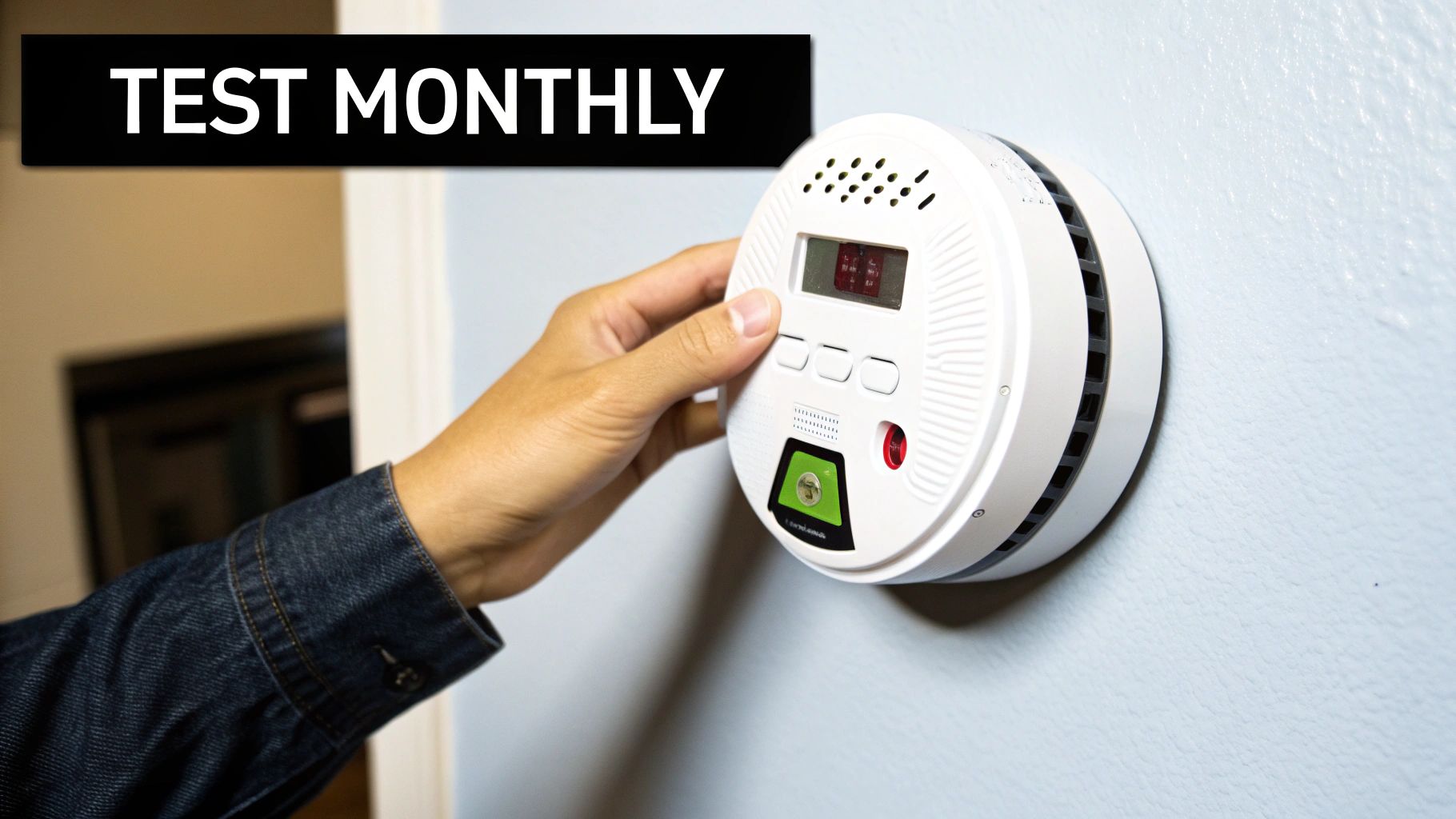
A carbon monoxide detector that just sits there, untested, is really nothing more than a piece of plastic on the wall. Having one is a great first step, but making sure it’s always ready to protect you and your family requires a simple, memorable routine. It isn't complicated at all—just a few minutes of your time that pays off in a huge way.
Think of it like checking the oil in your car. It's a quick, regular check-up that prevents a total disaster down the road. For your CO detector, this just means getting into a rhythm of testing, cleaning, and replacing parts before they have a chance to fail.
The Simple Monthly Test
The easiest and most frequent task is the monthly test button check. Just once a month, go to each of your CO detectors and press and hold the "Test" button. You should be greeted with a loud, piercing alarm, which confirms the siren and internal electronics are good to go.
If that alarm sounds weak or doesn't go off at all, that's a major red flag. It needs your attention right away.
For a more in-depth check, especially in high-risk spots like the garage, some people use digital CO meters that show real-time PPM readings. This is a solid idea near any area where a car might be idling, as attached garages are a surprisingly common source of CO poisonings. You can review the research on Tracking California to see just how much idling vehicles can contribute to CO exposure.
Understanding the Beeps and Chirps
Your detector has its own language, and it's crucial to know what it's trying to tell you. Different sounds mean very different things.
- Loud, Continuous Alarm: This is the real deal—an emergency. It means your detector has sensed dangerous levels of carbon monoxide. Get everyone out of the house immediately and call 911 from a safe distance.
- A Single Chirp Every Minute: This is the most common sound you'll hear. It’s the low-battery warning. Swap in a fresh battery right away.
- Several Chirps Every Minute: This usually signals an "end-of-life" warning. The sensor inside has worn out, and the entire unit must be replaced.
A chirping detector isn’t something you can just ignore or put on the to-do list for later. Whether it’s a dying battery or an expired sensor, it means your first line of defence against CO poisoning is down. Deal with it immediately.
Creating a Practical Maintenance Schedule
Consistency is everything. The easiest way to stay on top of maintenance is to tie it to habits you already have. Here’s a great Canadian trick: sync your battery changes with daylight saving time. When you change your clocks in the spring and autumn, make it a point to change the batteries in all your CO and smoke detectors.
On top of that, give the unit a gentle cleaning twice a year. Dust and cobwebs can easily block the sensor vents, stopping CO from ever reaching it. The soft brush attachment on your vacuum is perfect for carefully clearing debris off the detector's casing. Never use water or household cleaners on the unit.
Proper maintenance also ties into the health of your home's HVAC system. A furnace that's running properly is far less likely to produce CO in the first place. You can follow our furnace maintenance checklist to help keep your system running safely and efficiently.
The Most Overlooked Detail: The Expiry Date
Here’s a fact that catches so many homeowners by surprise: carbon monoxide detectors don’t last forever. The sensors inside break down over time, giving them a typical lifespan of five to ten years. An expired detector might look perfectly fine and even pass the button test, but its sensor could be completely useless at detecting carbon monoxide.
To check yours, take the detector off its mounting base. You should find a sticker on the back with a "replace by" date or a date of manufacture. If it only lists the manufacturing date, just add the lifespan from the user manual (usually seven or ten years) to figure out when it's due for replacement. If that date has passed, replace it now.
Think about the family whose old detector failed to go off when their furnace malfunctioned. The only reason they survived is that one person happened to wake up feeling dizzy. Their detector was two years past its expiry date—a silent failure that almost cost them everything. This is exactly why replacing your detector on time isn't just a recommendation; it's absolutely critical.
When DIY Testing Is Not Enough
Your home’s carbon monoxide detectors are the essential first line of defence, standing guard 24/7. But it's crucial to understand what they are—and what they aren't. They're alarms, not diagnostic tools. There are times when relying only on store-bought devices just doesn’t cut it, and you need to bring in a professional with specialized equipment.
Knowing when to move from passive monitoring to a hands-on professional inspection is a critical part of home safety. A trained technician can dig in and find the "why" behind a CO problem, not just tell you that you have one.
The Limits of a Consumer Alarm
A standard residential CO alarm is built for one job: to scream loud and clear when it detects a high concentration of carbon monoxide over a set time. And it does that job incredibly well, getting you and your family out of the house in an emergency.
But here’s the catch: it can’t tell you if you have a slow, low-level leak. These sneaky leaks, often flying under the alarm’s trigger threshold, can still cause serious health problems over time. Worse, they’re often a flashing red light for a bigger, brewing issue with one of your appliances. This is where a pro's toolkit makes all the difference.
A consumer CO alarm is like a smoke detector—it tells you there's a fire, but it can't tell you if it's a small spark in the wiring or a full-blown furnace failure. For that, you need an expert to investigate the source.
An HVAC technician doesn't just wave a detector around the room. They use advanced gear to pinpoint the exact source of the problem, making sure it’s fixed for good.
Scenarios That Demand a Professional Inspection
Some situations should automatically prompt a call to a qualified HVAC professional for a thorough CO check, even if your alarms are dead silent. These events can introduce new risks or signal a hidden danger that’s just waiting to get worse.
You should always book a professional inspection if:
- You've just installed new fuel-burning appliances. A brand-new gas furnace, water heater, or even a fireplace needs an expert eye to confirm it’s venting properly from day one. Don't just assume it is.
- Your family experiences CO-like symptoms. Are people in your home dealing with nagging headaches, dizziness, or nausea that magically seems to get better when they leave the house? Trust your gut. This is a textbook sign of low-level CO exposure that your alarm will likely miss.
- You see warning signs on your appliances. Soot stains building up around a furnace, a lot of moisture on your windows, or a lazy, yellow-orange flame on a gas stove (it should be a crisp blue) are all signs of incomplete combustion—the very process that creates carbon monoxide.
For a deeper look into your home's air beyond just CO, a comprehensive indoor air quality testing service can uncover other hidden pollutants and give you the full picture of what you're breathing every day.
What a Professional CO Test Involves
When you call a company like Can Do Duct Cleaning, our process is worlds away from what a home detector can do. Our technicians use a piece of equipment called a combustion analyzer, which is the gold standard for CO diagnostics.
Instead of just sampling the air in the room, this device takes a direct reading from inside the flue pipe of your furnace or water heater. This lets us measure the exact amount of carbon monoxide being produced during combustion, before it even has a chance to leak into your home.
This is the only way to identify serious problems like a cracked heat exchanger in your furnace—a dangerous defect that’s completely invisible to the naked eye and a common source of major CO leaks.
A professional will also check for proper venting, make sure there’s enough air for combustion, and inspect the overall safety and efficiency of your equipment. It's a proactive approach that doesn't just find existing leaks; it prevents future ones from happening. That’s how you get genuine peace of mind.
Frequently Asked Questions About CO Safety
Even with detectors installed and a good routine, it's natural to have questions about carbon monoxide. It's one of those topics where knowing the right answer can literally save a life. Let's clear up some of the most common questions we hear from homeowners across Canada.
Getting these details straight is the difference between just having a detector and actually understanding how it keeps your family safe.
What Should I Do If My Carbon Monoxide Alarm Goes Off?
This is the one question you need to know by heart. The second your CO alarm starts blaring its loud, continuous alert, your only job is to get everyone out of the house immediately.
Don't stop to open windows, don't try to find the source, don't grab your wallet. Just get out into the fresh air. Once you're safely outside and a good distance from the house, call 911. The fire department is equipped to handle this; they have professional-grade equipment to test the air and will tell you when it's safe to go back in. Never, ever re-enter your home until they give you the all-clear.
Are Portable Heaters a CO Risk?
During a chilly Canadian winter, this question comes up a lot. The answer depends entirely on the type of heater you're using.
Electric heaters are totally fine. Since they don't burn fuel, they don't produce carbon monoxide. But any heater that burns fuel—think propane, kerosene, or other flammable liquids—is a serious CO risk. These should never be used in an enclosed space like your house, a garage, or even a tent unless they are specifically designed for indoor use and have proper ventilation. It's often during power outages that people make a fatal mistake with these, so be prepared with safe alternatives.
A chirping detector is not a full-blown alarm, but it's a warning that your safety net is compromised. An intermittent chirp is a clear signal that your detector needs immediate attention to get back in working order.
Why Is My CO Detector Chirping?
That annoying chirp is completely different from a full-blown emergency alarm. It’s the device's way of telling you it needs maintenance. Knowing what it means is crucial.
- A single chirp every 30-60 seconds is the classic "low battery" signal. Swap it out with a fresh, high-quality battery right away.
- A series of chirps or a digital display showing "END" or "ERR" usually means the whole unit has reached its end-of-life. The sensor is expired, and you need to replace the entire detector.
When in doubt, check the user manual for your specific model, as the signals can vary a bit.
Is It a Legal Requirement to Have CO Detectors in Canada?
There isn't a single federal law covering the whole country, but most provinces have made it mandatory. Right here in Ontario, as well as in Alberta, Quebec, the Yukon, and Manitoba, it's the law to have CO detectors if your home has a fuel-burning appliance, a fireplace, or an attached garage.
Laws like Ontario's Hawkins Gignac Act were put in place to prevent tragedies. It’s always smart to check your local municipal and provincial building codes to make sure you're compliant. These rules exist for one reason: to save lives. Knowing how to test for carbon monoxide in your home isn't just a good practice—in many parts of Canada, it's the law.
A working CO detector is your first line of defence, but ensuring your appliances are running safely is the best prevention. If you're worried about your furnace, vents, or the general air quality in your home, it's time to call in the pros. The team at Can Do Duct Cleaning has over 30 years of experience helping families in the GTA breathe safer, cleaner air. Schedule your inspection today at https://www.candoductcleaning.com.