
Everyone wants to know what the best furnace brands in Canada are. You’ll always hear names like Carrier, Lennox, and Trane thrown around, and they’re great. But here's the real secret from someone in the business: the "best" brand isn't a brand at all. It's the one that’s a perfect match for your home, your climate, and your budget.
Finding that sweet spot means balancing brand reliability with energy efficiency and, most importantly, the skill of the person installing it.
Your Ultimate Guide to Choosing a Furnace in Canada
Trying to pick a new furnace can feel like you’ve been dropped in a maze. There are dozens of models, confusing technical specs, and a whole new language to learn. Let's cut through the noise. Think of this guide as your personal roadmap to making a smart, long-term investment in your home's comfort.
A new furnace is a big deal. It's one of the most important purchases you'll make for your home. Get it right, and you’re set for years of cozy warmth and predictable energy bills, especially when those Canadian winters hit hard. Get it wrong, and you could be facing a future of high costs, surprise repair bills, and a thermostat that never seems to get it right.
Key Factors for Canadian Homeowners
Before you even start looking at brand logos, you need to get a handle on the fundamentals. These are the core elements that define a great furnace choice for any home in Canada, from Vancouver Island to St. John's.
- Home Size and Layout: A furnace that's too small will run constantly, struggling to keep up. One that's too big is just as bad—it will short-cycle, turning on and off too often, which wastes a ton of energy and puts extra strain on its components.
- Regional Climate: The heating needs in a damp B.C. winter are worlds apart from what you’d need on the frozen Prairies. Your local weather dictates how powerful and efficient your furnace needs to be.
- Installer Quality: I can't stress this enough—this is the single most important piece of the puzzle. A top-tier installer can make a mid-range furnace perform flawlessly, while a poor installation can ruin even the most expensive unit.
This simple decision tree lays it out perfectly. Figuring out your home's size, your local climate, and who you'll trust for the installation are the absolute first steps.
As you can see, the brand choice comes after you’ve sorted out the basics. It’s all about finding a solution tailored to your specific situation, not just picking a name out of a hat.
Why a Holistic View Matters
Choosing a furnace is not like buying a toaster. You're not just picking a box off a shelf. You’re investing in a complex system that has to work in perfect harmony with your home.
The most reliable, high-end furnace will fail to perform if it's installed incorrectly or improperly sized for your home. Your focus should be on the entire heating solution—the equipment, the installation quality, and the ongoing support.
The goal is to find that perfect balance. A reliable brand is important, of course, but its true potential is only unlocked by a professional who knows how to assess your home and install the unit correctly.
For a deeper dive into what makes a great setup, you can learn more about what to expect from professional furnace installation services that make sure your new unit actually delivers on its promises.
Understanding AFUE and Your Heating Bills
When you start digging into furnace options for your Canadian home, you’ll quickly run into a four-letter acronym: AFUE. It might sound like technical jargon, but it’s actually the single most important number for figuring out how much that new furnace will cost you to run, winter after winter.
Think of the Annual Fuel Utilization Efficiency (AFUE) rating just like the fuel economy (L/100km) on a new car. It’s a straightforward measure of how much of the hydro or natural gas you pay for actually gets turned into cozy heat for your family.
Decoding the AFUE Percentage
The AFUE rating is simply a percentage. A furnace with a 96% AFUE rating, for example, is incredibly efficient. It means that for every dollar you spend on natural gas, 96 cents of it becomes heat for your living room. The other four cents? That’s just waste heat lost up the exhaust vent.
Now, compare that to an old furnace that's been chugging along in your basement for 15 or 20 years. It might have an AFUE of 80% or even less. That means a whopping 20 cents of every single dollar you spend on heating is literally going up in smoke, doing nothing to keep you warm.
The good news? In Canada, federal regulations now mandate that most new natural gas furnaces sold must have a minimum efficiency of 95% AFUE. This move ensures that even entry-level models are light-years ahead of the old energy-guzzlers, preventing massive energy waste.
This high minimum standard is fantastic for homeowners. It guarantees you’ll see significant savings right off the bat compared to an older unit. But pushing for an even higher rating, like 97% or 98%, can really pay off in the long run as energy prices continue to climb.
How AFUE Translates to Real-World Savings
Making the jump from an old, inefficient furnace to a new high-efficiency model isn't a minor tweak—it's a strategic investment that pays you back every month. The difference on your heating bills can be huge, often adding up to hundreds of dollars saved each year.
Let’s run some numbers. Say your old furnace has an 80% AFUE rating, and your annual heating bill is around $1,500. Straight away, we know $300 of that (20%) is wasted energy. Let's see what happens when you upgrade.
- Upgrade to a 96% AFUE Furnace: Your energy waste plummets from 20% down to just 4%. That simple change could slash your annual heating bill by about $240, bringing it down to $1,260.
- Upgrade to a 98% AFUE Furnace: If you opt for a top-tier 98% efficient model, your waste is a tiny 2%. That could translate into yearly savings of around $270, dropping your bill to about $1,230.
Over the typical 15-to-20-year lifespan of a new furnace, those yearly savings can easily pile up to $4,000 to $5,000 or more. Suddenly, spending a bit more upfront for a higher AFUE model looks like a very smart financial decision.
Efficiency and Maintenance Go Hand in Hand
Here’s the catch: that shiny high-efficiency rating on the sticker is only a guarantee if you take care of the equipment. A furnace is a machine, and without regular maintenance, its performance will decline. Neglecting it is like throwing away the savings you paid for.
Annual tune-ups are essential. They ensure all the components are clean, calibrated, and working in sync, which allows the unit to hit its certified AFUE rating year after year. To see what a proper service call involves, check out this comprehensive furnace maintenance checklist. Think of it as protecting your investment and keeping those heating bills as low as possible.
Comparing Furnace Types for Canadian Winters
Beyond the brand name and the AFUE rating lies something that will have a much bigger impact on your home’s comfort and your monthly bills: the furnace’s stage of operation.
Simply put, not all furnaces deliver heat the same way. Getting your head around the differences is the key to picking a unit that can actually handle the wild temperature swings of a typical Canadian winter.
To make this easy, let's think of it like a car's accelerator.
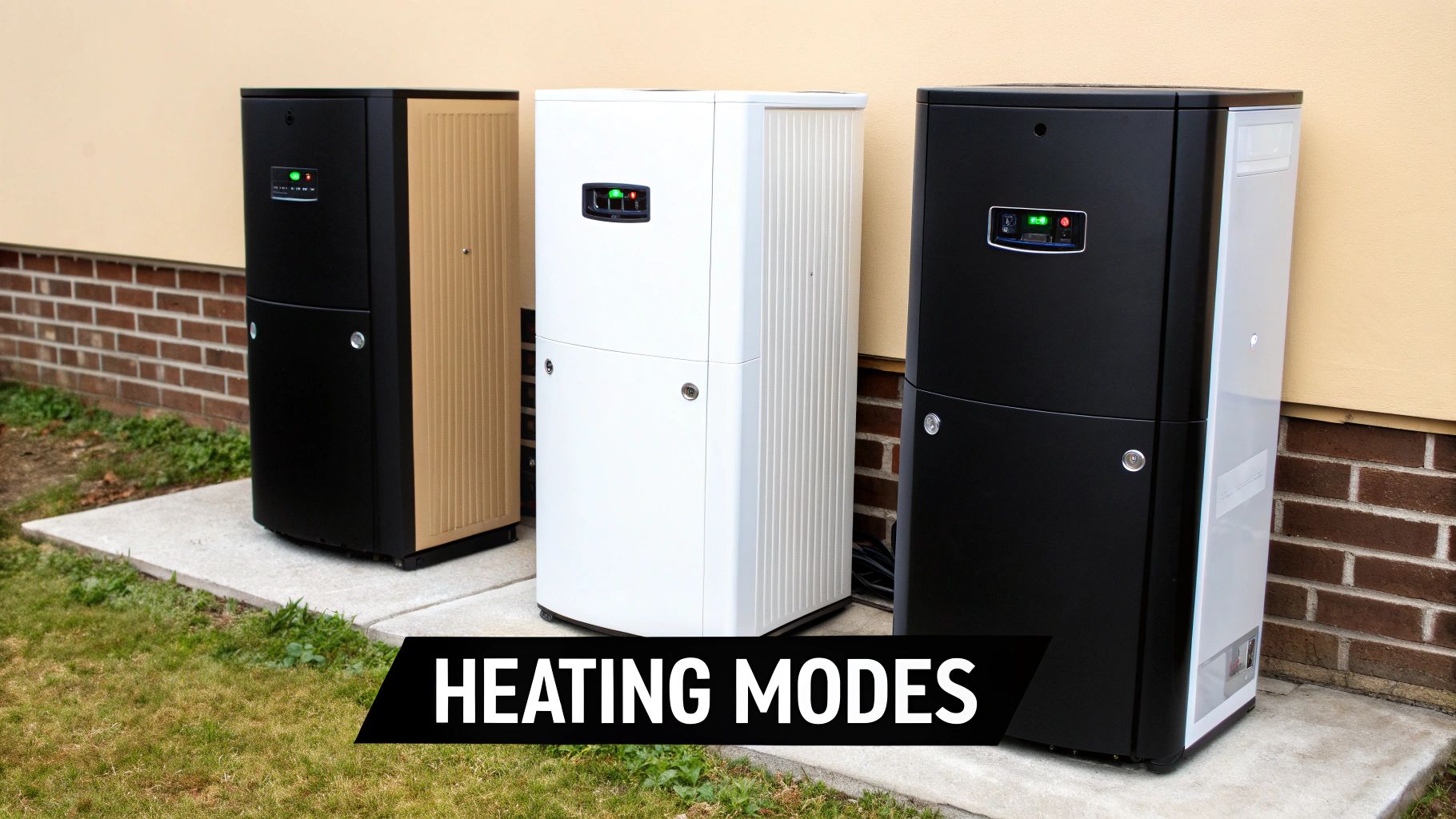
A furnace's "stage" is really just its power setting. It dictates how much heat it can crank out at any given time, ranging from a basic on/off function to incredibly precise, self-adjusting performance.
Single-Stage Furnaces: The On or Off Switch
A single-stage furnace is the most basic model you can buy. It operates like a light switch—it’s either running at 100% full blast or it’s completely off. There’s no in-between.
Imagine flooring the gas pedal every time you need to speed up, then taking your foot off completely. It’s jerky, and it's not very efficient. This all-or-nothing approach leads to noticeable temperature swings in your home. The furnace blasts hot air until the thermostat is happy, then shuts down, letting the house get chilly before the whole noisy cycle starts over again.
Two-Stage Furnaces: Adding a Low Gear
A two-stage furnace is a big step up in both comfort and efficiency. It has two output levels: a low setting (usually around 60-70% of its max power) and the full-power high setting.
This is like having a low gear for cruising. For most of the winter, the furnace will hum along on its quiet, energy-saving low stage. This provides a longer, gentler heating cycle that keeps the temperature much more consistent. But when a real cold snap hits, it can kick into high gear to bring your home back to a comfortable temperature quickly.
Modulating Furnaces: The Cruise Control of Home Heating
At the top of the line, you'll find the modulating furnace. This is the smartest of the bunch. It can adjust its heat output in tiny, precise increments—often as small as 1% at a time—to perfectly match your home's heating needs from one moment to the next.
Think of this as the cruise control for your home's comfort. Instead of jarring stops and starts, a modulating furnace makes constant, subtle adjustments to maintain an incredibly stable indoor temperature. The result is pure comfort and the best possible energy efficiency.
This constant, low-level operation gets rid of that uncomfortable cycle of getting too hot, then too cold. And because the fan runs longer at a lower speed, it does a much better job of circulating and filtering the air in your home. This advanced control is why many homeowners believe the best furnace brands in Canada are the ones that have mastered modulating technology. For homes with unique heating needs, other solutions like those in our guide on hot water baseboard heaters might be a better fit.
To help you decide, here’s a quick breakdown of how these three types stack up against each other.
Single-Stage vs Two-Stage vs Modulating Furnaces
| Furnace Type | How It Works | Best For | Pros | Cons |
|---|---|---|---|---|
| Single-Stage | On/Off switch. Runs at 100% capacity or is off. | Budget-conscious buyers, smaller homes, milder climates. | – Lower upfront cost – Simpler mechanics, fewer parts to fail | – Noticeable temperature swings – Less energy efficient – Can be noisy |
| Two-Stage | Has a low (60-70%) and high (100%) setting. | Most Canadian homes, balancing cost and comfort. | – More consistent temperature – Quieter operation – Better efficiency | – Higher upfront cost than single-stage |
| Modulating | Adjusts output in tiny increments (e.g., 40% to 100%). | Homeowners prioritizing ultimate comfort and efficiency. | – Superior comfort with no drafts – Highest energy efficiency – Best for air filtration | – Highest initial investment |
Ultimately, the right choice depends on your budget and how much you value consistent, quiet comfort. For most Canadians, a two-stage furnace hits the sweet spot, but a modulating unit is the undisputed king of comfort.
Why It Matters for Canadian Climates
In a country where the weather can be so unpredictable, a furnace that can adapt is a huge asset. This is where a modulating furnace truly shines. On a mild autumn day, it might just sip fuel, running at 40% capacity. But when a blizzard rolls into town, it can seamlessly ramp up to 100% to keep your family warm, all without wasting a loonie.
A Profile of Canada's Leading Furnace Brands
When you start digging into the best furnace brands in Canada, you'll see a few names pop up again and again. These are the industry heavyweights, and they’ve earned their reputations by delivering reliable, efficient, and long-lasting performance. But here’s the thing: each brand has its own personality and excels in different areas.
Instead of just crowning one brand as the absolute "best," we’re going to give you an honest look at the major players. This way, you can see their strengths and figure out which one aligns with what matters most to you—whether that’s bleeding-edge efficiency, bulletproof durability, or just great, straightforward value.
Lennox: The Efficiency Champion
Lennox has built a rock-solid reputation for pushing the limits of energy efficiency. If your main goal is to shrink your long-term energy bills, Lennox is probably the first name you’ll hear. Their top-of-the-line models are engineered to wring every last drop of heat out of the fuel they consume.
With heating costs always on the rise, this focus on peak performance is more important than ever. Lennox really is the energy efficiency king among Canadian furnace brands, with some models hitting AFUE ratings of up to 99%—the highest you can get. That's a huge deal for anyone trying to cope with skyrocketing natural gas prices.
To put it in perspective, a family in a standard 2,000 sq ft Calgary home could save $400-$500 a year on utilities by switching from an old 80% efficient unit to a Lennox SLP99V. Over a decade, that’s $4,000-$5,000 back in your pocket, which is a significant buffer against rising gas rates across the country.
The brand’s Signature Collection, especially the SLP99V model, is an engineering marvel. It uses a modulating gas valve and a variable-speed blower to give you incredibly precise, steady heat while running so quietly you'll barely know it's on.
Trane: Built to Last
If Lennox is the efficiency specialist, then Trane is the undisputed heavyweight champion of durability. Their whole marketing slogan is "It's hard to stop a Trane," and frankly, they've earned it. For Canadian homeowners who face down brutal winters year after year, that promise of rock-solid reliability is music to our ears.
Trane furnaces are famous for their beefy construction and high-quality internal parts. This obsession with durability often means a longer lifespan and fewer calls to the repair tech over the years. Homeowners who value peace of mind and don't mind investing a bit more upfront for a furnace that can take a beating often end up with a Trane.
Their top models, like the XV series, manage to blend this legendary toughness with advanced features like modulating performance, so you don’t have to trade comfort for reliability.
Carrier: The Innovative All-Rounder
Carrier is one of the most recognized and respected names in the HVAC world, and for very good reason. The brand consistently strikes a fantastic balance of innovation, reliability, and efficiency across all its product lines. You can think of Carrier as the dependable all-rounder that just does everything really, really well.
A great example of their technical prowess is the Infinity Series with Greenspeed Intelligence. This smart technology allows the furnace to adapt its output with incredible precision, which means super stable indoor temperatures and excellent energy savings. They also offer a huge range of models, from the budget-friendly Comfort series to the high-performance Infinity series, so it’s easier to find a unit that fits your home and your wallet.
Goodman and Amana: The Value Leaders
For a lot of us, the upfront cost is a huge part of the decision. This is exactly where brands like Goodman and its sister company, Amana, come into their own. They’ve built their business on a simple premise: providing reliable, no-frills heating that’s more affordable from day one.
While they might not always have the most cutting-edge features or the absolute highest AFUE ratings, Goodman and Amana furnaces offer a powerful value proposition. They just work, and they don't break the bank.
Amana, in particular, has a killer feature: one of the best warranties in the business. On some of their premium models, they offer a lifetime unit replacement warranty. That provides a fantastic layer of security and long-term value for budget-conscious buyers.
Of course, the furnace itself is only part of the equation. To understand the total investment for a new system, check out our detailed guide on new furnace costs in Ontario.
Napoleon: The Canadian Contender
For anyone who loves to support local, Napoleon is a fantastic choice. This is a Canadian company, based right in Barrie, Ontario, and they design and build their furnaces specifically for our country's unforgiving climate.
Napoleon offers a solid lineup of high-efficiency furnaces, including modulating models that deliver top-tier comfort and energy savings. Choosing a Canadian-made brand like Napoleon doesn't just support our national economy—it gets you a product engineered by people who know exactly what a Canadian winter feels like.
Why Your Installer Is More Important Than the Brand
If you only take one piece of advice from this entire guide, let it be this: a top-of-the-line furnace installed poorly will always be worse than a mid-range furnace installed by a true professional. The quality of the installation is, without a doubt, the biggest factor in your furnace’s efficiency, reliability, and lifespan.
Think of it like buying a high-performance engine for a race car. If a backyard mechanic shoves it in, misaligns the parts, and cuts corners on the wiring, you’ll never get the power you paid for. It’s the exact same story with your furnace.
A shoddy installation is a recipe for disaster. It leads to terrible energy efficiency, frequent breakdowns, a drastically shorter lifespan, and even serious safety hazards like carbon monoxide leaks. Your investment is too big to leave in the hands of anyone but an expert.
The Non-Negotiable Manual J Load Calculation
Before a contractor even whispers a model number, they absolutely must perform a Manual J load calculation. This isn't just a quick look-see; it's a detailed analysis of your home's unique heating needs. It accounts for everything—square footage, window quality, insulation levels, ceiling height, and local climate data.
It is the only scientific method for sizing a furnace correctly. Any installer who just eyeballs your old unit and suggests a "same-size" replacement is just guessing, and that’s a massive red flag.
An improperly sized furnace—whether it’s too big or too small—will never run efficiently. It will short-cycle, wear out faster, and leave you uncomfortable. Insisting on a Manual J calculation is your first and best defence against a botched installation.
Vetting Your HVAC Contractor
Choosing the right installer is a project in itself, but it pays off. A great contractor is more than just a pair of hands; they’re an expert partner protecting your investment. The challenge of finding a reliable general contractor is something many homeowners face, and the same diligence applies here.
Here's a quick checklist to help you find the right team for the job:
- Licensing and Insurance: Make sure they are fully licensed, insured, and WSIB compliant. No exceptions.
- Detailed Quotes: A real pro provides an itemized quote listing the exact equipment models, labour costs, and any extra work needed.
- References and Reviews: Don't just trust the website. Check recent Google reviews and ask for references from past clients in your neighbourhood.
- Brand Certifications: The best installers are often certified directly by the brands they sell, meaning they’ve had factory-level training on that specific equipment.
Even the most bulletproof brands need an expert touch. Take Trane, for instance. Their furnaces are engineered to handle Canada’s brutal winters, pumping out heat down to -30°C. With a typical lifespan of over 20 years and a first-decade failure rate of just 1.2% (compared to the 5% industry average), their quality is undeniable. But it's the professional installation that actually unlocks that legendary durability.
Finally, remember that a quality installation sets the stage for your home's air quality. Once the new system is in, consider hiring a professional air duct cleaning company to make sure the air circulating through your brand-new furnace is as clean as possible from day one.
Navigating Rebates and Warranties in Canada
Let’s be honest, a new furnace is a major purchase. But with a bit of savvy planning, you can significantly trim the cost and protect your investment for the long haul. Think of government rebates and manufacturer warranties as your two best tools for getting the most value out of your new heating system.
Rebates are essentially a thank-you note from the government for choosing an energy-efficient furnace. Federal and provincial programs are designed to nudge homeowners toward high-efficiency models, which helps ease the load on our energy grid and shrinks our collective carbon footprint.
Unlocking Government Rebates
The big one you've probably heard of is the Canada Greener Homes Grant. This federal program helps Canadians fund energy-saving home upgrades, including new furnaces. But to get cash back from this or any provincial program, your new unit has to clear a few hurdles.
- ENERGY STAR® Certification: This is pretty much non-negotiable. Your furnace must be ENERGY STAR certified, proving it meets strict energy performance standards.
- High AFUE Ratings: You can’t just pick any model. Programs often specify a minimum AFUE rating, like requiring a furnace with 96% or higher.
- Professional Installation: This isn't a DIY project. The installation must be done by a licensed and qualified HVAC technician to qualify.
It’s a true win-win situation. You get money back in your pocket, and you end up with a furnace that’s going to keep slicing your energy bills for years. Just make sure to check the latest rules for your province, as these programs and their requirements can change.
Decoding Furnace Warranties
Once your furnace is up and running, the warranty is your safety net. The problem is, they aren't all created equal, and the fine print can hide some costly surprises if you're not careful. You need to know what you’re looking at.
A furnace warranty isn't a single guarantee. It’s actually made up of three separate parts: parts, heat exchanger, and labour. Understanding what each one covers is the key to knowing how well you're protected.
The parts warranty covers the guts of the furnace—things like the ignitor, blower motor, and control board. This typically lasts for 5 to 10 years. The heat exchanger warranty is the big one, often covering 20 years or even a lifetime, because this part is the heart of your furnace and the most expensive to replace.
Finally, there's the labour warranty. This part comes from your installer, not the manufacturer, and covers the cost of their time if they have to come out for a service call. It’s usually much shorter, covering the first 1 to 2 years.
Here's the most important part: you must register your product with the manufacturer right after it’s installed. If you forget, the warranty often defaults to a much shorter base coverage, leaving you high and dry if something goes wrong.
Frequently Asked Questions
When you're trying to figure out the world of home heating, it’s easy to get overwhelmed. We get it. Here are some no-nonsense answers to the questions we hear most often from Canadian homeowners looking for a new furnace.
How Much Does a New Furnace Cost in Canada?
You can expect a new high-efficiency gas furnace in Canada to cost anywhere from $4,500 to $8,000, and that price includes the full installation.
What causes that big price range? It really comes down to the brand you pick, the furnace’s efficiency (its AFUE rating), and the technology inside—a basic single-stage model will be on the lower end, while a premium modulating furnace will be at the top. The complexity of the job in your particular home also plays a big part in the final quote.
What Is the Best Month to Buy a Furnace in Canada?
Hands down, the best time to buy a new furnace is during the “shoulder seasons”—think spring (April to May) or early autumn (September to October). HVAC contractors are much less frantic during these months compared to the dead of winter when they’re swamped with emergency calls.
Fewer emergency breakdowns means more scheduling flexibility for you and, often, better pricing from installers looking to keep their teams busy.
Planning your furnace replacement during these quieter months is a smart move. You get the breathing room to do your research properly and pick the right contractor, all without the panic of a sudden failure when it's -20°C outside. It’s a strategy that can save you a lot of money and even more stress.
How Long Should a Furnace Last in Canada?
A well-maintained, modern furnace should give you 15 to 20 years of reliable service here in Canada. But hitting that lifespan depends entirely on a few critical things: the quality of the original installation, whether you get it serviced annually, and the build quality of the brand itself.
Our tough Canadian winters put a heavy workload on our heating systems, so professional maintenance isn't just a suggestion—it's essential to keep it running efficiently and make sure it lasts as long as it was designed to.
Is a Canadian-Made Furnace Better?
Not always, but buying Canadian definitely has its perks. Brands like Napoleon, which builds its furnaces right here at home, design their equipment specifically for our climate’s brutal demands.
Of course, top international brands like Carrier, Lennox, and Trane are engineered to perform exceptionally well in cold weather. But choosing a Canadian-made furnace is a great way to support our local economy while getting a machine built by people who know exactly what a Canadian winter feels like.
At Can Do Duct Cleaning, we believe that when a homeowner knows more, they make better choices for their family. Whether you're all set for a new furnace or just need some solid advice on your current system, our team is here to help you create a healthier, more comfortable home. Learn more about our services at https://www.candoductcleaning.com.