
If you're looking for the best central vacuum systems in Canada, a few names consistently come to the top: Cana-Vac, Beam, and Husky. These aren't just vacuums; they're powerful, whole-home cleaning systems that deliver a deeper clean and seriously improve your indoor air quality. Think of it as a long-term investment in your home and your family's health.
Why Central Vacuums Are a Smart Investment for Canadian Homes
It's easy to focus on the convenience—no more lugging a heavy canister up and down the stairs—but the real benefits of a central vacuum system run much deeper. Installing one is a genuine upgrade to your home's infrastructure, on par with putting in a high-efficiency furnace or a modern HVAC system.
The biggest advantage is how these systems deal with dust and allergens. A portable vacuum, no matter how good its filter is, can still end up recirculating microscopic dust particles back into the room you're trying to clean. A central vac, on the other hand, pulls all that debris into a central unit and vents the exhaust air completely outside your living space. For homes with pets, kids, or anyone sensitive to allergies, this makes a world of difference.
Superior Power and Longevity
Let's talk about power. The motors in central vacuum units are beasts, often up to five times more powerful than what you'll find in a typical upright or portable vacuum. That raw suction means a more effective clean on everything from plush carpets to hardwood floors, pulling out dirt you didn't even know was there.
Because the main unit is stationary and built for the long haul, these systems are also incredibly durable. You might get a few good years out of a portable vacuum before it starts to lose suction or break down. A well-maintained central vacuum can easily keep running strong for 15 to 20 years, sometimes even longer.
A central vacuum is not just a cleaning appliance; it's a permanent home improvement that adds tangible value and enhances the health of your living environment.
A Growing Trend in Canadian Homes
It's no surprise that demand for these systems is picking up across Canada. As part of a larger North American trend, the global market for central vacuums is valued at nearly USD 500 million and is expected to keep growing. You can find more details on this market growth at straitsresearch.com. This push is coming from both new home construction and a growing awareness among homeowners about the importance of healthy indoor air.
To truly get why they're so effective, it helps to understand the mechanics. If you're curious to see how dirt is pulled through a network of hidden pipes to the main unit, learn more about how a central vacuum system works in our detailed guide. It really clarifies why they outperform portable vacuums so decisively.
Comparing Critical Features for Canadian Homes
Choosing the right central vacuum isn't just about picking a brand from a big box store. It’s about matching the machine’s core components to your home and lifestyle. For us here in Canada, that means thinking about house size, the kind of messes we clean up (hello, winter salt and slush), and the need for fresh indoor air when we're cooped up all winter.
Getting a handle on the key specs is your first step. A lot of people get hung up on amperage, but that just tells you how much power the motor draws. The real number you want to look for is Air Watts. This is the gold standard because it combines airflow (cubic feet per minute) and water lift (raw suction power) into one number that actually tells you how well the thing cleans. More Air Watts means more power at the end of the hose where it counts.
To make it easier to see what truly matters, here’s a quick breakdown of the features you should be comparing.
Central Vacuum System Feature Breakdown
| Feature | What to Look For | Why It Matters in Canada |
|---|---|---|
| Power | High Air Watts | This is the true measure of cleaning power, crucial for lifting heavy debris like salt, sand, and pet hair from deep within carpets. |
| Motor Type | Tangential Bypass for garages | Protects the motor from moisture and humidity common in Canadian garages and basements, extending the unit's lifespan. |
| Filtration | HEPA or Hybrid (bag/bagless) | Captures fine dust, pollen, and dander, significantly improving indoor air quality during long winters when windows are shut. |
| Canister Size | 20-25 litres or more | A larger canister means you only have to empty it a couple of times a year, which is a welcome convenience. |
| Warranty | 5-10 years on motor/parts | A strong warranty reflects the manufacturer's confidence and protects your investment against our demanding climate. |
This table gives you a starting point, but let's dive a little deeper into what makes these components so important.
Understanding Motor Types for Performance and Durability
The motor is the heart of your central vac, and the type you choose directly affects its power, noise, and how long it will last. You'll generally run into three designs.
- Flow-Through Motors: These are the most common and budget-friendly. The air you vacuum up flows right over the motor to cool it down. They work just fine, but they’re best installed in a dry, climate-controlled space like a finished basement.
- Tangential Bypass Motors: This is a big step up. A separate fan cools the motor, so the dirty, damp air you suck up gets shot straight out the exhaust. It never touches the sensitive electrical parts. This is the design you want if your unit is going in a garage or shed where it's exposed to humidity and temperature swings.
- Peripheral Bypass Motors: Think of this as a happy medium. It keeps the dirty air separate from the motor like a tangential, but it uses a more compact design where both the cooling air and exhaust air exit through the same port. It offers better protection than a flow-through without the larger size of a full tangential.
For anyone with a damp basement or a garage that sees a lot of temperature swings, a tangential bypass motor is a smart long-term investment. It's built to withstand the moisture and corrosive bits of salt we track in, which can seriously extend its working life.
Filtration Technology and Its Impact on Air Quality
A central vacuum’s biggest advantage is how it improves your home’s air. The filtration system is what makes this happen, trapping all the nasty stuff and venting only clean air outside.
Most systems start with Cyclonic Filtration. It uses centrifugal force to spin heavy dirt and debris out of the air and drop it into the canister. It's a simple, bagless method that’s great for big particles and keeps the suction strong.
For those with allergies, HEPA (High-Efficiency Particulate Air) Filtration is what you need. A certified HEPA filter grabs 99.97% of microscopic particles like dust mites, dander, and pollen. The best central vacuums in Canada often use a HEPA filter either on its own or after the cyclonic stage for unbeatable air purification.
Many modern units also offer a hybrid approach—you can run them bagless or pop in a disposable bag. Using a bag adds another filtration layer, makes emptying the canister a much cleaner job, and helps the main filter last longer.
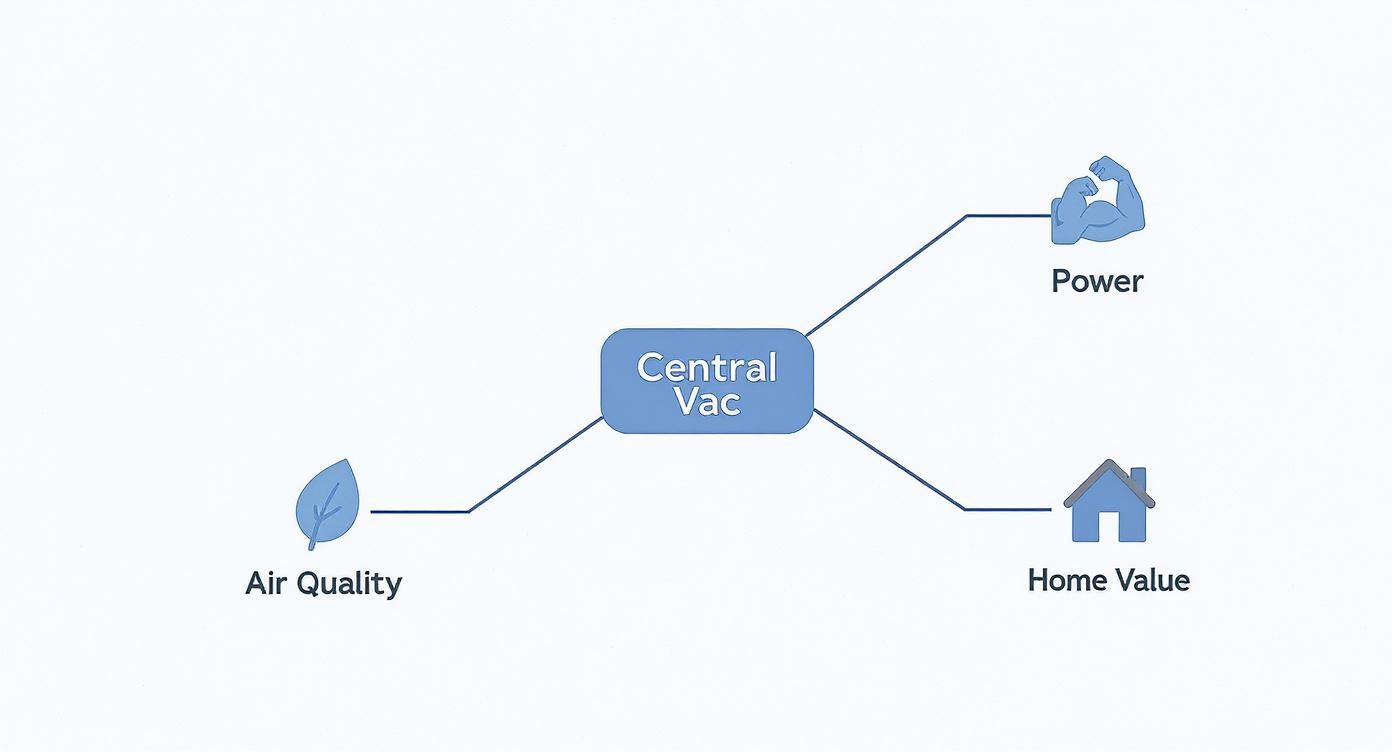
This image sums it up perfectly: a good central vac delivers better cleaning power, healthier air, and even adds value to your home.
Canister and Accessory Considerations
The canister—the bucket that holds all the dirt—is another practical thing to consider. For a typical family home in Canada, a canister around 20-25 litres is a great size. That usually means you're only emptying it two or three times a year. Most are made from either durable steel or a tough polymer; steel is often favoured for its sheer longevity.
Finally, don't forget the tools. The right attachments are what make the system truly useful. A good kit will always include a powerhead with a spinning brush for getting deep into carpets, plus dedicated tools for hardwood, upholstery, and tight corners. You can really dial in your cleaning routine when you explore the full range of available central vacuum accessories, with options for everything from grooming your dog to detailing the car.
An In-Depth Comparison of Top Central Vacuum Brands
When you start shopping for a central vacuum in Canada, you'll quickly run into a handful of respected brands, each with its own take on what makes a great system. The truth is, there's no single "best" brand for everyone. It's about finding the right fit for your home and your needs.
A system that’s perfect for a new suburban build in Calgary might be overkill for a century home in downtown Toronto. So, let’s cut through the marketing noise and look at what really sets the top names—Beam, Cana-Vac, Husky, and Nilfisk—apart. We'll break down their core strengths and who they're really built for.
Cana-Vac: The Canadian Workhorse
Cana-Vac has built its name on being a tough, Canadian-made brand that just doesn't quit. People often call them workhorses for a reason—they’re engineered with powerful motors and solid steel construction meant to handle big homes and serious messes.
Their Signature and XLS series, for example, often use high-performance tangential bypass motors. This is a huge plus if your unit is going in the garage or basement. It cleverly keeps moisture and fine dust away from the motor's key electrical parts, a real problem in Canadian climates where salt and slush get tracked inside.
- Best For: Large homes (over 5,000 sq. ft.), families with heavy cleaning loads, and anyone who puts raw power and durability first.
- Key Differentiator: A laser focus on powerful motors (like their 8.4” Tangential models) and rugged, all-steel bodies.
- Typical User Scenario: Think of a family in a big rural home with a couple of dogs, a cat, and a mix of deep-pile carpets and hardwood. They need a vacuum that can pull up stubborn pet hair and dirt every single time, even when the canister is installed in a chilly garage.
Cana-Vac offers a pretty wide range, from their more affordable Ethos line for smaller homes to the top-tier Signature models, so there’s usually an option for most budgets.
Beam by Electrolux: The Quiet Innovator
As part of the Electrolux family, Beam is one of the most recognized brands out there. They've made their mark with smart features and incredibly quiet operation, making them a favourite for homeowners who can't stand a racket.
Beam's claim to fame is its Quiet Pak™ sound insulation system. Many of their units are so quiet they sound more like a gentle hum than a roaring engine, meaning you can clean without derailing a phone call or waking a sleeping baby. They were also one of the first to use self-cleaning HEPA filters, which cleverly use the system's own cyclonic force to shake dust loose, keeping suction strong.
Beam's design really centres on the user experience. By merging quiet performance with effective, low-fuss filtration, they've won over families in modern, open-concept homes where noise is a real concern.
This focus on peace and quiet makes Beam a fantastic choice for condos, townhouses, or any home where the power unit has to be installed near living spaces. That reliable filtration is also a game-changer for anyone dealing with allergies.
Husky: The Quebec Powerhouse
Straight out of Quebec, Husky is another Canadian giant known for building seriously powerful and durable systems. When it comes to pure suction power (measured in water lift), Husky is often at the top of the charts. That means their units are incredible at yanking deeply embedded dirt, sand, and pet hair out of even the thickest carpets.
Husky's whole approach feels like they're bringing industrial-grade quality to the residential market. They stick with high-end tangential bypass motors and use large, antibacterial-treated canisters. Their warranties are also some of the best you'll find, often covering the motor and electrical parts for up to 25 years—a clear sign they stand behind their product.
- Best For: Homeowners who demand the absolute strongest suction possible, especially for high-pile carpets, workshops, or cleaning up after renovations.
- Key Differentiator: Best-in-class suction power (water lift) and remarkably long warranties that offer real peace of mind.
- Typical User Scenario: Imagine a homeowner with a finished basement workshop that kicks up fine sawdust, plus a house full of plush, thick carpeting. They need a machine that can handle everything from fine dust to heavy debris without breaking a sweat.
Nilfisk: The Filtration Specialist
Nilfisk is a Danish company with deep roots in commercial and industrial cleaning, and it shows. Their central vacuums are celebrated for having some of the most advanced, multi-stage filtration you can get.
If you or someone in your family has severe allergies, asthma, or chemical sensitivities, Nilfisk should be on your radar. Their systems typically use a triple-threat approach: cyclonic separation, an oversized filter bag, and often a HEPA-level exhaust filter to make sure almost no dust or allergens get back into your air. They're less about boasting the highest Air Watts and more about delivering clinically clean air.
While any central vac will improve your home’s air, Nilfisk takes it to a whole other level. Their sealed systems are engineered to trap the tiniest microscopic particles. For any homeowner whose main goal is better health, Nilfisk is a must-see. Of course, to keep any high-performance system working its best, regular upkeep is key; you can learn more in our guide on central vacuum system maintenance. A little care goes a long way in protecting your home’s air quality for years.
Understanding Installation Costs and Timelines in Canada
When you’re thinking about getting a central vacuum system in Canada, one of the first things to figure out is the total investment. The price on the box isn't the whole story. You're actually looking at a complete package that includes the machine itself, the accessories, all the piping and materials, and the cost of professional installation. Having a clear budget from the get-go saves you from any unexpected costs later on.
The total cost really boils down to four key parts:
- The Power Unit: This is the engine of your whole system and where the cost can vary the most. Expect to see prices anywhere from $600 to over $2,000, depending on the brand, motor, and raw power (Air Watts).
- Accessory Kit: This is your hose, wands, and all the cleaning attachments. A basic kit can start around $200, but if you want the works—like a premium electric powerhead and specialty tools—you could be looking at over $500.
- Piping and Inlets: The amount of PVC piping, fittings, and wall inlets you'll need depends entirely on your home's size and how many connection points you want.
- Professional Installation Labour: This is a crucial piece of the puzzle. Getting it done right ensures your system runs perfectly for years. The fees here will change based on how complex the job is.
More and more Canadians are choosing these whole-home cleaning solutions. In fact, Canada’s vacuum cleaner market, which includes central vacs, is booming. Revenue is projected to jump from USD 862.4 million to more than USD 2.1 billion by 2033. This growth is being fuelled by new home builds, major renovations, and a growing focus on improving indoor air quality.
New Construction vs. Retrofitting an Existing Home
The single biggest factor that will influence the cost and difficulty of your installation is timing. It’s far easier and more affordable to put a system into a new build or a house undergoing a major reno than it is to fit one into a finished home.
For a new build, installers have wide-open access to wall cavities and floor joists. This lets them run the pipes along the most direct and efficient paths, which maximizes airflow and cuts down on labour. It's a pretty straightforward job, often wrapped up in a single day for an average-sized house.
Retrofitting an existing home is a different ball game—it requires a specialized skill set. Technicians have to carefully "fish" the pipes through finished walls, ceilings, and closets to keep the disruption to a minimum. It takes a lot more planning, precision, and time, which naturally bumps up the labour cost. A typical retrofit can take one to two days, all depending on your home’s layout.
The expertise of a professional installer is absolutely priceless during a retrofit. They know exactly how to work around structural hurdles and where to place inlets for the best possible coverage, making sure the system works just as well as it would in a new home.
Budgeting for Professional Installation
So, what should you actually set aside for installation? Every home is different, but you can use these numbers as a solid starting point.
- New Construction Installation: For a standard new home, the installation costs (labour and materials, but not the power unit or accessory kit) will likely fall between $600 and $1,200.
- Existing Home Retrofit: If you're retrofitting, costs typically start around $800 and can climb to $1,800 or more. Things like multiple stories, finished basements, or tricky framing can add to the final price.
While going the DIY route might seem like a way to save money, a professional installation ensures the pipe network is perfectly designed and sealed for maximum suction. A poorly installed system often leads to weak performance and is much more likely to get clogged. For a complex job, understanding the principles of airflow is essential; you can learn more about the fundamentals in our professional ductwork installation in our related guide to see why that expert knowledge matters so much.
At the end of the day, investing in a professional installation protects your investment in the hardware and guarantees you get the powerful, reliable cleaning you expect from a central vacuum system.
How to Choose the Right System for Your Home
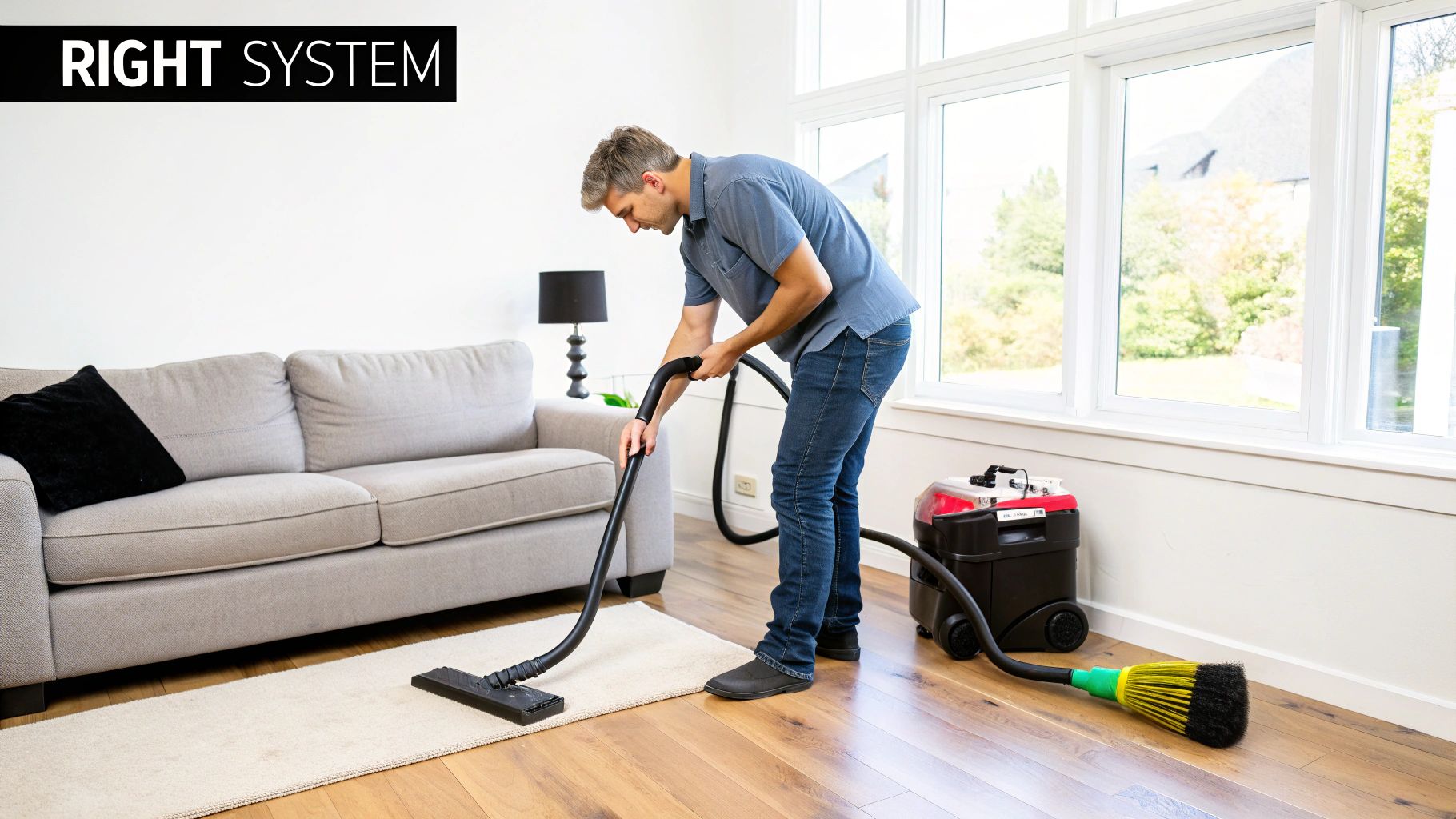
Picking the right central vacuum system goes beyond just grabbing the model with the most power. The best unit for you is one that actually fits the size of your home, its layout, and how you live. Let's be honest, a one-size-fits-all approach just doesn't cut it when you’re comparing a downtown Toronto condo to a sprawling rural bungalow.
Think of it like buying a car. You wouldn't pick a tiny hatchback to haul lumber, and you wouldn't get a giant pickup truck for a tight city commute. The same logic applies here—you want your investment to deliver the performance you actually need.
For Multi-Story Homes and Townhouses
If you’ve got multiple floors, your biggest hurdle is fighting gravity. The system needs some serious muscle to pull dirt and debris straight up through the walls without losing suction on the top floor.
This is where a unit with a high water lift rating—the raw measure of suction force—is non-negotiable. You should be looking for models with at least 120 inches of water lift to make sure everything gets pulled effectively from the basement to the top bedroom. Just as important is where the inlets are placed; a pro installer can map them out so you have great coverage on every level without having to drag around a super long hose.
For Sprawling Bungalows and Ranch-Style Homes
In a single-story home that spreads out, the enemy is distance. The air has to travel a long way horizontally, and that can really kill your airflow if the system isn't up to the task.
For this kind of layout, you need to prioritize airflow, which is measured in Cubic Feet per Minute (CFM). A higher CFM number means debris will keep moving right along through those long runs of pipe. It's also worth thinking about a longer hose (35 to 50 feet) or even a slick Hide-A-Hose retractable system to hit every corner without constantly unplugging and re-plugging.
A common mistake I see in larger homes is underestimating the number of inlets needed. It's always better to have one extra inlet you barely use than to constantly be stretching a hose to its absolute limit. That puts a strain on the equipment and just makes cleaning a chore.
For Condos and Compact Spaces
Living in a smaller space like a condo or apartment brings two things to the forefront: noise and size. The power unit is probably going to be installed in a utility closet right next to where you live, so quiet operation is a must.
Keep an eye out for models advertised as "quiet," and check for a decibel rating below 65 dB. These units are built with sound-dampening materials and have smaller, more efficient motors. A compact, wall-mounted unit with a smaller canister is usually all you need and won't eat up your precious storage space.
Addressing Special Household Needs
Don't forget to factor in your home's unique quirks. Every family has different needs, and the best central vacuum systems Canada has to offer can be tailored to match.
- Homes with Pets: You’ll definitely want a system that comes with a good electric powerhead. That motorized brush is key for digging into carpets to pull out stubborn pet hair and dander. A hybrid filtration system that uses disposable bags is also a smart move—it makes cleanup way less messy and helps trap allergens.
- Workshops and Garages: If you’re cleaning up fine sawdust or heavier garage debris, a system with a tangential bypass motor is essential. This design keeps fine dust and any moisture away from the motor itself. I'd also recommend adding a dedicated utility inlet right in the garage for quick car clean-ups.
- Allergy Sufferers: Make multi-stage filtration your top priority, especially a certified HEPA filter. This setup ensures that 99.97% of microscopic allergens are captured and vented safely outside. Of course, even the best systems can run into hiccups, so having a good central vacuum troubleshooting guide bookmarked can help you keep your unit running at peak efficiency.
What to Expect During Professional Installation
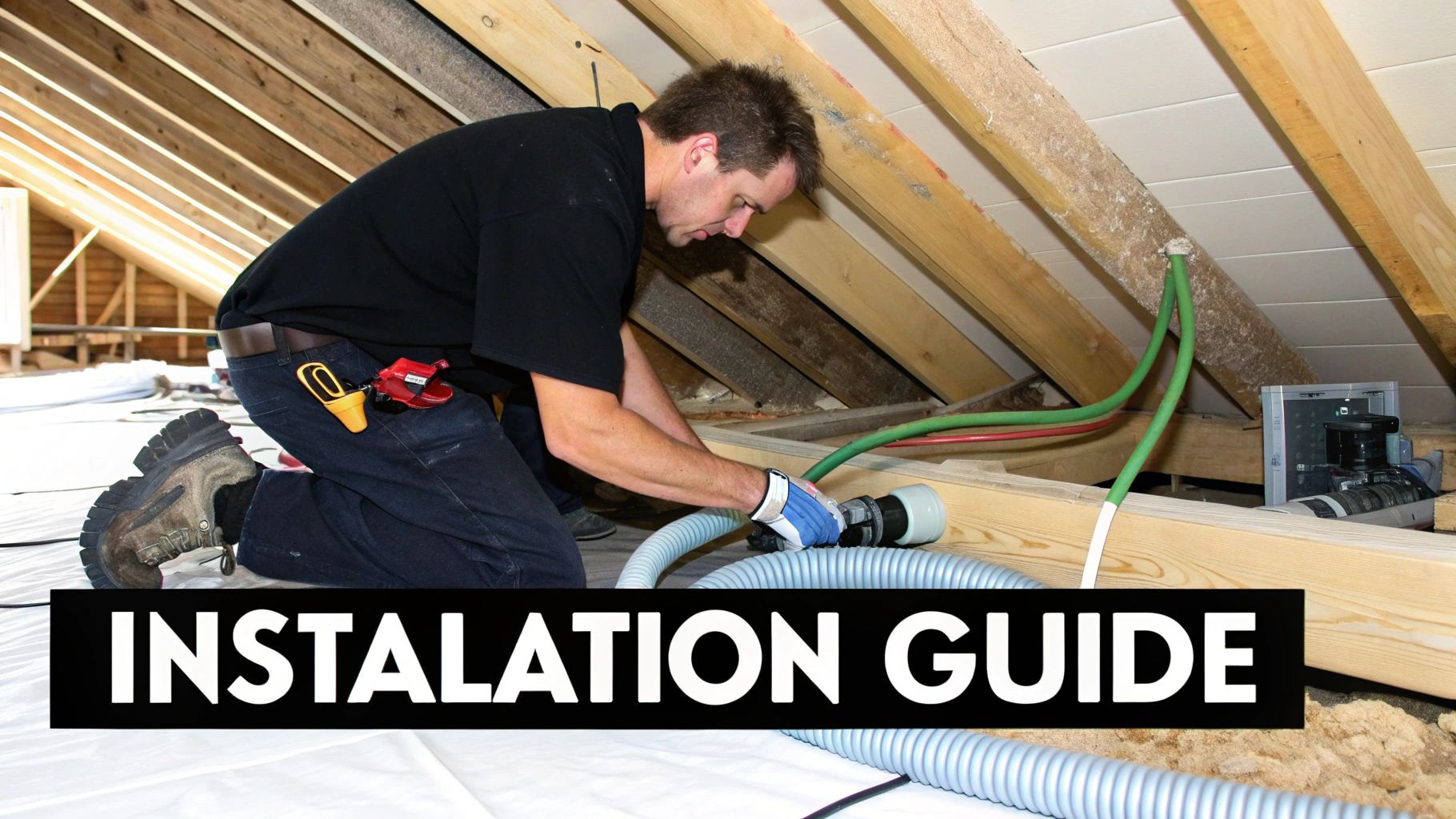
Picking one of the best central vacuum systems in Canada is the easy part. It’s the professional installation that really brings that investment to life, turning a powerful unit into a seamless, high-performance cleaning solution for your entire home. Knowing what to expect helps you work with your installer to get the job done right.
A great installation team doesn’t just hook up pipes. They map out a smart system that delivers maximum suction everywhere, keeps noise to a minimum, and puts inlets right where you need them. This kind of careful planning is especially important when retrofitting an older home, where working around finished walls and floors takes a real pro’s touch.
The Initial Consultation and System Design
It all starts with a detailed on-site consultation. This isn't just a quick walk-through. A good technician will want to understand your home’s unique layout, scope out the best routes for piping, and even ask about your cleaning habits. This is your chance to ask questions and make sure the plan works for you.
You'll want to get on the same page about a few key things:
- Inlet Placement: Where do the vacuum inlets need to go? The goal is to make sure a standard hose can reach every nook and cranny. Strategic spots in hallways and central areas are usually the answer.
- Pipe Routing: How will the PVC pipes snake through your walls, ceilings, and basement? A skilled installer finds the least disruptive path, keeping your home’s structure and drywall intact.
- Power Unit Location: The technician will find the ideal spot for the main unit. This is almost always the garage, basement, or a utility room to keep noise out of your living space and make emptying the canister easy.
- Exhaust Venting: Where will the system vent to the outdoors? Proper venting is a must for getting fine dust and allergens completely out of your home, which is one of the main benefits of a central vac.
A professional quote is your best friend. It should be fully itemized, breaking down the cost of the power unit, accessories, labour, and every last fitting. No homeowner likes surprise charges.
What Happens on Installation Day
When the big day arrives, the installation crew will show up with the full plan in hand. For a typical retrofit in an existing Canadian home, expect the job to take one to two full days. The first step is usually cutting precise openings for the wall inlets and then carefully “fishing” the low-voltage wire and PVC pipes through the walls.
Installers use specialized tools to keep the mess to a minimum, often running pipes through closets, the attic, or an unfinished basement. Every single pipe connection is glued and sealed to create a completely airtight network—that’s the secret to maintaining powerful suction from one end of the house to the other.
Once the pipe network is in place, they'll mount the main power unit and connect everything. The last steps are installing the inlet valves, testing each one to ensure it has strong suction, and giving you a quick tutorial on your new system and all its attachments. A true professional crew cleans up after themselves, leaving your home just as they found it, so all you have to do is enjoy a flawlessly performing system for years to come.
A great central vacuum system deserves a great installation. At Can Do Duct Cleaning, our experts provide specialized installation services across the GTA, designing systems built for peak efficiency and a long life. Contact us today for a professional consultation and quote.

