
That dreaded moment when your furnace gives up mid-winter or your AC dies during a summer heatwave is a homeowner’s nightmare. The first question that pops into your head is always, "How much is this going to cost?" For a full furnace and AC replacement in Canada, you're typically looking at an all-in investment between $7,500 and over $15,000. That number covers both pieces of equipment and the professional installation to get your home comfortable again.
Your Quick Guide to Furnace and AC Replacement Costs in Canada
Replacing your home’s entire heating, ventilation, and air conditioning (HVAC) system is easily one of the biggest investments you'll make in your property. It's so much more than just swapping out two big metal boxes. You're upgrading your home's entire comfort system, which has a huge impact on your day-to-day life and, of course, your monthly utility bills. That wide price range exists because so many different factors go into a project of this size.
It helps to think of it like buying a car. A standard, no-frills sedan gets the job done, but if you want better fuel economy, advanced safety features, and a smoother ride, you’ll opt for a higher-end model with a bigger price tag. HVAC systems are no different; they come in various tiers of efficiency and performance.
We put together this quick table to give you a ballpark idea of what to expect for a full system replacement in Canada, based on the efficiency level you choose.
Estimated Cost Range for Full HVAC Replacement in Canada
| System Efficiency Level | Average Price Range (CAD) |
|---|---|
| Standard-Efficiency | $7,500 – $9,500 |
| High-Efficiency | $9,500 – $12,500 |
| Top-Tier/Premium | $12,500 – $15,000+ |
As you can see, the jump from standard to high-efficiency can be significant, but we'll get into how that extra upfront cost can pay for itself over time.
What Shapes the Final Price Tag
The final quote you get from a contractor isn’t just pulled out of thin air. It’s a careful calculation of the equipment itself, plus the skilled labour needed to install everything safely and correctly. For any homeowner in Canada, getting a handle on these moving parts is the first step to making a smart, confident decision.
Here are the main things that will influence your final cost:
- System Efficiency: This is a big one. High-efficiency units have higher upfront costs but can shave hundreds off your energy bills each year. We measure furnace efficiency in AFUE and air conditioner efficiency in SEER2.
- Home Size and Layout: A larger, multi-story home needs a more powerful (and more expensive) system to heat and cool it properly compared to a small bungalow.
- Installation Complexity: If your furnace is tucked away in a tiny, hard-to-reach crawlspace, or if your existing ductwork is in bad shape, it will take more time and labour to complete the job.
- Brand and Model: Just like with cars or kitchen appliances, different HVAC brands offer different features, warranties, and reliability at various price points.
Trying to sort through all these options can feel like a lot, but breaking it down makes it much easier. As you dive deeper, you can learn more about the specifics of air conditioning replacement cost to get a clearer picture of one half of this essential home upgrade.
Deconstructing the Price: What Are You Actually Paying For?
Staring at a quote to replace your furnace and AC can feel a bit like looking at a car's sticker price—it’s one big, intimidating number. But once you understand where every dollar goes, it's a lot easier to make a smart decision for your home.
Think of it this way: when you buy a gourmet meal, you're not just paying for the raw ingredients. You're paying for the chef's expertise, the perfectly calibrated oven, and the time it took to bring it all together. An HVAC replacement is no different. You’re investing in the equipment, yes, but also in the professional skill, safety protocols, and all the little details that ensure your system runs perfectly for years.
The Core Components: Equipment and Labour
The lion’s share of any HVAC replacement quote—typically 75-85% of the total cost—boils down to two things: the hardware and the hands that install it.
First up is the equipment cost. This is the price tag on the furnace and air conditioner units themselves. The cost can swing wildly depending on the brand, the size (measured in BTUs for furnaces and tonnage for ACs), and, most importantly, the efficiency rating. High-efficiency models with better SEER2 and AFUE ratings cost more upfront, but they pay you back with lower energy bills down the road.
Then you have the labour cost. This isn't just for heavy lifting. You're paying for the certified expertise of HVAC technicians who will carefully disconnect and haul away your old system, install the new units with precision, connect all the complex electrical and refrigerant lines, and then test everything to make sure it’s running at peak performance. In a market like Canada, skilled, licensed labour is a crucial investment in getting the job done right and meeting all safety codes.
This chart gives you a clear picture of how equipment costs scale with efficiency.
As you can see, mid-efficiency systems are easier on the initial budget, while premium systems require a bigger investment for the best performance and long-term savings.
Beyond the Basics: Permits, Disposal, and Ductwork
After the main units and the installation work, a few other critical costs make up the rest of the quote. These aren't optional "add-ons"—they're essential parts of a safe, legal, and professional job.
A proper installation is more than just connecting pipes and wires. It involves ensuring the system complies with local safety codes, operates efficiently, and that the old equipment is handled responsibly. These smaller costs are investments in safety and peace of mind.
To give you a clearer idea, here’s a typical breakdown of a complete project quote:
Typical HVAC Replacement Cost Breakdown
| Cost Component | Percentage of Total Cost | Estimated Cost Range (CAD) |
|---|---|---|
| Equipment | 50% – 60% | $4,500 – $8,400 |
| Labour | 25% – 30% | $2,250 – $4,200 |
| Ductwork/Modifications | 5% – 10% | $450 – $1,400 |
| Permits & Fees | 2% – 5% | $180 – $700 |
| Disposal of Old Unit | 1% – 3% | $90 – $420 |
| Miscellaneous Materials | 2% – 5% | $180 – $700 |
As the table shows, the "other" costs are small but mighty, ensuring the entire project is completed to professional standards.
Here’s what those other line items on your quote almost always cover:
- Municipal Permits: Most Canadian municipalities require a permit for any new furnace and AC installation. This triggers an inspection to verify the work meets all building and safety codes. It’s a non-negotiable step that protects your family.
- Disposal of Old Units: You can't just drag an old furnace or AC to the curb. They contain refrigerants and other materials that require special, environmentally-safe disposal. Reputable HVAC companies handle this for you and include it in the cost.
- System Modifications: Often, a new system isn't a simple swap. Your home might need minor ductwork adjustments, an upgraded electrical connection, or new venting to work with a modern high-efficiency furnace.
When a contractor itemizes these costs, it’s a good sign. It shows they are transparent and aren't burying fees in a single number. To get a more detailed look at the factors that drive the price of the heating unit itself, check out our guide to typical furnace installation costs.
Key Factors That Influence Your Replacement Cost
When you start collecting quotes for a new furnace and AC, you'll see right away that no two are alike. That’s because replacing your HVAC system isn't an off-the-shelf purchase; it's a custom job tailored specifically to your home.
Think of it like buying a suit. You wouldn't expect a bespoke suit to have a one-size-fits-all price tag. The final cost depends on the material, the fit, and all the little details. The same goes for your heating and cooling system. Getting a handle on these key variables will help you understand your quotes, ask smarter questions, and make the best choice for your comfort and your wallet.
Your Home’s Size and Layout
First things first: the size of your home is the biggest piece of the puzzle. A sprawling two-storey home in Calgary needs a lot more muscle to heat and cool than a compact bungalow in Halifax. It’s not just about raw power, but about having the right amount of power to push conditioned air into every last room.
HVAC systems have their own language for size:
- BTUs (British Thermal Units) tell you a furnace's heating power.
- Tonnage measures an air conditioner's cooling capacity, where one ton equals 12,000 BTUs.
A good contractor will do what's called a "load calculation" to figure out the perfect size for your space. Getting this wrong is a big deal. An undersized system will run non-stop, struggling to keep up and never quite hitting the temperature you want. Go too big, and the system will constantly short-cycle—blasting on and off—which kills efficiency, does a poor job of controlling humidity, and wears out parts fast. Either way, you're looking at wasted energy and higher utility bills.
System Efficiency Ratings: SEER2 and AFUE
After size, the next major factor driving the price is efficiency. Modern systems come with two key report cards that tell you exactly how well they turn energy into comfort.
AFUE (Annual Fuel Utilization Efficiency) is for your furnace. An AFUE rating of 96% means that for every dollar you spend on natural gas, 96 cents turn into heat for your home. Only 4% is wasted.
SEER2 (Seasonal Energy Efficiency Ratio 2) is for your air conditioner. The rule is simple: the higher the SEER2 rating, the less electricity your AC guzzles to keep you cool all summer.
It's true that high-efficiency models with top-tier AFUE and SEER2 ratings cost more upfront. But that initial investment often pays for itself through serious savings on your monthly utility bills. Here in Canada, where energy costs can take a real bite out of your budget, choosing a more efficient system is one of the smartest financial moves a homeowner can make.
Brand and Model Tier
Just like with cars or appliances, HVAC brands offer different product lines, from no-frills models to fully-loaded premium systems.
- Builder-Grade/Entry-Level: These are the most budget-friendly options. They get the job done, but usually have lower efficiency ratings and lack fancy features like variable-speed fans or built-in smart home compatibility.
- Mid-Range: This is the sweet spot for most homeowners, offering a fantastic balance of performance, efficiency, and price. You get great energy savings without the top-tier price tag.
- Premium/Top-Tier: These are the best of the best. They have the highest efficiency ratings, run whisper-quiet, and are packed with advanced technology for precise comfort control. They cost more, but they also deliver the lowest running costs and best performance over the long haul.
While a reputable brand matters, remember this: the quality of the installation is even more important for your system's performance and lifespan.
Ductwork Condition and Accessibility
Finally, there's the hidden factor that many homeowners forget about: your home's existing infrastructure. Your ducts are the highways for your heated and cooled air. If they're leaky, poorly designed, or the wrong size, even the most efficient new furnace and AC won't perform properly.
A thorough contractor will always inspect your ductwork. If they find problems that need fixing—like sealing leaks or re-sizing sections—that will add to the labour and material costs. You can learn more about why your air conditioner is so dependent on good ductwork right here: https://candoductcleaning.com/ducts-for-air-conditioner/.
The physical location of your equipment also plays a role. Swapping out a furnace in a wide-open basement is a straightforward job. But if it's crammed into a tight attic or a hard-to-reach crawlspace, the job gets a lot more complex. Tricky installations take more time and skill, and that will show up on the final bill. If you want to dig deeper, exploring the key factors affecting AC installation cost can shed more light on where your money is going.
Should You Replace Your Furnace and AC Together?
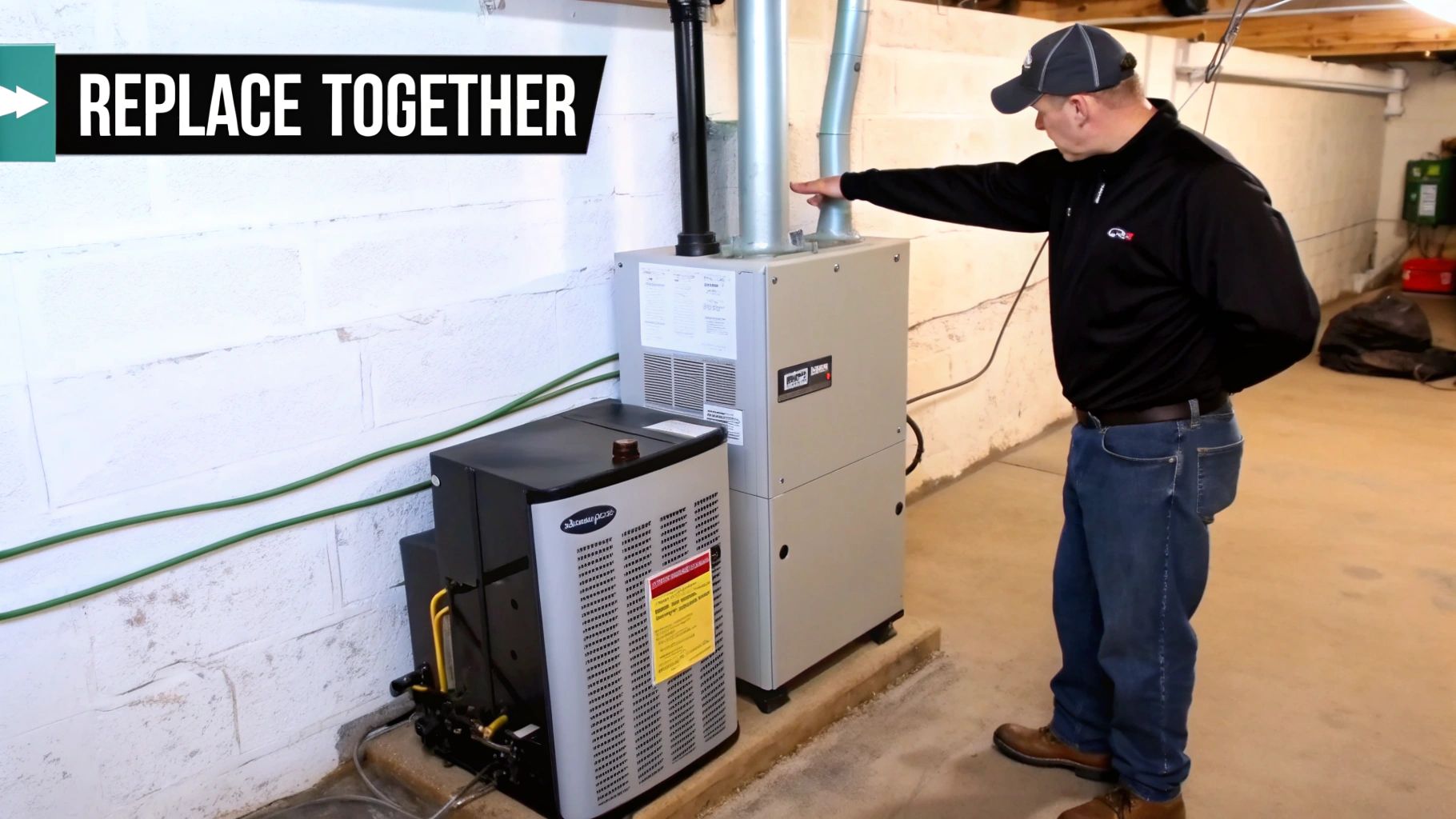
It’s a classic dilemma for Canadian homeowners. Your air conditioner finally bites the dust during a blistering July heatwave, but the furnace, while getting on in years, is still chugging along. The temptation is to just replace the broken unit and put off the bigger expense.
But hold on. While that seems like the wallet-friendly move right now, only replacing half of your HVAC system can lead to some serious headaches—and higher costs—down the line. Truth is, the biggest savings and best performance almost always come from replacing both systems at the same time.
The Power of a Matched System
Think of your furnace and AC as a team. They're designed to work in sync. The AC unit outside handles the cooling, but it’s the furnace's indoor blower fan that actually pushes that chilled air through your home's ductwork. They’re completely co-dependent.
Now, imagine pairing a brand-new, high-efficiency air conditioner with an old, clunky furnace. You've just created a massive performance bottleneck. Your shiny new AC might be capable of incredible things, but it’s completely at the mercy of that old furnace blower motor to get the job done. And an older motor just can't keep up with the airflow demands of a modern AC.
This mismatch forces the whole system to work harder, and that leads to problems:
- Reduced Efficiency: You won't see the energy savings you paid for. The old furnace is holding your new AC back from reaching its potential.
- Increased Wear and Tear: The constant strain puts stress on both units, which can cause premature failure in your new AC and push the old furnace over the edge.
- Uneven Comfort: Weak airflow from an old blower often means hot and cold spots around the house and poor humidity control.
A new, high-efficiency air conditioner paired with an old furnace is like putting high-performance tires on a car with a worn-out engine. You'll never get the performance you expect because one critical component is limiting the entire system.
Unlocking Significant Labour Savings
Beyond performance, the most compelling reason to bundle the job is simple: labour costs. The process of installing a furnace and an AC shares a ton of overlapping steps. Technicians have to set up in your home, connect everything to the ductwork, wire up the electrical, and test the system.
When you replace both at once, the crew does all this work in a single, efficient visit. That means you pay for travel time, setup, and labour hours just once.
But if you split the jobs? You're paying for two entirely separate installations, often years apart. That means you’re paying for all those overlapping labour costs twice, which can dramatically inflate the overall cost of replacing your furnace and AC. Doing it all at once can easily save you hundreds, if not thousands, of dollars in labour alone.
The Value of Total Peace of Mind
Finally, let's talk about convenience. Managing one project is infinitely simpler than juggling two. You have one contractor, one timeline, and one unified warranty that covers the entire system. No more trying to remember who installed what and when.
Starting fresh with a perfectly matched system gives you a clean slate. Both units are brand new, work together seamlessly, and are fully covered. You get optimal comfort and efficiency from day one, giving you total peace of mind for the next 15 to 20 years.
How to Save on Your HVAC Replacement
That initial sticker shock when you see a quote for a full HVAC replacement is real. But here’s some good news: the number on the page is rarely the final price you have to pay. For homeowners across Canada, there are some powerful ways to chip away at that total and make this major home investment much more manageable.
Think of it like stacking coupons on a big-ticket item. By layering government programs, manufacturer deals, and smart financing, you can seriously reduce the upfront cost. These opportunities are there to encourage energy-efficient upgrades, which is a win for your wallet and a win for the environment.
Tap into Government Rebates and Incentives
One of the best places to start is with green energy programs. The federal and provincial governments often have rebates available for homeowners who choose high-efficiency heating and cooling systems. They want to reduce energy consumption across the country, and you get to reap the financial rewards.
For instance, the Canada Greener Homes Grant has helped thousands of homeowners with grants for energy-saving retrofits, including new heat pumps and furnaces. You’ll also find that energy providers like Enbridge Gas frequently offer their own rebates for upgrading to high-efficiency natural gas furnaces.
The key here is to check for the most current information, because these programs and their rules can change. Any reputable HVAC contractor in Canada should be on top of the latest offerings and can walk you through the paperwork to make sure you get every dollar you’re entitled to.
Look for Seasonal Manufacturer Deals
Timing is everything. You can score some great deals by strategically planning your purchase. HVAC manufacturers often run their own rebates and promotions, especially during the “shoulder seasons”—usually spring and fall when demand is a bit lower.
Keep an eye out for deals like:
- Cash-back rebates on specific furnace and AC combos.
- Special discounts offered only through their certified local dealers.
- Freebies like a smart thermostat thrown in with a complete system purchase.
Always ask your contractor about any upcoming manufacturer promotions. Timing your replacement to line up with one of these deals could easily save you hundreds of dollars right off the top. If a new thermostat is on your radar, it's worth learning more about the best smart thermostats in Canada to see what you could get.
Explore Flexible Financing Options
Even with rebates, the upfront cost can be a stretch. That’s where financing comes in. Instead of paying for it all in one go, you can break the cost down into manageable monthly payments over several years.
Most established HVAC companies in Canada have partnerships with financial institutions to offer these plans, often with pretty decent interest rates. This lets you get the high-efficiency system you actually want—the one that will pay you back in energy savings—without having to empty your bank account. It turns the total cost of replacing your furnace and AC into a predictable line item in your monthly budget.
Once your new system is in, you can keep the savings going. Check out these 7 proven HVAC and energy tips to lower your electric bill—small changes that really add up over time.
Choosing the Right Contractor: A Homeowner's Checklist

Here’s a hard truth: the best furnace and air conditioner in the world will run like a lemon if it’s installed poorly. A botched installation doesn't just kill your system's efficiency; it can lead to constant breakdowns, a drastically shorter lifespan, and even create serious safety hazards.
This makes your choice of contractor just as important—if not more so—than the equipment you pick.
Trying to find a great HVAC company in Canada can feel overwhelming. The key is to cut through the noise by focusing on a few essential qualifications. You're not just hiring a technician; you're looking for a qualified, insured, and transparent partner who will protect your investment and get the job done right the first time.
Verifying the Essentials
Before you even think about quotes, you need to do a quick background check. There are a few non-negotiable credentials every legitimate HVAC company in Canada must have, though specific requirements can vary by province. These aren't just suggestions; they’re requirements that protect you from liability and shoddy work.
Make sure any company you consider can show you proof of these three things:
- Provincial Certification: In Ontario, this is the Technical Standards and Safety Authority (TSSA). Other provinces have equivalent bodies. A contractor touching a gas-fired appliance like your furnace must hold the proper certifications and licenses for your province. No exceptions.
- WSIB/WCB Coverage: This is mandatory. Whether it's the Workplace Safety and Insurance Board (WSIB) in Ontario or a Workers' Compensation Board (WCB) elsewhere, this coverage means you won't be held liable if a technician gets hurt on your property. If they don't have it, don't hire them.
- Liability Insurance: Ask to see their certificate of insurance, and make sure it’s for at least $2,000,000. This is what covers any accidental damage to your home during the installation.
A true pro will have this paperwork ready to go and won't flinch when you ask for it. If a company gets defensive or makes excuses, that's your cue to walk away.
Critical Questions to Ask Every Contractor
Once you've confirmed they're licensed and insured, it's time to dig a little deeper. The answers to these questions will tell you a lot about their experience, their process, and the quality of their work.
A detailed quote is great, but understanding the team behind the numbers is what really matters. You can get a better feel for what a proper installation looks like by learning about what's involved when pairing a new furnace with installation.
Here are the key questions to ask before you sign on the dotted line:
- How long have you been in business in this area? You want a company with deep roots in the community and a solid local reputation.
- Do you perform a Manual J load calculation? This is a big one. This calculation is the only way to properly size your new system for your home. Any contractor who just wants to match the size of your old unit is cutting corners.
- Is your quote all-inclusive? Get them to confirm in writing that the price covers everything: the equipment, all labour, materials, permit fees, and the removal and disposal of your old system.
- What brands do you recommend and why? A good contractor won't just push one brand. They should be able to explain the pros and cons of different options and why one might be a better fit for your home and budget.
- What warranties are included? Ask for specifics on the manufacturer's parts warranty and their own labour warranty. Make sure you get it all in writing.
Common HVAC Replacement Questions Answered
Even with the big picture sorted, a few key questions always seem to come up when homeowners are on the brink of a decision. Getting these details straight is what helps you feel truly confident about the cost of replacing your furnace and AC. Here are some clear, no-nonsense answers to the questions we hear most often from families across Canada.
How Long Does a Typical Replacement Take?
This is one of the first things people ask, and it’s a great practical question. For a standard, full swap of both the furnace and the air conditioner, you should plan for it to take a full day. Expect a professional crew to be at your home for about 8 to 12 hours.
That timeline assumes everything behind your walls—ductwork, electrical, gas lines—is in good shape and ready for the new equipment. If we run into surprises that need fixing, like running a new refrigerant line or making big adjustments to the ductwork, the job could stretch into a second day.
What Are SEER2 and AFUE Ratings?
Think of these acronyms as the "fuel efficiency" rating for your HVAC system. They’re all about efficiency, and they have a direct impact on your upfront cost and what you’ll save down the road.
- SEER2 (Seasonal Energy Efficiency Ratio 2) is for your air conditioner. The higher the SEER2 number, the less electricity it sips to cool your home through a hot Canadian summer.
- AFUE (Annual Fuel Utilization Efficiency) is for your furnace. An AFUE of 96% is easy to understand: it means 96 cents of every dollar you spend on gas is turned into cozy heat, and only 4 cents is lost up the chimney.
Paying more for higher-rated units feels like a bigger hit at first, but the payoff comes every month on your energy bills. Over the life of the system, a high-efficiency model doesn't just pay for its price difference—it often puts money back in your pocket.
Will a New HVAC System Improve Air Quality?
Yes, and the difference can be dramatic. Swapping an old, tired system for a new one can give your home's indoor air quality a serious boost.
Today’s furnaces come with much better filtration systems that do a fantastic job of trapping things like dust, pet dander, and pollen. When you combine that powerful new filter with professionally cleaned ducts, you're circulating much cleaner air to every corner of your house. It’s a huge plus for anyone dealing with allergies or respiratory issues. You can even add on extras like a whole-home humidifier or an advanced air purifier to get total control over your home's air.
For a healthy home from top to bottom, trust the experts at Can Do Duct Cleaning. Whether you need a full HVAC replacement or a thorough duct cleaning to maximize your system's performance, we have over 30 years of experience serving Canadian families. Visit us online to get your personalized quote today at https://www.candoductcleaning.com.

